Spanish group demos "Hiriko" fold-up urban EV (w/ Video)
Aug 10, 2012 by Bob Yirka report

(Phys.org) -- Ten years ago, MIT’s Media lab began working on a concept for an urban vehicle to replace bicycle sharing, and other options people were using to get them to and from public transportation, to cover that first mile, as it’s known; the distance between where they live and the train station; or the last mile, from the train to where they work. It’s a problem that has become more urgent as congestion in city centers worsens over time as cities become ever more crowded.

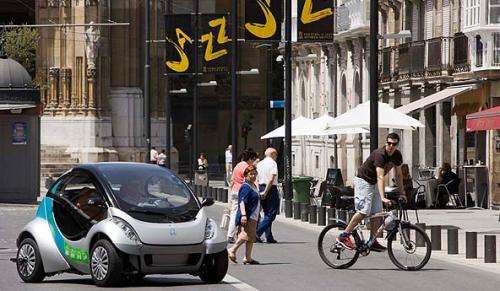
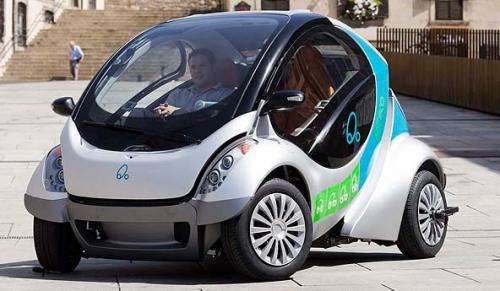
That initiative has led to a working relationship with a group of auto parts suppliers in the Basque region of Spain, who have formed what they call the Hiriko Driving Mobility Group, whose purpose is to solve congestion and parking problems in downtown city areas. The result is a concept called the Hiriko, which in Basque, means, “from the city.” It’s an electric vehicle that when driven is about eight feet long, but when parked, can be squeezed or folded down to just five feet, which is shorter than the average bicycle.
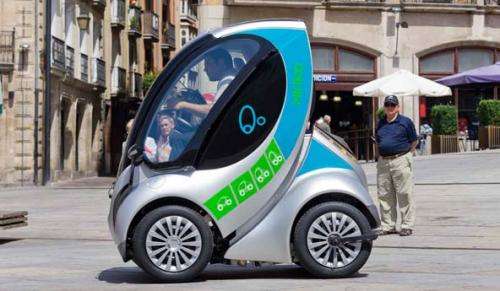
The idea is to sell a slew of the Hiriko EVs to municipalities, who then rent them to commuters, as shared vehicles. A person leaving work could walk to a lot where several of the Hirikos are parked, rent one to drive to the train station, leave it there in a special lot, ride the train home, rent another Hiriko to get home, keep it overnight, then drive it back to the special lot, leave it there and then take the train to work and so on. Thus, those that rent the Hirikos would not rent a specific car, but would get a different one every time. In such a scenario, those that rent would do so by the month or year, to make things easier of course. The advantage to commuters would be an easy way to get to and from work while the advantage to the city would be fewer vehicles clogging streets, less air pollution and more vehicles able to fit into parking lots because of the tiny parking requirements of the Hiriko.

To make parking even easier engineers have designed all four tires to turn independently, allowing drivers to slide sideways into spots if necessary. The car would not be for everyone of course as it can only go 31 miles per hour maximum, though it does have a range of 75 miles. The company has already made 20 of the cars which are being tested by various groups. They are currently trying to sell to San Francisco, Berlin and Barcelona, at a price of about $16,000 each.

Explore further: Three to a space: the folding car

Related Stories

Fold-up car of the future unveiled at EU

Jan 24, 2012

A tiny revolutionary fold-up car designed in Spain's Basque country as the answer to urban stress and pollution was unveiled Tuesday before hitting European cities in 2013.

Spanish fold-up car to be unveiled at EU

Jan 19, 2012

A tiny revolutionary electric fold-up car designed in Spain's Basque country as the answer to urban stress and pollution is to be unveiled next week before hitting Europe's cities in 2013.

Three to a space: the folding car

Jun 25, 2012

If you're of a certain age - or just watch a lot of Hulu or Nick at Nite - you probably remember the folding (and flying) car from "The Jetsons."

Paris revs up for electric car rentals

Dec 05, 2011

Four years after transforming Paris's two-wheeled transport habits with an easy-to-rent bicycle system, officials on Monday launched a similar project for the electric car.

Road trains may be coming soon to Europe (w/ Video)

Nov 13, 2009

(PhysOrg.com) -- Road trains linking vehicles together in a traveling convoy are planned for Europe. With only the lead vehicle being actively driven, the road trains would allow commuters to sleep, read a ...

Recommended for you

Sensitive bomb detector to rove in search of danger

17 hours ago

European researchers have developed and tested a light-weight device capable of detecting extremely minute quantities of explosives from up to 20 metres away, providing an invaluable law-enforcement tool ...

How soon could car seats enter the 3-D comfort zone?

May 23, 2013

New 3D textiles made of recyclable polyester fibres could contribute help cars be easier to recycle. But recycling technology has yet to progress in separating seat material from other car components.

NASA: Austin, calling Austin. 3-D pizzas to go

May 22, 2013

(Phys.org) —The idea of living with 3-D printed food is neither unthinkable nor new; designers and futurists have been looking to 3-D printing as food's next frontier. In 2012, there was news that the Thiel ...

User comments : 3

Adjust slider to filter visible comments by rank

Display comments: newest first

dschlink
not rated yet Aug 10, 2012
Certainly the best NEV (neighborhood electric vehicle) I've seen. I could drive this to the supermarket, if it could do 35 mph.
Skepticus
3 / 5 (2) Aug 10, 2012
I hope the locking mechanism is strong enough to withstand a major rear-ender sandwich without folding up.
Mayday
1 / 5 (1) Aug 11, 2012
Between where I live, work, shop, and work out, the highest speed limit is 35 mph, with a maximum distance of 4 miles, so a vehicle like this would be a fine option. However, as a suburban renter I have exactly zero places to plug it in. This is a universal problem of EVs. They are effectively isolating their vital early-adopter market among well-heeled home owners. In the US, these are people who typically drive dozens of miles per day and love to haul around serious tonnage. Thus, EVs are relegated to being toys and curiosities of very limited practical use. Just my opinion.

More news stories

Google eyes emerging markets networks

Google has become deeply involved in a series of projects to build and operate wireless networks in emerging markets including sub-Saharan Africa and Southeast Asia, a report said Friday.

Facial-recognition technology proves its mettle

(Phys.org) —In a study that evaluated some of the latest in automatic facial recognition technology, researchers at Michigan State University were able to quickly identify one of the Boston Marathon bombing ...

Drones may violate international law

(Phys.org) —As President Obama gives a speech on national security—including defending U.S. use of drones to combat terrorism—Leila Sadat, JD, international law expert and professor of law at Washington University in ...

The long road to the 2000-watt society

The vision of a society in which each inhabitant of the earth manages to consume only 2000 watts has already been around for 15 years. During this time, there has been a steady increase in environmental awareness ...

Galaxies fed by funnels of fuel

(Phys.org) —Computer simulations of galaxies growing over billions of years have revealed a likely scenario for how they feed: a cosmic version of swirly straws.