Researchers develop new physical face cloning method
Aug 10, 2012
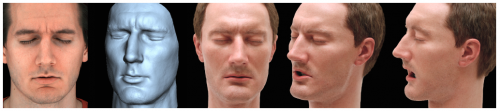
Left: photograph and scanned 3D geometry of a human face. We use a physics-based optimization process to design the geometry of a synthetic skin in order to best match given target expressions. Right: final animatronic figure with fabricated skin.

Animatronics aims at creating physical robots that move and look like real humans. Many impressive characters have been created in this spirit, like those in the Hall of Presidents attraction at Walt Disney World. Until now, creating animatronic copies of real human individuals is a difficult and labor-intensive process requiring the manual work of skilled animators, material designers and mechanical engineers. Researchers at Disney Research, Zürich, ETH Zürich, and Walt Disney Imagineering R&D have developed a new computational design process for cloning human faces that could greatly simplify the creation of synthetic skin for animatronic characters.

Due to its expressive power, replicating the human face presents huge challenges. To deliver compelling and realistic performances, an animatronic character must produce a vast range of facial expressions, each having different deformations and wrinkles. Manually designing the shape and material properties of a single skin that is able to achieve all of these targets is a formidable task. The Zürich researchers, however, invented a computational method for automatically designing synthetic skin to match real individuals.

The process starts by scanning 3D facial expressions from a human subject. Then, a novel optimization scheme determines the shape of the as well as control parameters for the robotic head that provide the best match to the human subject. This processing increases the realism of the resulting character, resulting in an animatronic face that closely resembles the human subject.

This video is not supported by your browser at this time.

"With our method, we can simply create a robotic clone of a real person," said Dr. Bernd Bickel, researcher at Disney Research, Zürich. "The custom digitally designed skin can be fabricated using injection molding and modern rapid prototyping technology. We 3D print a mold and use elastic silicon with properties similar to human skin as base material". Their findings were presented at ACM SIGGRAPH 2012, the International Conference on Computer Graphics and Interactive Techniques.

"Our research focuses on the creation of the silicone skin," explained Dr. Peter Kaufmann, researcher at Disney Research, Zürich. "We use computation to carefully modify the thickness of the across the face, leading to deformations that closely match those of the real human."

Prof. Markus Gross, director of Disney Research, Zürich, applauded the results, stating, "This innovative research builds upon our heritage in 'Audio-Animatronics' pioneered by himself. Physical face cloning enables us to create personalized animatronic figures based on real individuals with a level of fidelity and realism never before possible."

Explore further: Researchers invent system for 3-D reconstruction of sparse facial hair and skin

More information: For more information, please visit the web site at www.disneyresearch.com/research/projects/m_PhysicalFaceCloning_drz.htm

add to favorites email to friend print save as pdf

Related Stories

Mask-bot: A robot with a human face

Nov 07, 2011

Robotics researchers in Munich, Germany, have joined forces with Japanese scientists to develop an ingenious technical solution that gives robots a human face. By using a projector to beam the 3D image of ...

A new window to the face

Aug 09, 2011

The human face is a complicated thing—powered by 52 muscles; contoured by the nose, eyebrows, and other features; and capable of an almost infinite range of expressions, from joy to anger to sorrow to ...

Recommended for you

Pandora posts in-line 1Q loss, upbeat sales

11 hours ago

(AP)—Internet radio company Pandora reported higher-than-expected revenue in the latest quarter, with losses in line with analysts' forecasts, as the number of subscribers who pay for ad-free listening rose above 2.5 million.

Google Drive sports new view and scan enhancements

11 hours ago

(Phys.org) —Google Drive has a new look and functions. The makeover in Google Drive features scanning and interface enhancements that put the user into "card" mode. The enhancements make it easy for the ...

Inventor creates Card Beams with 3D printer

11 hours ago

What are card beams, you may ask? They are the building toy that allows you to build gravity-defying houses of cards with the help of friction, gravity, and two types of beams - the cap and the connector.

Solar Kettle allows for boiling water off the grid

12 hours ago

(Phys.org) —A company called Contemporary Energy has unveiled a new device it calls the Solar Kettle. It looks very much like a normal coffee thermos, but has flaps on one side that open to allow for collecting ...

Review: Google music plan solid, serendipitous

15 hours ago

Google's new music service offers a lot of eye candy to go with the tunes. The song selection of around 18 million tracks is comparable to popular services such as Spotify and Rhapsody, and a myriad of playlists ...

User comments : 1

Adjust slider to filter visible comments by rank

Display comments: newest first

Vendicar_Decarian
not rated yet Aug 11, 2012
Impressive.

More news stories

Solar Kettle allows for boiling water off the grid

(Phys.org) —A company called Contemporary Energy has unveiled a new device it calls the Solar Kettle. It looks very much like a normal coffee thermos, but has flaps on one side that open to allow for collecting ...

Google Drive sports new view and scan enhancements

(Phys.org) —Google Drive has a new look and functions. The makeover in Google Drive features scanning and interface enhancements that put the user into "card" mode. The enhancements make it easy for the ...

Controlling mood through the motions of mitochondria

(Medical Xpress)—Regulating the distribution of power in neurons is done by a system that makes the national electric grid look simple by comparison. Each neuron has several thousand mitochondria confined ...

A hidden population of exotic neutron stars

(Phys.org) —Magnetars – the dense remains of dead stars that erupt sporadically with bursts of high-energy radiation - are some of the most extreme objects known in the Universe. A major campaign using ...

A quantum simulator for magnetic materials

Physicists understand perfectly well why a fridge magnet sticks to certain metallic surfaces. But there are more exotic forms of magnetism whose properties remain unclear, despite decades of intense research. ...