Huge solar filament stretches across the Sun
Aug 07, 2012 By Nancy Atkinson, Universe Today
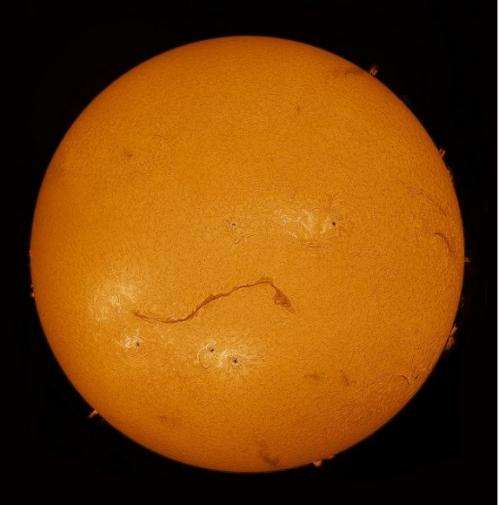
High resolution full disc hydrogen alpha composite of the Sun on August 5, 2012, comprising of 6 images for the disc and 5 images for the prominences.Credit: Paul Andrew on Flickr.

The Sun wanted to let us know there was action going on in other places in the Solar System besides Mars.

A huge, dark-colored stretched across nearly half the solar face on August 5th.

Estimates are this filament was about 800,000 km in length! Wow!
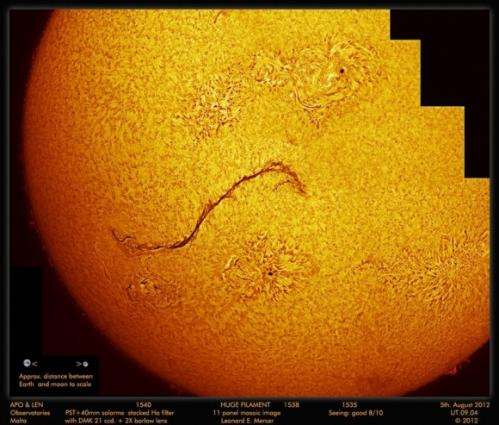
Credit: 11 images combined to create this view of a large filament on the Sun. Credit: Leonard Mercer.

Paul Andrew took six images to create a composite, full image of the Sun, and below is an 11-panel mosaic by Leonard Mercer from Malta to show the surrounding region with the main 1535, 1538, 1540 present.

Explore further: The Sun has a great idea

add to favorites email to friend print save as pdf

Related Stories

Giant sunspot turns to face the Earth

Nov 11, 2011

What has been billed as the largest sunspot observed in several years has now rotated around to stare straight at Earth. How large is it? Active Region 1339 and the group of sunspots adjacent to it extends ...

Huge coronal hole is sending solar wind our way

Mar 14, 2012

An enormous triangular hole in the Sun’s corona was captured earlier today by NASA’s Solar Dynamics Observatory, seen above from the AIA 211 imaging assembly. This gap in the Sun’s atmosphere ...

Space Image: Sunspots and solar flares

Mar 21, 2012

(PhysOrg.com) -- NASA's Solar Dynamics Observatory (SDO) captured this image of an M7.9 class flare on March 13, 2012 at 1:29 p.m. EDT. It is shown here in the 131 Angstrom wavelength, a wavelength particularly ...

The Sun has a great idea

Jul 24, 2012

(Phys.org) -- A light bulb-shaped eruption leaps from the Sun and blasts into space in this archival image from the ESA/NASA Solar and Heliospheric Observatory, SOHO.   SOHO captured the scene on 27 Febru ...

Recommended for you

Forecast for Titan: Wild weather could be ahead

17 hours ago

(Phys.org) —Saturn's moon Titan might be in for some wild weather as it heads into its spring and summer, if two new models are correct. Scientists think that as the seasons change in Titan's northern hemisphere, ...

SDO observes mid-level solar flare

17 hours ago

UPDATE 16:30 p.m. EDT: The M7-class flare was also associated with a coronal mass ejection or CME, another solar phenomenon that can send billions of tons of particles into space. While this CME was not Ea ...

NASA's IRIS mission readies for a new challenge

May 22, 2013

(Phys.org) —The time draws near. NASA is getting ready to launch a new mission, a mission to observe a largely unexplored region of the solar atmosphere that powers its dynamic million-degree outer atmosphere and drives ...

User comments : 7

Adjust slider to filter visible comments by rank

Display comments: newest first

Jitterbewegung
5 / 5 (3) Aug 07, 2012
Looks like crack in the universe is real;-)
sennekuyl
5 / 5 (1) Aug 07, 2012
Thats how the light gets in?
SoylentGrin
not rated yet Aug 07, 2012
Thats how the light gets in?


Leonard Cohen rules.
Shelgeyr
2.3 / 5 (3) Aug 07, 2012
@Jitterbewegung: I am quite curious as to how (or even if) they're going to resolve that this upcoming season. Especially if there's not going to be an overall story arc. And by "resolve", of course I mean "find out who did it and how", since the crack has apparently already been closed.

Good call on the photo, by the way!
sennekuyl
5 / 5 (1) Aug 09, 2012
@Shelgeyr: Now I can't remember if the TARDIS blowing up had been revealed. I was thinking it was.

So what causes this filament? Is it a solar version of continental plate?
Satene
1 / 5 (1) Aug 09, 2012
Nope, it's based on reconnection of magnetic fields in corona high above the solar surface. Such phenomena is not very rare...
Shelgeyr
1 / 5 (1) Aug 17, 2012
@sennekuyl: Well, they "un-blew it up" at the end of "Big Bang", but unless I've seriously missed an episode that has to coincidentally be missing from Wikipedia's episode list as well, then I'm pretty sure they haven't revealed who actually blew it up, much less how.

As far as this particular filament is concerned - same story as all the rest. It is a field-aligned (i.e. Birkeland) current, as are all such expressions of solar irritability. Nothing spooky or even that mysterious about it, beyond our overall need to study the phenomena in considerably greater detail.

Oh, and I know this comment won't be popular, but nonetheless here goes: "Magnetic reconnection" is a myth. It is the term applied to exploding double-layers in energized plasma by those who are unfamiliar with plasma double-layers. Unfortunately, the term has stuck and become commonplace.

More news stories

Century-old science helps confirm global warming

(Phys.org) —Ocean measurements taken more than 135 years ago during the scientific expedition of HMS Challenger have provided further confirmation of human-produced global warming over the past century.

Bacterium from Canadian High Arctic and life on Mars

(Phys.org) —The temperature in the permafrost on Ellesmere Island in the Canadian high Arctic is nearly as cold as that of the surface of Mars. So the recent discovery by a McGill University led team of ...

Chemists find new compounds to curb staph infection

(Phys.org) —In an age when microbial pathogens are growing increasingly resistant to the conventional antibiotics used to tamp down infection, a team of Wisconsin scientists has synthesized a potent new ...

Engineers pioneer flat spray-on optical lens

A University of British Columbia engineer and a team of U.S. researchers have made a breakthrough utilizing spray-on technology that could revolutionize the way optical lenses are made and used.