Equations take a bit of working out
Aug 28, 2012
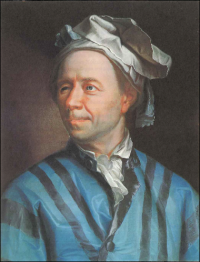
Leonhard Euler (Basel, 1707 - St Petersburg, 1783.

The myth that mathematical theorems suddenly come together in the most elegant and smooth proofs will be busted at an upcoming lecture.

Associate Professor Hans Lausch, an adjunct senior research fellow in Monash University's School of , will be discussing how mathematical theorems come to exist at his upcoming 'Euler, Gauss and someone else—who got it right and who didn't'.

"This lecture is to illustrate once more that celebrated mathematical results can have, perhaps more often than not, a long gestation period, with leaps and bounds, with errors and dead ends, and with frustration," Associate Professor Lausch said.

"These issues are usually not, or only sparsely, mentioned in text books, so a young student may get the impression that mathematical theorems suddenly come down upon us from heaven together with the most elegant and smooth proofs.

"On the other hand, there have been results, or proofs of results, correct ones as well as erroneous ones that were left unnoticed for a long time and not surprisingly, were rediscovered."

Associate Professor Lausch's lecture is looking at some work of the famous mathematicians Leonhard Euler and Carl Friedrich Gauss and specific theorems they worked on to determine who originally proved those theorems, in comparison to who was thought to have been first to have flawlessly proved them.

His talk is the second of the ', Mathematics, Philosophy and Technology' lecture series, organised by Dr Alan Dorin from the Monash Faculty of Information Technology.

"I hope my lecture will illustrate that great mathematicians are not supermen, but 'only' highly gifted human beings," Associate Professor Lausch said.

Explore further: OK, computation

More information: 'Euler, Gauss and someone else—who got it right and who didn't' will be held from 2-3pm on Thursday, 30 August 2012 in Seminar Room 135, Building 26, at Monash University's Clayton campus.

add to favorites email to friend print save as pdf

Related Stories

OK, computation

Jul 02, 2012

"It seems like Nature has some secret that lets it make complicated stuff in an effortless way," Stephen Wolfram recently told an audience at Oxford University’s Mathematical Institute.

MIT develops lecture search engine to aid students

Nov 08, 2007

Imagine you are taking an introductory biology course. You're studying for an exam and realize it would be helpful to revisit the professor's explanation of RNA interference. Fortunately for you, a digital ...

Now you see him

Mar 08, 2011

Imagine if Harry Potter’s cloak were real , or that you could blot out the sight of something as easily as pressing a mute button to eliminate sound. To some, this seems like “pi in the sky” ...

Mathematical models key to tracking gossip, terrorists

Dec 09, 2009

(PhysOrg.com) -- Thanks to the Internet and online social networks (OSNs) news and gossip now spread literally like wildfire -- uncontrollably and seemingly without any order. But according to one Ryerson ...

Recommended for you

Submerged structure stumps Israeli archaeologists

5 hours ago

The massive circular structure appears to be an archaeologists dream: a recently discovered antiquity that could reveal secrets of ancient life in the Middle East and is just waiting to be excavated.

Mais non! French universities may teach in English

19 hours ago

In France, there's a brewing debate over whether to speak anglais in universite. The National Assembly on Wednesday was taking up an education reform bill that would allow public universities to hold some courses—like science ...

User comments : 3

Adjust slider to filter visible comments by rank

Display comments: newest first

AWaB
not rated yet Aug 28, 2012
A perfect example of this is Maxwell's EM equations. He spent a lot of time deriving his results as can be seen from his papers. Once he had them, the originals were horrendous and quite cumbersome. It took even more time to generalize them into what we have today.
natello
1 / 5 (4) Aug 28, 2012
Once he had them, the originals were horrendous and quite cumbersome.

Maxwell's original theory was based on 20 equations in 20 unknowns. The original quaternion form of Maxwell's equations was more consequential and exact, than the later form reduced by Heaviside, Hertz, and Gibbs. The exclusion of scalar component from quaternions removed the description of spin-2 component of EM waves and scalar waves from Maxwell's theory. It's similar, like if we would neglect the elastic deformation of underwater and underwater waves from description of surface ripples with deforms of elastic fluid. The energy density of underwater waves is indeed minute with compare to the energy of surface ripples - but in many connections it cannot be neglected.
defactoseven
5 / 5 (1) Aug 29, 2012
"...Ye cubic surfaces! By threes and nines, Draw round his camp your seven-and-twenty lines- The seal of Solomon in three dimensions....."

More news stories

Submerged structure stumps Israeli archaeologists

The massive circular structure appears to be an archaeologists dream: a recently discovered antiquity that could reveal secrets of ancient life in the Middle East and is just waiting to be excavated.

Mais non! French universities may teach in English

In France, there's a brewing debate over whether to speak anglais in universite. The National Assembly on Wednesday was taking up an education reform bill that would allow public universities to hold some courses—like science ...

Engineers pioneer flat spray-on optical lens

A University of British Columbia engineer and a team of U.S. researchers have made a breakthrough utilizing spray-on technology that could revolutionize the way optical lenses are made and used.

Major human drug trial underway for Alzheimer's

A potentially ground-breaking human drug trial is currently underway, which aims to discover whether blood pressure medication can slow or halt the progression of Alzheimer's Disease (AD). This is the latest ...