Computer-simulated knitting goes right down to the yarn (w/ Video)
Aug 17, 2012
Computer-simulated knitting goes right down to the yarn (w/ Video)
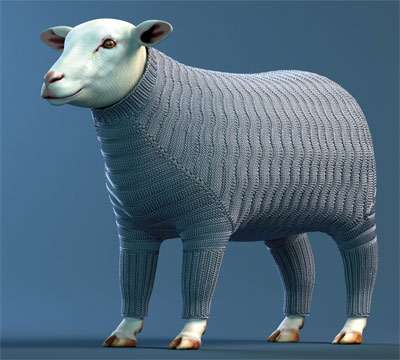
Whimsically - and to demonstrate the ability to fit any form - researchers put a sweater on a sheep.

To put clothes on their characters, computer graphic artists usually simulate cloth by creating a thin sheet, then adding some sort of texture. But that doesn’t work for knit sweaters. To make the image realistic, the computer has to simulate the surface right down to the intricate intertwining of yarn.

So scientists must, in effect, teach computers to knit – and graphic artists have to painstakingly model the 3-D structure of every stitch.

A new method for building simulated knitted fabric out of an array of individual stitches was reported at the 39th International Conference and Exhibition of Computer Graphics and Interactive Techniques earlier this month in Los Angeles by Cem Yuksel of the University of Utah; Jonathan Kaldor, of Facebook; and Steve Marschner and Doug James, Cornell University associate professors of computer science. The work was done when Yuksel and Kaldor were at Cornell.

This video is not supported by your browser at this time.

The Cornell innovation is to create a 3-D model of a single stitch and then combine multiple copies into a mesh, like tiles in a mosaic. The computer projects the mesh onto a model of the desired shape of the garment, treating each stitch as a tiny flat polygon that stretches and bends to fit the 3-D surface. Then it “relaxes” the graphic image of each stitch to fit the shape of its polygon, just as real yarn would stretch and bend to fit the shape of the wearer.

The result is a simulation with detail down to the yarn level.

“We are actually changing the shape of the yarn loops that make up the stitches,” Marschner said, “simulating how they wrap around other loops.”

The researchers tested their method with several patterns from knitting books and created images of dresses, sweaters, a shawl and a tea cozy. The simulations are highly realistic, but the researchers noted that the results of knitting a particular pattern depend on the yarn and needles used, as well as the style of the individual knitter. The method has some parameters that can be adjusted to simulate the effects of different needles or yarn, or different yarn tension used by the knitter, they said.

The process is computationally intensive, requiring several hours to simulate a garment (cable stitching takes the longest). As of today it would not be practical for an interactive application such as virtual reality, Marschner said, but it would be usable for movies.

The research was supported by the National Science Foundation, the Alfred P. Sloan Foundation, the John Simon Guggenheim Memorial Foundation and Pixar.

Explore further: Team develops new model for animated faces and bodies

Related Stories

Company develops conductive yarn for soldier uniforms

Apr 03, 2012

(PhysOrg.com) -- Modern military uniforms for servicemen from some countries such as those that serve Great Britain have evolved to the point that batteries and cables are needed for electronic devices that are carried; the ...

Engineer focuses on the mechanics of better bullet proofing

Nov 20, 2006

Body armor with greater ballistics resistance is the aim of the research being carried out by Youqi Wang, associate professor of mechanical engineering at Kansas State University, with support from two U.S. Department of ...

In a small-device world, bigger may still be better

Apr 20, 2012

In the early days, standard computers could be as large as a single story house. Over the last several decades, many development efforts have focused on shrinking them for use in the home and eventually anywhere in the world ...

Team develops new model for animated faces and bodies

Aug 06, 2012

Computer graphic artists who produce computer-animated movies and games spend much time creating subtle movements such as expressions on faces, gesticulations on bodies and the draping of clothes. A new way of modeling these ...

'Brave' features hair-raising animations

Jun 21, 2012

Trying to curl hair into perfect spiral curls is difficult enough to do in real life but for the team of scientists and artists at Pixar the quest to create a wild mane of curls for Merida, the redheaded heroine ...

Recommended for you

Drones may violate international law

2 hours ago

(Phys.org) —As President Obama gives a speech on national security—including defending U.S. use of drones to combat terrorism—Leila Sadat, JD, international law expert and professor of law at Washington University in ...

The long road to the 2000-watt society

2 hours ago

The vision of a society in which each inhabitant of the earth manages to consume only 2000 watts has already been around for 15 years. During this time, there has been a steady increase in environmental awareness ...

Sensitive bomb detector to rove in search of danger

3 hours ago

European researchers have developed and tested a light-weight device capable of detecting extremely minute quantities of explosives from up to 20 metres away, providing an invaluable law-enforcement tool ...

Germany must spread cost of energy shift fairly: IEA

4 hours ago

The International Energy Agency said Friday that Germany must shield its consumers from paying too much of the cost of its ambitious switch from nuclear power and fossil fuels toward renewable energy.

US panel rejects Motorola bid to block Xbox imports

4 hours ago

The US International Trade Commission sided with Microsoft in a patent dispute with Google-owned Motorola Mobility that could have led to Xbox 360 videogame consoles being banned from import.

User comments : 1

Adjust slider to filter visible comments by rank

Display comments: newest first

Howard_Vickridge
5 / 5 (2) Aug 18, 2012
I'm curious to know if this rendering technology can be applied to knitwear design & manufacture, or if it has actually been developed from existing manufacture design tools. Or in other words, in terms of textile behaviour can the technique be predictive, or is it purely reflective of the textile? It would be cool to knit a virtual garment and see how it moves / flows / stretches, without having to physically prototype it. Any hints welcome.

More news stories

Drones may violate international law

(Phys.org) —As President Obama gives a speech on national security—including defending U.S. use of drones to combat terrorism—Leila Sadat, JD, international law expert and professor of law at Washington University in ...