The Titanian seasons turn, turn, turn
Jul 11, 2012 By Jia-Rui C. Cook
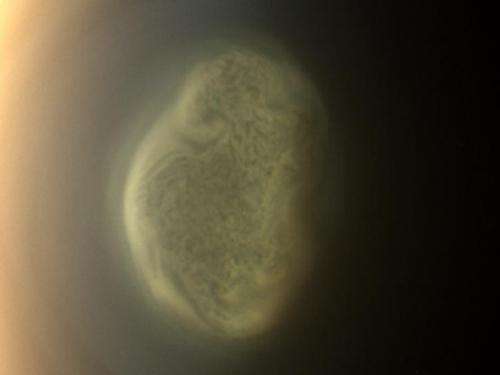
This true color image captured by NASA'S Cassini spacecraft before a distant flyby of Saturn's moon Titan on June 27, 2012, shows a south polar vortex, or a mass of swirling gas around the pole in the atmosphere of the moon. Credit: NASA/JPL-Caltech/Space Science Institute

(Phys.org) -- Images from NASA's Cassini spacecraft show a concentration of high-altitude haze and a vortex materializing at the south pole of Saturn's moon Titan, signs that the seasons are turning on Saturn's largest moon. "The structure inside the vortex is reminiscent of the open cellular convection that is often seen over Earth's oceans," said Tony Del Genio, a Cassini team member at NASA's Goddard Institute for Space Studies, N.Y. "But unlike on Earth, where such layers are just above the surface, this one is at very high altitude, maybe a response of Titan's stratosphere to seasonal cooling as southern winter approaches. But so soon in the game, we're not sure."

Cassini first saw a "hood" of haze and a vortex, which is a mass of swirling gas around the pole in the moon's atmosphere, at Titan's north pole when the spacecraft first arrived in the in 2004. At the time, it was northern winter. Multiple instruments have been keeping an eye on the Titan atmosphere above the for signs of the coming southern winter.

While the northern hood has remained, the circulation in the upper atmosphere has been moving from the illuminated north pole to the cooling south pole. This movement appears to be causing downwellings over the south pole and the formation of high-altitude haze and a vortex.

Cassini's visible light cameras saw the first signs of hazes starting to concentrate over Titan's south pole in March, and the spacecraft's visual and infrared mapping spectrometer (VIMS) obtained false-color images on May 22 and June 7.
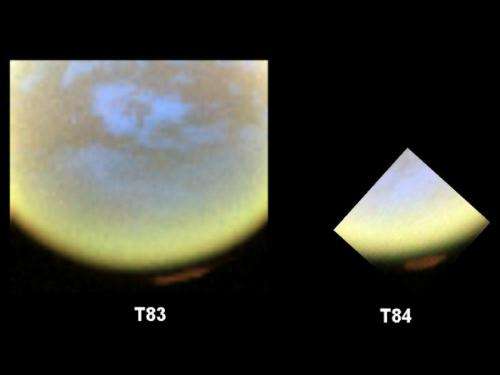
False-color images from NASA's Cassini spacecraft show the development of a hood of high-altitude haze ­- which appears orange in this image -- forming over the south pole of Saturn's moon Titan. Credit: NASA/JPL-Caltech/University of Arizona/LPGNantes

"VIMS has seen a concentration of aerosols forming about 200 miles [300 kilometers] above the surface of Titan's south pole," said Christophe Sotin, a VIMS team member at NASA's Jet Propulsion Laboratory, Pasadena, Calif. "We've never seen aerosols here at this level before, so we know this is something new."

During a June 27 distant flyby, Cassini's imaging cameras captured a crow's-eye view of the south polar vortex in visible light. These new images show this detached, high-altitude haze layer in stunning new detail.

"Future observations of this feature will provide good tests of dynamical models of the Titan circulation, chemistry, cloud and aerosol processes in the upper atmosphere," said Bob West, deputy imaging team lead at JPL. The Cassini-Huygens mission is a cooperative project of NASA, the European Space Agency and the Italian Space Agency.

Explore further: NASA head views progress on asteroid lasso mission

Related Stories

South polar region of Titan, Saturn's largest moon

Dec 29, 2011

(PhysOrg.com) -- This view from NASA's Cassini spacecraft looks toward the south polar region of Saturn's largest moon, Titan, and shows a depression within the moon's orange and blue haze layers near the ...

Cassini gazes at veiled Titan

Sep 23, 2010

(PhysOrg.com) -- NASA's Cassini spacecraft will swing high over Saturn's moon Titan on Friday, Sept. 24, taking a long, sustained look at the hazy moon. At closest approach, Cassini will fly within 8,175 kilometers ...

Titan's Purple Haze Points to a Fuzzy Past

Aug 02, 2004

Encircled in purple stratospheric haze, Saturn's largest moon, Titan, appears as a softly glowing sphere in this colorized image taken on July 3, 2004, one day after Cassini's first flyby of that moon. Titan ha ...

Cassini Returns to Southern Hemisphere of Titan

Jan 12, 2010

(PhysOrg.com) -- NASA'S Cassini spacecraft will return to Titan's southern hemisphere on a flyby tomorrow, Jan. 12, plunging to within about 1,050 kilometers (about 670 miles) of the hazy moon's surface.

Cassini, Saturn Moon Photographer

May 03, 2012

NASA's Cassini spacecraft successfully flew by Saturn's moons Enceladus and Dione during close flybys on May 2, 2012, capturing these raw images. The flybys were the last close encounters of these icy moons ...

Recommended for you

Dark, massive asteroid to fly by Earth on May 31

15 hours ago

It's 1.7 miles long. Its surface is covered in a sticky black substance similar to the gunk at the bottom of a barbecue. If it impacted Earth it would probably result in global extinction. Good thing it is ...

Research team explains 'Lazarus' comets

18 hours ago

Astronomers from the University of Antioquia have discovered a graveyard of comets. These once-dormant comets, dubbed by astronomers as "The Lazarus comets," are now rejuvenated.

NASA ships sensors for seafaring satellite to France

19 hours ago

(Phys.org) —Three NASA-built instruments that are integral components of the next in a series of U.S./European ocean altimetry satellites have arrived in France for integration with their spacecraft in ...

Trip into space with DiCaprio costs $1.55m

19 hours ago

Leonardo DiCaprio is going to get closer to stars of a different kind as he heads into space aboard the Virgin Galactic, and a well-heeled bidder at the Cannes Film Festival has paid 1.2 million euros (1.5 million) to be ...

User comments : 2

Adjust slider to filter visible comments by rank

Display comments: newest first

that_guy
3 / 5 (1) Jul 11, 2012
Question. If something relating to the moon Titan is referred to as Titanian, then what will we use to refer to something from Uranus' largest moon, Titania. Is it also Titanian? Or would it be titanianan?

I mean, one day, when we have colonies on both places, we could have some pretty difficult mixups. A telescope is shipped to titan, while methane lake scuba gear ends up on titania...you get the idea.

Once again, uranus is always getting in the way of everything.
nuge
5 / 5 (2) Jul 11, 2012
@that guy: Great question, no idea. Maybe Titan should be Titanan, and Titania should be Titanian. Or maybe they should think of a new name for one of them.

Moving on:

"VIMS has seen a concentration of aerosols forming about 200 miles [300 kilometers] above the surface of Titan's south pole," said Christophe Sotin


That's incredible. For context, our own atmosphere is considered to end at about 100 km up. This really is something new.

More news stories

Galaxies fed by funnels of fuel

(Phys.org) —Computer simulations of galaxies growing over billions of years have revealed a likely scenario for how they feed: a cosmic version of swirly straws.

Source of life running out: water scientists

The majority of people on Earth people will face severe water shortages within a generation or two if pollution and waste continues unabated, scientists warned at a conference in Bonn Friday.

Dark, massive asteroid to fly by Earth on May 31

It's 1.7 miles long. Its surface is covered in a sticky black substance similar to the gunk at the bottom of a barbecue. If it impacted Earth it would probably result in global extinction. Good thing it is ...