Saturn's rings are back
Jul 10, 2012 By Jia-Rui C. Cook
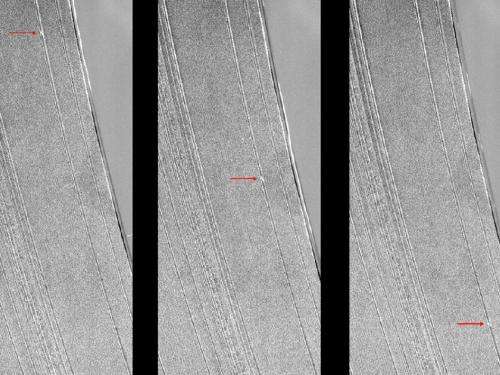
These three Cassini images show a propeller-shaped structure created by an unseen moon in Saturn's A ring. Credit: NASA/JPL-Caltech/SSI/Cornell

(Phys.org) -- It's been nearly two years since NASA's Cassini spacecraft has had views like these of Saturn's glorious rings. These views are possible again because Cassini has changed the angle at which it orbits Saturn and regularly passes above and below Saturn's equatorial plane. Steeply inclined orbits around the Saturn system also allow scientists to get better views of the poles and atmosphere of Saturn and its moons.
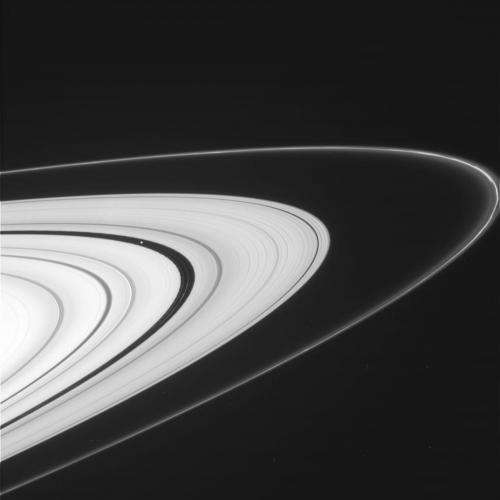
NASA's Cassini spacecraft has recently resumed the kind of orbits that allow for spectacular views of Saturn's rings. This view, from Cassini's imaging camera, shows the outer A ring and the F ring. The wide gap in the image is the Encke gap, where you see not only the embedded moon Pan but also several kinky, dusty ringlets. A wavy pattern on the inner edge of the Encke gap downstream from Pan and aspiral pattern moving inwards from that edge show Pan's gravitational influence. The narrow gap close to the outer edge is the Keeler gap. Image credit: NASA/JPL-Caltech/SSI

Cassini's recent return of ring images has started to pay off. A group of scientists has restarted the team's studies of propeller-shaped gaps. These gaps are cleared out by objects that are smaller than known moons but larger than typical ring particles. Cassini scientists haven't seen propellers in two years. Matt Tiscareno, a Cassini imaging team associate at Cornell University, Ithaca, N.Y., and colleagues have been following these objects for several years. Because some of the propellers are exactly where models predicted they would be, scientists believe they are seeing some old friends again.

Scientists are eagerly waiting for the other data that will come from this change in perspective. What's the secret to getting Cassini to at such high angles? Cassini's lead navigator, Duane Roth, explains in a JPL blog post: http://blogs.jpl.nasa.gov/2012/07/a-different-slant/.

Explore further: Cassini spots tiny moon, begins to tilt orbit

Related Stories

Journey to Saturn From Your Computer

Feb 01, 2008

Want a peek at Saturn as seen from space? A new interactive 3-D viewer that uses a game engine and allows users to travel to Saturn and see it the way the Cassini spacecraft sees it is now online at http://saturn.jpl.nasa.gov/multimedia/CASSIE ...

Cassini spots tiny moon, begins to tilt orbit

May 22, 2012

(Phys.org) -- NASA's Cassini spacecraft made its closest approach to Saturn's tiny moon Methone as part of a trajectory that will take it on a close flyby of another of Saturn's moons, Titan. The Titan flyby ...

Cassini delivers holiday treats from Saturn

Dec 22, 2011

(PhysOrg.com) -- No team of reindeer, but radio signals flying clear across the solar system from NASA’s Cassini spacecraft have delivered a holiday package of glorious images. The pictures, from Cassini’s ...

Saturn Propellers Reflect Solar System Origins

Jul 08, 2010

(PhysOrg.com) -- Scientists using NASA's Cassini spacecraft at Saturn have stalked a new class of moons in the rings of Saturn that create distinctive propeller-shaped gaps in ring material. It marks the first ...

Portraits of moons captured by Cassini

Dec 13, 2011

(PhysOrg.com) -- NASA's Cassini spacecraft successfully completed its closest-ever pass over Saturn's moon Dione on Monday, Dec. 12, slaloming its way through the Saturn system on its way to tomorrow's close ...

Recommended for you

Mars rover Opportunity examines clay clues in rock

14 hours ago

(Phys.org) —NASA's senior Mars rover, Opportunity, is driving to a new study area after a dramatic finish to 20 months on "Cape York" with examination of a rock intensely altered by water.

NASA's STEREO detects a CME from the sun

May 17, 2013

On 5:24 a.m. EDT on May 17, 2013, the sun erupted with an Earth-directed coronal mass ejection or CME, a solar phenomenon that can send billions of tons of solar particles into space that can reach Earth ...

Nine-year-old Mars rover passes 40-year-old record

May 17, 2013

While Apollo 17 astronauts Eugene Cernan and Harrison Schmitt visited Earth's moon for three days in December 1972, they drove their mission's Lunar Roving Vehicle 19.3 nautical miles (22.210 statute miles ...

Bright explosion on the Moon

May 17, 2013

For the past 8 years, NASA astronomers have been monitoring the Moon for signs of explosions caused by meteoroids hitting the lunar surface. "Lunar meteor showers" have turned out to be more common than anyone ...

User comments : 0

More news stories

Galaxy's Ring of Fire

Johnny Cash may have preferred this galaxy's burning ring of fire to the one he sang about falling into in his popular song. The "starburst ring" seen at center in red and yellow hues is not the product of ...

Alaska volcano shoots ash 15,000 feet into the air

(AP)—One of Alaska's most restless volcanoes has shot an ash cloud 15,000 feet into the air in an ongoing eruption that has drawn attention from a nearby community but isn't expected to threaten air traffic.

Chinese, Indian airlines face EU pollution fines

Eight Chinese and two Indian airlines face fines of up to several million euros for not paying for their greenhouse gas emissions during flights within the bloc, the European Commission said on Friday.

Morocco to harness the wind in energy hunt

Morocco is ploughing ahead with a programme to boost wind energy production, particularly in the southern Tarfaya region, where Africa's largest wind farm is set to open in 2014.

US seizes Bitcoin operator accounts

US authorities seized the accounts of a Bitcoin digital currency exchange operator, claiming it was functioning as an "unlicensed money service business," court documents showed Friday.