NASA analyzes twin hurricanes in the eastern Pacific
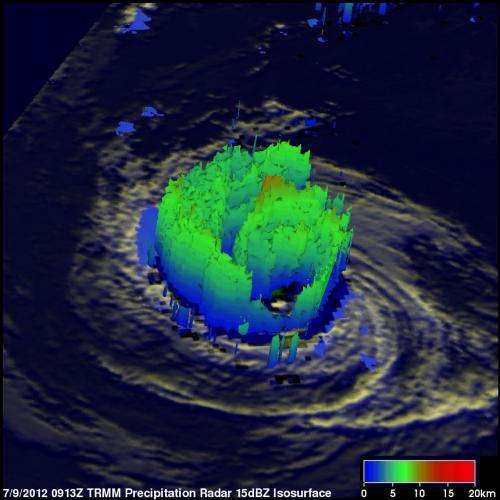
There are two hurricanes in the Eastern Pacific today, Daniel and Emilia. NASA's TRMM satellite passed over both storms in pinpointed the intensity of the rainfall within each storm, indicative of their power. Emilia is dropping rain at a greater rate than Daniel according to satellite data.
Tropical storm Daniel strengthened and became the third hurricane over the weekend, and today, Monday, July 9, Tropical Storm Emilia strengthened into the fourth hurricane of the season. Tropical storm Emilia formed on July 7 as tropical depression 5E and became a tropical storm on July 8. On July 9, Emilia is trailing Daniel by 645 miles in the eastern Pacific, as both storms continue to move away from land.
The Tropical Rainfall Measuring Mission (TRMM) satellite recently saw both tropical cyclones. TRMM flew above hurricane Daniel on July 8, 2012 at 0019 UTC (July 7, 2012 5:19 p.m. PDT) and over Emilia when it was a tropical storm on July 8, 2012 at 0837 UTC (1:37 a.m. PDT). Rainfall data collected with TRMM's Microwave Imager (TMI) and Precipitation Radar (PR) instruments was overlaid on enhanced infrared and visible images from TRMM's Visible and InfraRed Scanner (VIRS) at NASA's Goddard Space Flight Center in Greenbelt, Md. to show the intensity of the rain falling within each storm.
TRMM noticed only light-to-moderate rainfall happening within Daniel, as the hurricane continues to weaken. Light-to-moderate rainfall means rain is falling between 20 and 40 millimeters (.78 to 1.57 inches) per hour.
When TRMM passed over Tropical Storm Emilia on July 8, before she became a hurricane, data showed various areas of heavy rainfall in bands of thunderstorms along the northwestern, north, and eastern quadrants, feeding into the center. The heavy rain was falling at a rate of more than 2 inches/50 mm per hour. Surrounding the areas of heavy rain were large areas of light-to-moderate rainfall between 20 and 40 millimeters (.78 to 1.57 inches) per hour.
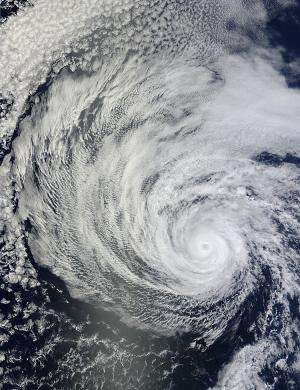
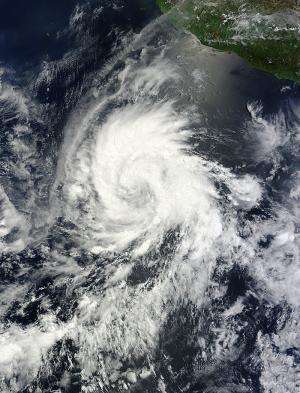
NASA's Terra satellite also passed over both storms, providing a clear, visible image of the cloud cover and extent on July 8. At that time, compact Daniel had a visible eye, while Emilia did not, and was still getting organized.
The Moderate Resolution Imaging Spectroradiometer (MODIS) instrument onboard NASA's Terra satellite captured a visible image of Hurricane Daniel in the eastern Pacific on July 8, 2012 at 1920 UTC 3:20 p.m. EDT that showed the tight circulation of the storm, and a small cloud-filled eye.
On July 9, Hurricane Daniel had maximum sustained winds near 85 mph (140 kmh). The center of Daniel was about 1355 miles (2185 km) west-southwest of the southern tip of Baja California, near latitude 15.3 north and longitude 129.1 west. The National Hurricane Center reports that "Daniel is moving toward the west near 15 mph (24 kmh) and this general motion with a slight increase in forward speed is expected during the next couple of days. Slow weakening is forecast during the next 48 hours."
Hurricane-force winds only extend out 25 miles (35 km) from the center, and tropical storm-force winds extend out up to 115 miles (185 km), making Daniel about 230 miles in diameter.
NASA's Terra satellite captured a visible image of Emilia when it was a tropical storm off the western coast of Mexico on July 8, 2012 at 1745 UTC 1:45 p.m. EDT. The storm appeared comma-shaped, but there was no visible eye in the center of circulation.
Emilia underwent rapid intensification today, July 9, from a tropical storm in the morning hours (Pacific Daylight Time/local time) into a category two hurricane. Emilia's maximum sustained winds were near 100 mph (160 kmh) and the National Hurricane Center noted that she could become a major hurricane (Category Three) later today. Emilia was located about 710 miles (1145 km) south of the southern tip of Baja California. Emilia is moving at 12 mph (19 kmh) to the west-northwest.
Just like Daniel, Emilia's hurricane force winds extend outward up to 25 miles (35 km) from the center of circulation, but Emilia's tropical-storm-force winds are much smaller in area, extending to 80 miles (130 km). Size doesn't matter here, though, because Emilia is expected to become a major hurricane in the next day, while Daniel weakens.
Provided by NASA's Goddard Space Flight Center


