NASA sees Tropical Storm Khanun weakening for South Korea landfall
Jul 18, 2012
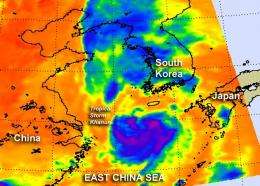
When NASA's Aqua satellite passed over Tropical Storm Khanun on July 18 at 0459 UTC (12:59 a.m. EDT) and infrared imagery from the AIRS instrument showed the strongest rainfall south of the center of circulation. Credit: Credit: NASA JPL, Ed Olsen

Infrared imagery of Tropical Storm Khanun shows that the storm is weakening as it heads toward a landfall in the Chungcheongnam-do province of western South Korea. Khanun is already bringing rainfall and stirring up seas around southwestern South Korea.

When NASA's Aqua satellite passed over Tropical Storm Khanun on July 18 at 0459 UTC (12:59 a.m. EDT), the Atmospheric Infrared Sounder (AIRS) instrument captured temperature data on cloud tops. from the AIRS instrument showed that convection (rising air that forms thunderstorms that make up a tropical cyclone) was weakening around the center of the storm. The highest, coldest, tops were south of the center of circulation, that's where temperatures were as cold as -63 Fahrenheit (-52 Celsius), and that's where the heaviest rain was falling.

At 1500 UTC (11 a.m. EDT) on July 18, Khanun's center had already passed the Cheju Island, South Korea, and is headed for the mainland. It is center near 33.9 North and 126.2 East, which is 30 miles northwest of Cheju Island. It is moving to the north at 15 knots and has near 45 knots. Khanun is creating 15-foot high seas in the East China Sea as it moves to a landfall.

Khanun is expected to make landfall in South Korea, just south of the North Korean border. After landfall the Joint expects it to weaken rapidly.

Explore further: NASA satellite sees strengthening in Tropical Cyclone Khanun

add to favorites email to friend print save as pdf

Related Stories

Ыatellite gets two tropical cyclones in one shot

Jun 23, 2011

The Northwestern Pacific Ocean is active with two tropical cyclones today, Tropical Storm Meari near the Philippines, and Tropical Depression Haima moving over China and now toward Vietnam. NASA's Aqua satellite ...

Recommended for you

Alaska volcano shoots ash 15,000 feet into the air

May 18, 2013

(AP)—One of Alaska's most restless volcanoes has shot an ash cloud 15,000 feet into the air in an ongoing eruption that has drawn attention from a nearby community but isn't expected to threaten air traffic.

NASA sees Cyclone Mahasen hit Bangladesh

May 17, 2013

NASA's Tropical Rainfall Measuring Mission satellite known as TRMM measured Cyclone Mahasen's rainfall rates from space as it made landfall on May 16. Mahasen has since dissipated over eastern India.

Rapid climate change ruled out ice age trees

May 17, 2013

Short, sharp fluctuations in the Earth's climate throughout the last ice age may have stopped trees from getting a foothold in Europe and northern Asia, scientists say.

User comments : 0

More news stories

Heat-related deaths in Manhattan projected to rise

Residents of Manhattan will not just sweat harder from rising temperatures in the future, says a new study; many may die. Researchers say deaths linked to warming climate may rise some 20 percent by the 2020s, ...

Mice, gerbils perish in Russia space flight

A number of mice and eight gerbils sent into space in a Russian capsule destined to find out how well organisms can withstand extended flights perished during their journey, scientists said Sunday as the ...