Hubble sees red giant blow a bubble
Jul 09, 2012
Credit: ESA/NASA

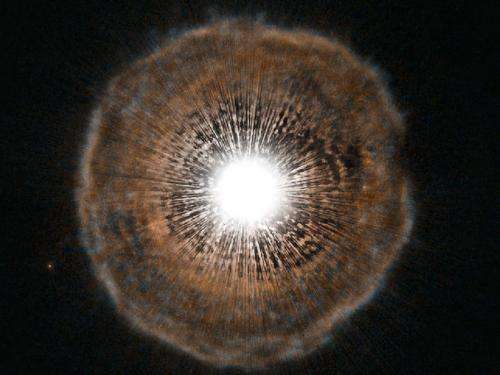
(Phys.org) -- Camelopardalis, or U Cam for short, is a star nearing the end of its life. As stars run low on fuel, they become unstable. Every few thousand years, U Cam coughs out a nearly spherical shell of gas as a layer of helium around its core begins to fuse. The gas ejected in the star’s latest eruption is clearly visible in this picture as a faint bubble of gas surrounding the star.

U Cam is an example of a carbon star, a rare type of star with an atmosphere that contains more carbon than oxygen. Due to its low surface gravity, typically as much as half of the total mass of a carbon star may be lost by way of powerful stellar winds. Located in the constellation of (The Giraffe), near the North Celestial Pole, U Cam itself is much smaller than it appears in this Hubble image. In fact, the star would easily fit within a single pixel at the center of the image. Its brightness, however, is enough to saturate the camera's receptors, making the star look much larger than it is.

The shell of gas, which is both much larger and much fainter than its parent star, is visible in intricate detail in Hubble’s portrait. This phenomenon is often quite irregular and unstable, but the shell of expelled from U Cam is almost perfectly spherical.

Explore further: Hubble reveals the ring nebula's true shape

Related Stories

Speed demon creates a shock

Mar 11, 2011

(PhysOrg.com) -- Just as some drivers obey the speed limit while others treat every road as if it were the Autobahn, some stars move through space faster than others. NASA's Wide-field Infrared Survey Explorer, ...

The Last Confessions of a Dying Star

Mar 04, 2008

Probing a glowing bubble of gas and dust encircling a dying star, NASA's Hubble Space Telescope reveals a wealth of previously unseen structures.

Young star rebels against its parent cloud

Dec 13, 2011

Despite the celestial colours of this picture, there is nothing peaceful about star forming region Sh 2-106, or S106 for short. A devilish young star, named S106 IR, lies in it and ejects material at high ...

Giant star expels multiple dust shells

Sep 28, 2011

An international team led by Leen Decin, a K.U. Leuven (Belgium) astronomer, has discovered a series of dust shells in the vicinity of CW Leonis, a dying giant star. The star expelled the shells in the course of its long ...

Image: Hubble peeks inside a stellar cloud

Apr 23, 2012

(Phys.org) -- These bright stars shining through what looks like a haze in the night sky are part of a young stellar grouping in one of the largest known star formation regions of the Large Magellanic Cloud ...

Recommended for you

Galaxies fed by funnels of fuel

48 minutes ago

(Phys.org) —Computer simulations of galaxies growing over billions of years have revealed a likely scenario for how they feed: a cosmic version of swirly straws.

Hubble reveals the ring nebula's true shape

May 23, 2013

(Phys.org) —The Ring Nebula's distinctive shape makes it a popular illustration for astronomy books. But new observations by NASA's Hubble Space Telescope of the glowing gas shroud around an old, dying, ...

User comments : 4

Adjust slider to filter visible comments by rank

Display comments: newest first

kevinrtrs
1 / 5 (8) Jul 09, 2012
Looks uncannily like the iris of an eye. Cats' eye in the sky, maybe??
I wonder if it is possible to take HDR images with the Hubble telescope? That might then show the true size of the star relative to the bubble.
barakn
5 / 5 (1) Jul 09, 2012
That's odd - every single cat I have ever met has had a slit pupil, not a round one.
Husky
1 / 5 (1) Jul 09, 2012
its like the magnetic fieldlines are "fossilised"during the ejection
barakn
not rated yet Jul 09, 2012
its like the magnetic fieldlines are "fossilised"during the ejection

What field lines? The material is ejected in spherically symmetric shells. Are you confused by the diffraction spikes?

More news stories

Galaxies fed by funnels of fuel

(Phys.org) —Computer simulations of galaxies growing over billions of years have revealed a likely scenario for how they feed: a cosmic version of swirly straws.

Source of life running out: water scientists

The majority of people on Earth people will face severe water shortages within a generation or two if pollution and waste continues unabated, scientists warned at a conference in Bonn Friday.

Dark, massive asteroid to fly by Earth on May 31

It's 1.7 miles long. Its surface is covered in a sticky black substance similar to the gunk at the bottom of a barbecue. If it impacted Earth it would probably result in global extinction. Good thing it is ...

Google eyes emerging markets networks

Google has become deeply involved in a series of projects to build and operate wireless networks in emerging markets including sub-Saharan Africa and Southeast Asia, a report said Friday.