Europe's plans to visit the Moon in 2018
Jul 27, 2012 by Jason Major, Universe Today
Credit: ESA

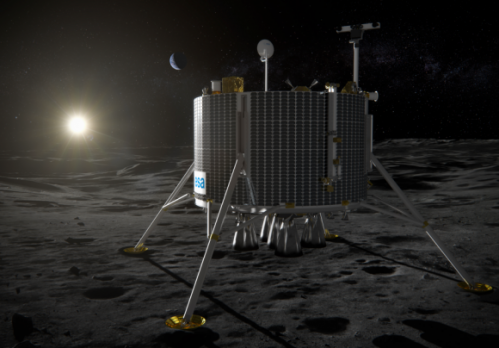
The European Space Agency is aiming for the Moon with their Lunar Lander mission, anticipated to arrive on the lunar surface in 2018. Although ESA successfully put a lander on the surface of Titan with the Huygens probe in 2005, this will be the first European spacecraft to visit Earth’s Moon.

Although will be an unmanned robotic explorer, the mission will be a forerunner to future human exploration of the Moon as well as Mars. Lunar Lander will use advanced technologies for autonomous landing and will be able to determine the best location for touchdown on its own, utilizing lasers to avoid obstacles on the Moon’s surface.

With no GPS on the Moon, Lunar Lander will navigate by digitally imaging the surface on the fly. Landing will be accomplished via thrusters, which were successfully tested earlier this year at a test chamber in Germany.

Lunar Lander’s destination will be the Moon’s south pole, where no exploration missions have ever landed. Once on the , the Lander will investigate Moon dust using a robotic arm and a suite of onboard diagnostic instruments, sending data and images back to scientists on Earth for further study.

Watch a video of the Lunar Lander mission below, from launch to landing.

This video is not supported by your browser at this time.


Explore further: Mice, gerbils perish in Russia space flight

More information: Read more about Lunar Lander on the ESA site here. www.esa.int/SPECIALS/lunarlander/SEMS5CA573H_0.html

add to favorites email to friend print save as pdf

Related Stories

Lunar lander firing up for touchdown

Mar 08, 2012

Europe’s ambition of touching down at the Moon’s south pole by 2018 has been boosted by recent test firings of the craft’s thrusters. The robot lander will prove new techniques for sending humans ...

NASA Selects Team To Build Lunar Lander

Oct 03, 2005

NASA's Deputy Associate Administrator for the Exploration Systems Mission Directorate Doug Cooke announced Friday the selection of NASA's Marshall Space Flight Center, Huntsville, Ala., and Goddard Space Flight Center, Greenbelt, ...

Looking at the volatile side of the Moon

Jun 01, 2011

Four decades after the first Moon landing, our only natural satellite remains a fascinating enigma. Specialists from Europe and the US have been looking at ESA’s proposed Lunar Lander mission to find ...

Fly us to the Moon... south pole to be precise

Mar 31, 2010

(PhysOrg.com) -- The south polar region of the Moon, with dark craters and high ridges, is a world away from the relatively smooth terrain visited by Apollo astronauts four decades ago. This rugged moonscape ...

NASA announces $2M lunar lander prize

Oct 25, 2007

The U.S. space agency announced it will offer $2 million in prizes to competing teams successfully demonstrating a prototype lunar lander.

Recommended for you

Mice, gerbils perish in Russia space flight

7 hours ago

A number of mice and eight gerbils sent into space in a Russian capsule destined to find out how well organisms can withstand extended flights perished during their journey, scientists said Sunday as the ...

Mars rover Opportunity examines clay clues in rock

May 18, 2013

(Phys.org) —NASA's senior Mars rover, Opportunity, is driving to a new study area after a dramatic finish to 20 months on "Cape York" with examination of a rock intensely altered by water.

NASA's STEREO detects a CME from the sun

May 17, 2013

On 5:24 a.m. EDT on May 17, 2013, the sun erupted with an Earth-directed coronal mass ejection or CME, a solar phenomenon that can send billions of tons of solar particles into space that can reach Earth ...

Nine-year-old Mars rover passes 40-year-old record

May 17, 2013

While Apollo 17 astronauts Eugene Cernan and Harrison Schmitt visited Earth's moon for three days in December 1972, they drove their mission's Lunar Roving Vehicle 19.3 nautical miles (22.210 statute miles ...

Bright explosion on the Moon

May 17, 2013

For the past 8 years, NASA astronomers have been monitoring the Moon for signs of explosions caused by meteoroids hitting the lunar surface. "Lunar meteor showers" have turned out to be more common than anyone ...

User comments : 8

Adjust slider to filter visible comments by rank

Display comments: newest first

El_Nose
4.5 / 5 (2) Jul 27, 2012
I wonder if it is named after Christain Huygens? -- he revolutionized pendulum clocks.

Now this is great space innovation. -- the only thing better would be putting six GPS satellites in orbit around the moon -- plus sixe geosync satellite for communication and precision mapping.
GDM
not rated yet Jul 27, 2012
I would agree about GPS in lunar orbit, but...to prevent noise pollution on the far side (which would disrupt planned radio telescopes), it would be better to place them at L1 (and L2).
The South Pole is where the action is going to be...soon, very soon. Looks like "everyone" is heading there. Maybe the US will also get there eventually (2020 at best). I hope the Chinese and Europeans will grant us visas to stay for a while. ;-)
IronhorseA
5 / 5 (1) Jul 28, 2012
Or instead of redoing the 1960's in higher resolution, we could just put a lab on the moon (under a few meters of lunar soil for radiation shielding) and post scientists there to do actual research.
I agree with the GPS idea guys, it would make the scientists job easier, but eternally mapping and remapping when a person on the ground can change gears faster to address interesting new phenomena, just isn't efficient.
GDM
1 / 5 (1) Jul 28, 2012
Agreed. The lunar orbiters already there (or been there) have done an excellent job of imaging every area of the moon, in just about every wavelength. We know what is down there, now let's go get it.
The Singularity
1 / 5 (1) Jul 29, 2012
We've been to our moon plenty of times. Cant see the point in this really. A mission to phobos would be far more interesting.
SatanLover
2.5 / 5 (2) Jul 29, 2012
nobody here gets it. the united states of europe is the new united states of america.
this is purely symbolic.
hopefulbl
not rated yet Jul 29, 2012
how the hell are they going to pay for it when the eurocountries go bankrupt one by one?
The Singularity
not rated yet Aug 02, 2012
@GDM yeah we know whats down there, a load of nasty useless dust & rock. No point in going there at all. Crazy idea if you ask me.

More news stories

Mice, gerbils perish in Russia space flight

A number of mice and eight gerbils sent into space in a Russian capsule destined to find out how well organisms can withstand extended flights perished during their journey, scientists said Sunday as the ...

Heat-related deaths in Manhattan projected to rise

Residents of Manhattan will not just sweat harder from rising temperatures in the future, says a new study; many may die. Researchers say deaths linked to warming climate may rise some 20 percent by the 2020s, ...

Honeybees trained in Croatia to find land mines

(AP)—Mirjana Filipovic is still haunted by the land mine blast that killed her boyfriend and blew off her left leg while on a fishing trip nearly a decade ago. It happened in a field that was supposedly ...

Bold action, big money needed to curb Asia floods

Asia's flood-prone megacities should fund major drainage, water recycling and waste reduction projects to stem deluges and secure clean supply for their booming populations, experts said Sunday.