ESA hands over MSG-3 weather satellite to EUMETSAT
Jul 17, 2012
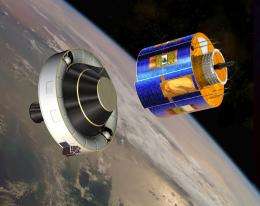
Meteosat Second Generation (MSG), Europe's latest weather satellite, operates in geostationary orbit at 0° Longitude over the West coast of Africa, from where it continuously scans the same quarter of the globe, showing the development and progression of weather systems and providing valuable data for Numerical Weather Prediction and climate monitoring. Credits: ESA/D. Ducros

Since the launch of MSG-3, ESA’s mission controllers have been working to ensure that this latest weather satellite’s voyage to 36 000 km above the Equator runs smoothly. With MSG-3 healthy and now in its place of work, ESA has handed operations over to Eumetsat.
 
The third Meteosat Second Generation satellite took to the skies on an Ariane 5 rocket on 5 July from Europe’s Spaceport in Kourou, French Guiana.
Once fully operational, it will deliver essential information from geostationary orbit to monitor the weather over Europe, Africa and parts of the Atlantic and Indian Oceans.

ESA is responsible for developing the series of satellites and performing the critical Launch and Early Orbit Phase (LEOP) on behalf of Eumetsat, the European Organisation for Exploitation of Meteorological Satellites, who then commission the payload and carry out routine operations.

The 11-day LEOP has involved several critical tasks for the team at ESA’s European Space Operations Centre in Darmstadt, Germany.

The mission controllers have completed four engine burns to put the in the correct orbit. These consumed almost 800 kg of propellants, about 80% of the total available.

As a result, the satellite is nearly in its geostationary orbit, drifting slowly east toward its final orbit position.

In addition, the meteorological instrument covers have been released, safely outside geostationary orbit. The instrument has been heated to drive off any contaminants and water vapour from the sensitive surfaces.

ESA’s MSG-3 Spacecraft Operations Manager, Chris Watson, said, “This is the third MSG we have launched, so you could say that we are familiar with the behaviour of the spacecraft.

“Nonetheless, MSG-3 managed to find a few minor surprises for us.

“Overall, though, this early phase has been extremely smooth and we are happy that this resource for weather forecasting has been brought safely to its place of work.”

Eumetsat now takes responsibility for MSG-3 and will commission it over last about six months. This includes checking that the imaging service is fully functional and delivers high-quality products for weather forecasting.

When fully operational, Eumetsat will rename MSG-3 as Meteosat-10.

Meteosat-10 joins its predecessor Meteosat-9 to keep a constant watch on developing weather systems.

Explore further: MSG-3 set to ensure quality of Europe's weather service from geostationary orbit

add to favorites email to friend print save as pdf

Related Stories

ESA to launch weather satellite Dec. 21

Dec 15, 2005

The European Space Agency says it will launch the second satellite in the Meteosat Second Generation family Dec. 21 from Kourou, French Guiana.

ESA and Thales Alenia Space enter negotiations for MTG

Mar 19, 2010

The tendering process that will result in the supply of Europe's next series of meteorological satellites, Meteosat Third Generation, has reached an advanced stage as ESA invites Thales Alenia Space to enter formal contract ...

Meteosat Third Generation takes a step forward

Feb 23, 2010

(PhysOrg.com) -- Since the launch of the first Meteosat in 1977, 33 years of imagery combined with increasing computer power have given meteorologists the tools to improve weather forecasting, with direct ...

Recommended for you

Dark, massive asteroid to fly by Earth on May 31

10 hours ago

It's 1.7 miles long. Its surface is covered in a sticky black substance similar to the gunk at the bottom of a barbecue. If it impacted Earth it would probably result in global extinction. Good thing it is ...

Research team explains 'Lazarus' comets

13 hours ago

Astronomers from the University of Antioquia have discovered a graveyard of comets. These once-dormant comets, dubbed by astronomers as "The Lazarus comets," are now rejuvenated.

NASA ships sensors for seafaring satellite to France

14 hours ago

(Phys.org) —Three NASA-built instruments that are integral components of the next in a series of U.S./European ocean altimetry satellites have arrived in France for integration with their spacecraft in ...

Trip into space with DiCaprio costs $1.55m

14 hours ago

Leonardo DiCaprio is going to get closer to stars of a different kind as he heads into space aboard the Virgin Galactic, and a well-heeled bidder at the Cannes Film Festival has paid 1.2 million euros (1.5 million) to be ...

User comments : 0

More news stories

Galaxies fed by funnels of fuel

(Phys.org) —Computer simulations of galaxies growing over billions of years have revealed a likely scenario for how they feed: a cosmic version of swirly straws.

Dark, massive asteroid to fly by Earth on May 31

It's 1.7 miles long. Its surface is covered in a sticky black substance similar to the gunk at the bottom of a barbecue. If it impacted Earth it would probably result in global extinction. Good thing it is ...

Source of life running out: water scientists

The majority of people on Earth people will face severe water shortages within a generation or two if pollution and waste continues unabated, scientists warned at a conference in Bonn Friday.

Google eyes emerging markets networks

Google has become deeply involved in a series of projects to build and operate wireless networks in emerging markets including sub-Saharan Africa and Southeast Asia, a report said Friday.