Earth is not enough: First fringes between effelsberg and RadioAstron using the DiFX correlator
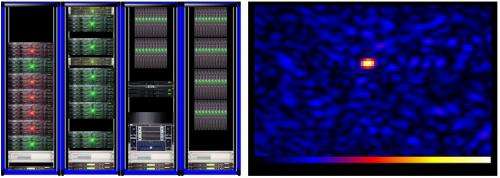
(Phys.org) -- Researchers at the Max-Planck-Institut für Radioastronomie (MPIfR, Bonn, Germany) and the Astro Space Center (ASC, Moscow, Russia) have obtained the first detection of interferometric signals between the Effelsberg 100 m telescope in Germany, and the RadioAstron spacecraft telescope orbiting the Earth using the DiFX software correlator.
This breakthrough enables new research to be pursued by the collaborators at the highest angular resolutions in astronomy, with simultaneous observations of two radio telescopes more than 300,000 km apart. Both telescopes were targeted at BL Lacertae, an Active Galactic Nucleus at a distance of approximately 900 million light years.
RadioAstron is an international project for VLBI (Very Long Baseline Interferometry) observations in space, led by the Astro Space Center (ASC) in Moscow and employing a 10-meter radio antenna on board of the Russian Spektr-R satellite. Launched in July 2011, the Spektr-R is a spacecraft orbiting the Earth on an elliptical orbit reaching out to 350 000 km from Earth. Combining the space borne antenna together with other radio telescopes on Earth, the RadioAstron project uses interferometric measurements to achieve extremely high angular resolutions --- equivalent to the resolution that would be achieved by a single telescope the size of the distance from the Earth to the Moon! The RadioAstron mission will enable astronomers to study exciting scientific topics including particle acceleration near supermassive black holes in active galactic nuclei, neutron stars and pulsars, to dark matter and dark energy.
The radio interferometry technique utilized by the RadioAstron mission relies on having pairs of telescopes that record the incoming radio wave signals, which are then electronically compared in a process called correlation. This processes, directly comparable to the optical "double-slit experiment" encountered in elementary optics classes by physics students, results in a series of sinusoidal intensity fluctuations as a function of the direction on the sky. Such sinusoidal variations are called "fringes" in radio astronomy, and the greater the distance between the two telescopes, the more precisely astronomers can measure the direction on the sky where a radio source is located.
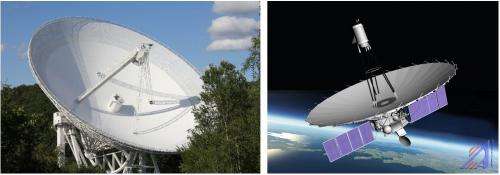
In order to fit within the mass and size limits of the launch vehicle (rocket), the size of the RadioAstron antenna was limited to 10 meters (Fig. 2b). The RadioAstron antenna is therefore not very sensitive on its own. This is where the collaboration with the MPIfR is extremely important. The MPIfR operates the 100 meter diameter radio telescope in Effelsberg, Germany (Fig. 2a), a large and extremely sensitive radio telescope that is well suited for participating in interferometry experiments such as this.
First fringes for the RadioAstron project were already detected using the Effelsberg 100 m telescope and the ASC correlator in 2011 and presented in an earlier press release. The observation described here has targeted BL Lacertae, an Active Galactic Nucleus (AGN) in the constellation Lacerta (the Lizard) in a distance of approximately 900 million light years. With its high variability and significant optical polarization, BL Lacerta forms the prototype for a whole class of AGNs.
Figure 1b shows an image of the first Effelsberg to RadioAstron fringe detection of BL Lacertae using the DiFX correlator with different colors showing the intensity of the measured fringe signal.
"An important new aspect of this analysis is that instead of having the radio signals processed by a hardware correlator, the radio signals were processed using the DiFX software correlator running on the VLBI computing stations at our institute in Bonn", states Anton Zensus, Director at MPIfR. "Our scientists, in consultation with RadioAstron experts, modified the DiFX source code to enable the use of radio signals from spacecraft orbiting the Earth." As traditional VLBI is performed using radio telescopes fixed to the surface of the Earth, these software changes included enabling DiFX to deal with telescopes moving in arbitrary ways, as well as correcting for the difference in the rate at which time progresses between the telescope on the ground and the spacecraft --- subtle changes predicted by the general relativity theory of Einstein that are essential for detecting interference signals between the two telescopes. The DiFX correlator is an open project involving many radio astronomers and geodetic (Earth science) scientists around the world, from Australia where it was initially developed to Europe and the United States. This will allow RadioAstron data to be processed using arrays of telescopes around the world, greatly opening up the opportunities for the RadioAstron mission to work together with other instruments around the world.
Another significant benefit of processing RadioAstron data using the DiFX correlator is that software tools commonly used by astronomers to process radio interferometry data already know how to use the data produced by DiFX, and astronomers can immediately start using their favorite software packages for processing RadioAstron data.
"This is an exciting development for the RadioAstron mission because it means that we can now successfully analyze the RadioAstron data from the point of view of studying the astronomy and physics", says James Anderson from Max-Planck-Institut für Radioastronomie. "We can sit down and make radio images of these objects at resolutions approaching the micro-arcsecond level --- something we have never been able to do before."
Provided by Max Planck Society


