SKorea sees big demand for fastest mobile network (Update)
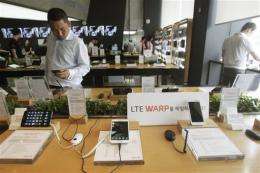
(AP) — South Korea is forecasting blistering growth in the use of a network technology that gives the fastest speeds for connecting to the Internet from a mobile device.
South Korea, already known for having the world's speediest fixed-line broadband Internet, was not the first to use the fourth generation mobile technology known as Long Term Evolution. The United States already eclipses South Korea in the number of LTE smartphone users.
But the proportion of the population using it is higher and rising faster in South Korea than in any other part of the world as mobile operators are making a big push to attract subscribers.
Some 7 million South Koreans, or about 14 percent of the population, are already using LTE smartphones. That is forecast to jump to about 30 percent of South Koreans within a few months. The proportion in the U.S. is less than 5 percent.
Based on subscriber targets laid out by South Korea's three mobile operators, the number of South Korean smartphone users accessing the Internet with LTE is expected to reach 15 million by the end of this year.
South Korea's Electronics and Telecommunications Research Institute said the number of LTE smartphone users will surpass 33 million in 2013.
That explosive growth means that by next year, most South Korean mobile phone users will be able to download multimedia content and stream videos at a faster speed than other countries.
Companies offering LTE claim it can stream data as much as five times faster than 3G networks. Those claims are often based on test conditions and the actual performance is likely to be less than that though still noticeably faster than 3G.
South Korea's smartphone market was kickstarted by the iPhone's launch in 2009 and expanded at a furious rate. The number of smartphone users reached 26 million as of April, allowing over half of the population to surf the web and download mobile applications on the go.
Around 20 million of them are still using the 3G mobile communication network, which gives a moderate Internet speed and will work fine for most basic functions, such as web surfing.
Market experts and industry officials believe smartphones that support the 4G mobile communication standard will become mainstream in South Korea as early as the end of this year and well before other countries.
That is not necessarily because South Koreans have insatiable demand for high-speed mobile Internet.
In the saturated mobile market, the main operators SK Telecom Co., KT Corp. and LG Uplus Corp. are splurging on marketing expenses to attract new subscribers.
They are giving generous subsidies to LTE smartphone subscribers while cutting down on subsidies for older devices.
"South Koreans usually get a new mobile phone in every one and a half or two years. When they get a new handset, they get the latest phone in part because device subsidies are given to the new models only," said Song Young-keun, a senior researcher at the Electronics and Telecommunications Research Institute.
With Apple Inc. yet to give access to LTE on its iPhone, most LTE handsets are manufactured by South Korean companies: Samsung Electronics Co., LG Electronics Inc. and Pantech Co.
Although Apple's iPad supports LTE in the United States, the tablet computer is not compatible with South Korean LTE networks.
The country's small size also allows quick completion of nationwide network coverage. All three operators completed nationwide LTE coverage earlier this year.
Copyright 2012 The Associated Press. All rights reserved. This material may not be published, broadcast, rewritten or redistributed.


