Scientists develop new tools for conservation and wildlife management
Jun 11, 2012
University scientists develop new tools for conservation and wildlife management
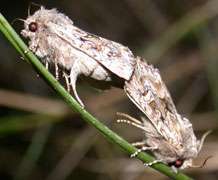
Sandhill Rustic moth.

(Phys.org) -- A University of Exeter team has developed new software tools for helping prioritise efforts in species conservation. As well as determining which species need our help, it will also be useful in pest control and sustainable harvesting.

The researchers from the University’s Environment and Sustainability Institute (ESI) and Centre for and Conservation on the Cornwall Campus have launched their new software, called ‘popdemo’ with the publication of two articles in the British Ecological Society journal Methods in Ecology & Evolution. The software is free to anyone and, although it is based on complex mathematical models, it is easy to use.

Popdemo adds to the established ‘R’ project, which provides free and powerful software, for statistics and modelling, to scientists and environmental groups worldwide.

Main researcher University of Exeter PhD student Iain Stott says: “Open source software is the future for scientific methods and tools: it allows anyone to engage with scientific research for free. I am proud to be able to contribute to this global philosophy.”

Stuart Townley, Professor of Applied Mathematics in the ESI, says: “This is the culmination of eight years interdisciplinary research involving biologists and mathematicians. Popdemo makes sophisticated mathematical tools accessible to applied ecologists”.

Dave Hodgson, Senior Lecturer in Ecology at the Centre for Ecology and Conservation, says: “There is a pressing need for the sustainable use of biological resources. Our package allows ecologists to make the right decisions when conserving or managing wildlife populations”.

Explore further: Climate change may have little impact on tropical lizards

More information: Popdemo is available online and is free to use. cran.r-project.org%20/

add to favorites email to friend print save as pdf

Related Stories

Dutch support for disaster zone phone software

Apr 13, 2011

Software developed by Flinders University’s Dr. Paul Gardner-Stephen which enables mobile phones to communicate during a disaster will be freely available to the public by the end of the year thanks to the support of ...

Recommended for you

Climate change may have little impact on tropical lizards

May 17, 2013

A new Dartmouth College study finds human-caused climate change may have little impact on many species of tropical lizards, contradicting a host of recent studies that predict their widespread extinction in a rapidly warming ...

Wetlands: value to locals matters most

May 17, 2013

A new way of valuing ecosystem services, incorporating the local perspective, is the driving force behind a project assessing aquatic ecosystems in highland areas of Asia

Symbolic saviour of an endangered species

May 16, 2013

In 2006 Berlin Zoo saw the birth of their first polar bear cub in 33 years. A retired circus polar bear gave birth to two cubs at the zoo. One of them died soon after, but Knut survived. At only a month old he became the ...

User comments : 0

More news stories

Honeybees trained in Croatia to find land mines

(AP)—Mirjana Filipovic is still haunted by the land mine blast that killed her boyfriend and blew off her left leg while on a fishing trip nearly a decade ago. It happened in a field that was supposedly ...

Heat-related deaths in Manhattan projected to rise

Residents of Manhattan will not just sweat harder from rising temperatures in the future, says a new study; many may die. Researchers say deaths linked to warming climate may rise some 20 percent by the 2020s, ...

Kinks and curves at the nanoscale

One of the basic principles of nanotechnology is that when you make things extremely small—one nanometer is about five atoms wide, 100,000 times smaller than the diameter of a human hair—they are going ...