Sandia Red Storm supercomputer exits world stage
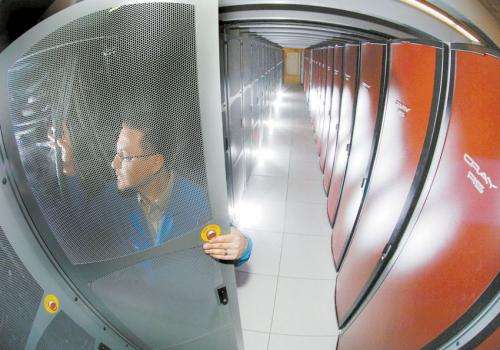
A celebration at Sandia’s Computer Science Research Institute in mid-May wrote finis to Red Storm, the Sandia-designed and Cray Inc.-built supercomputer, one of the most influential machines of its era, with 124 descendants at 70 sites around the world.
Cray Inc. President and Chief Executive Officer Peter Ungaro did not stint in his praise. He told the assembled group, “Without Red Storm I wouldn’t be here in front of you today. Virtually everything we do at Cray — each of our three business units — comes from Red Storm. It spawned a company around it, a historic company struggling as to where we would go next. Literally, this program saved Cray.”
Red Storm’s design and its descendants have racked up more than a billion dollars in sales for the company, he said.
Among the machine’s advances was its use of off-the-shelf parts, which made it cheaper to build, repair and upgrade. Red Storm was air-cooled instead of water-cooled, so parts could be replaced and upgrades completed while the machine was running. The only custom component was the Interconnect chip that made it possible to pass information more directly from processor to processor while applications were running. High-memory bandwidth kept the processors from being starved for data.
And its architecture was upgradeable, from a theoretical peak at birth of 41.47 teraflops in 2005 to 124.42 teraflops in 2006 to 284.16 teraflops in 2008, because (among other reasons) the machine accommodated single-, dual- and quad-core processors that eventually reached 12,920 in number.
Among the machine’s technical achievements was the operation in 2008 known as Burnt Frost, in which Red Storm programmed a 152-inch rocket to shoot down an errant satellite traveling at 17,000 miles per hour, 153 miles above the earth.
For months, Red Storm calculated a large number of shoot-down scenarios, until Sandians were ready to brief then-President George W. Bush on his options.
The result: after the successful take-down with no collateral damage, a military commander exulted, “We can hit a spot on a bullet with a bullet.”
Red Storm’s role, classified for several years, was made known when DoD released the information, followed by a Sandia impact video with a sound track that opened oracularly, “This IS rocket science!”
Other, still classified, Red Storm operations were officially described as solving “pressing national security problems in cyber defense, vulnerability assessments, informatics (network discovery), space systems threats and image processing.”
One nonclassified use for the machine and its more powerful descendant Jaguar at Oak Ridge was to produce high-fidelity climate models that revealed, for the first time in simulations, swirls of water, or vortices, in the Indian Ocean.
Sandia Center Director Rob Leland, who hosted the celebration, was the responsible senior manager when Red Storm was designed and built. He recalled that in 2004, he was on the verge of re-locating his family to Seattle, Cray’s home base, to help out. “Things were really tense. We couldn’t keep flying back and forth to be in immediate touch with Cray management and technicians,” he said in an interview. “Imagine going to a company whose defining idea is one thing [a custom vectorized, or linear, processor] and telling them it’s the wrong idea for the future and they needed to focus instead on building massively parallel systems out of commodity processors. It only worked because they were at risk of going out of business, so they were quite motivated to accommodate us. And it turned out really well for them. In four years, their market share of supercomputers jumped from 6 percent to 20 percent.”
“Red Storm is over, but its influence is not,” agreed Bill Camp, the retired Sandia director who achieved support for the design first proposed by Sandia technical adept Jim Tomkins (retired).
Then-Sandia vice-president Frank Figueroa was wary to let Camp embark on the project because, Figueroa protested, “The size of the project is bigger than the net worth of the company.” To Camp, with Intel refusing to remain in the specialty supercomputer field and IBM already committed to another type of machine, Cray was, so to speak, the only U.S. game in town, but Cray wasn’t sure it wanted to play.
Sandia executives convinced Congress and DOE to fund the new effort, which eventually reached a cost of approximately $72 million, a large sum but far less than comparable supercomputers at the time, and for a far more all-purpose machine.
“The normal supercomputer development time for Cray was four to five years,” said Leland. “We had in mind about 18-22 months.”
“It was the fastest development cycle of any supercomputer,” said Camp.
Things moved fast despite the perfectionism of the originator of the design, Jim Tomkins. “I had this nickname at Cray, ‘the devil incarnate,’ because I was something of a hard nose,” he told the group. “I believed if we didn’t pay attention to detail, we were going to fail. I wanted dotted i’s and crossed t’s. But it was the best team I ever worked with. There was no internal friction, and it was a great adventure.”
Because of the speed with which Sandians pressed forward, when the machine arrived in Albuquerque, it had neither management software to boot the system nor working communication software between processors, so Sandia researchers wrote them. “The communication software is still in use today,” said Sandia manager Sue Kelly, credited with leading the effort to make the system usable once it was delivered.
One of the most often-heard compliments to the machine, one man said at the celebration, is that “when a program doesn’t work on another machine, they say, ‘It works on Red Storm.’”
Horst Simon, deputy director at Lawrence Berkeley National Laboratory and a prominent computer scientist, emailed Camp, “I just want you to know what a wonderful thing you and Jim [Tomkins] have done for supercomputing.”
“Jim Tomkins and me, we hung in there and made it happen,” reminisced Camp.
About Camp, Leland said, “There were a handful of people in the country with the leadership skills for this job and a handful with the technical skills for this job, but I don’t know anyone who had both, except for Bill.”
Among other people mentioned as having a positive impact on the project were Don Cook (now NNSA Deputy Administrator for Defense Programs), and Sandia California vice president Rick Stulen.
Provided by Sandia National Laboratories


