Life cycles of mysterious Namibian grassland 'fairy circles' characterized
Jun 27, 2012
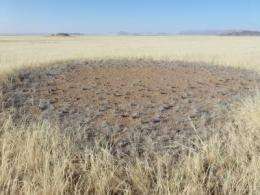
This is a newly formed fairy circle. Credit: Tschinkel WR (2012) The Life Cycle and Life Span of Namibian Fairy Circles. PLoS ONE 7(6): e38056. doi:10.1371/journal.pone.0038056

The grasslands in Namibia are home to so-called "fairy circles" - circular bare spots, usually surrounded by a ring of taller grass – of unknown origin. These circles are described and characterized in a report published June 27 in the open access journal PLoS ONE.

The author, Walter Tschinkel of Florida State University, showed that the circles are not permanent, and go through a birth, maturation, and death process. The life spans appear to range from 24 to 75 years, and smaller circles were generally shorter-lived than larger ones. The ultimate cause, however, remains unknown.

"The fact that fairy circles are born, mature and die, brings the dynamic nature of this mysterious ecological phenomenon into focus." Tschinkel explains. "Until now, their long life spans made it hard to detect that they are not permanent features."

Explore further: Coral reefs 'ruled by earthquakes and volcanoes'

More information: Tschinkel WR (2012) The Life Cycle and Life Span of Namibian Fairy Circles. PLoS ONE 7(6): e38056. doi:10.1371/journal.pone.0038056

add to favorites email to friend print save as pdf

Related Stories

Abuse from other universes -- a second opinion

Oct 10, 2011

At the end of last year, there was a flurry of activity from astronomers Gurzadyan and Penrose that considered the evidence of alternate universes or the existence of a universe prior to the Big Bang and suggested ...

Physics could be behind the secrets of crop-circle artists

Aug 01, 2011

In this month's edition of Physics World, Richard Taylor, director of the Materials Science Institute at the University of Oregon, takes a serious, objective look at a topic that critics might claim is beyond scientific understanding ...

Seeing isn't believing

Sep 07, 2011

Pay attention! It's a universal warning, which implies that keeping close watch helps us perceive the world more accurately. But a new study by Yale University cognitive psychologists Brandon Liverence and Brian Scholl finds ...

What the brain sees after the eye stops looking

Nov 08, 2011

(Medical Xpress) -- When we gaze at a shape and then the shape disappears, a strange thing happens: We see an afterimage in the complementary color. Now a Japanese study has observed for the first time an equally strange ...

New type of extra-chromosomal DNA discovered

Mar 09, 2012

(PhysOrg.com) -- A team of scientists from the University of Virginia and University of North Carolina in the US have discovered a previously unidentified type of small circular DNA molecule occurring outside ...

Recommended for you

Coral reefs 'ruled by earthquakes and volcanoes'

22 minutes ago

(Phys.org) —Titanic forces in the Earth's crust explain why the abundance and richness of corals varies dramatically across the vast expanse of the Indian and Pacific Oceans, a world-first study from the ...

Cane toad or native frog? App prevents mistaken identity

57 minutes ago

Travelling around the top end of Australia, would you be able to tell the difference between a poisonous cane toad and a bumpy rocket frog or a giant frog? - They look similar but sound quite different. ...

Designer eucalypts for urban landscapes

1 hour ago

University of Adelaide researchers are working with the Australian nursery industry to produce 'designer eucalypts' more suitable for our home gardens and urban landscapes than many trees currently available.

User comments : 0

More news stories

Coral reefs 'ruled by earthquakes and volcanoes'

(Phys.org) —Titanic forces in the Earth's crust explain why the abundance and richness of corals varies dramatically across the vast expanse of the Indian and Pacific Oceans, a world-first study from the ...

100K Pathogen Genome Project maps first genomes

(Phys.org) —Striking a blow at foodborne diseases, the 100K Pathogen Genome Project at the University of California, Davis, today announced that it has sequenced the genomes of its first 10 infectious microorganisms, including ...

Strawberry fields forever and fungus-free

(Phys.org) —Strawberries are one of the most economically important berry crops in the world, and a high value export crop for the Australian horticultural industry.For the first time, researchers at The ...

Theorists weigh in on where to hunt dark matter

(Phys.org) —Now that it looks like the hunt for the Higgs boson is over, particles of dark matter are at the top of the physics "Most Wanted" list. Dozens of experiments have been searching for them, but ...