Hubble sees a celestial swan and butterfly
Jun 05, 2012

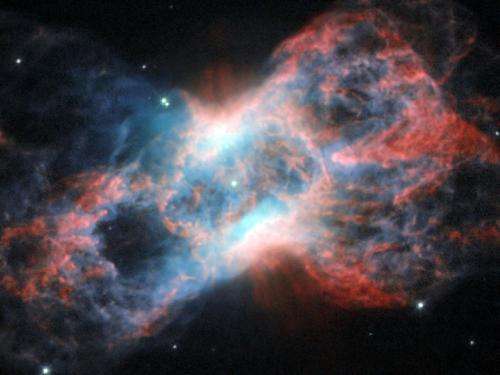
(Phys.org) -- This image from the Hubble Space Telescope shows planetary nebula NGC 7026. Located just beyond the tip of the tail of the constellation of Cygnus (The Swan), this butterfly-shaped cloud of glowing gas and dust is the wreckage of a star similar to the sun.

Planetary nebulae, despite their name, have nothing to do with planets. They are, in fact, a relatively short-lived phenomenon that occurs at the end of the life of mid-sized stars. As a star's nuclear fuel runs out, its outer layers are puffed out, leaving only the hot core of the star behind. As the heats up, the atoms in it are excited, and it lights up like a fluorescent sign.

Fluorescent lights on Earth get their bright colors from the gases with which they are filled. Neon signs, famously, produce a bright red color, while ultraviolet lights (black lights) typically contain mercury. The same is true for nebulae: their are produced by the mix of gases present in them.

This image was produced by the Wide Field and Planetary Camera 2 aboard the . A version of it was entered into the Hubble’s Hidden Treasures Competition by contestant Linda Morgan-O'Connor. Hidden Treasures is an initiative to invite astronomy enthusiasts to search the Hubble archive for stunning images that have never been seen by the general public.

Explore further: Researchers explain magnetic field misbehavior in solar flares

Related Stories

Image: Hubble peeks inside a stellar cloud

Apr 23, 2012

(Phys.org) -- These bright stars shining through what looks like a haze in the night sky are part of a young stellar grouping in one of the largest known star formation regions of the Large Magellanic Cloud ...

Hubble spies edge-on beauty

May 21, 2012

(Phys.org) -- Visible in the constellation of Andromeda, NGC 891 is located approximately 30 million light-years away from Earth. The NASA/ESA Hubble Space Telescope turned its powerful wide field Advanced ...

The Colorful Demise of a Sun-Like Star

Feb 13, 2007

This image, taken by NASA's Hubble Space Telescope, shows the colorful "last hurrah" of a star like our Sun. The star is ending its life by casting off its outer layers of gas, which formed a cocoon around ...

Image: A chameleon sky

Sep 03, 2010

The sands of time are running out for the central star of this the Hourglass Nebula.

Hubble Captures Stars Going Out in Style

Sep 11, 2007

The colorful, intricate shapes in these NASA Hubble Space Telescope images reveal how the glowing gas ejected by dying Sun-like stars evolves dramatically over time.

The Last Confessions of a Dying Star

Mar 04, 2008

Probing a glowing bubble of gas and dust encircling a dying star, NASA's Hubble Space Telescope reveals a wealth of previously unseen structures.

Recommended for you

Fragile mega-galaxy is missing link in history of cosmos

7 hours ago

Two hungry young galaxies that collided 11 billion years ago are rapidly forming a massive galaxy about 10 times the size of the Milky Way, according to UC Irvine-led research published Wednesday in the journal ...

Galaxy's Ring of Fire

May 18, 2013

Johnny Cash may have preferred this galaxy's burning ring of fire to the one he sang about falling into in his popular song. The "starburst ring" seen at center in red and yellow hues is not the product of ...

User comments : 0

More news stories

Forecast for Titan: Wild weather could be ahead

(Phys.org) —Saturn's moon Titan might be in for some wild weather as it heads into its spring and summer, if two new models are correct. Scientists think that as the seasons change in Titan's northern hemisphere, ...

NASA's Landsat satellite looks for a cloud-free view

For decades, Landsat satellites have documented the desiccation of the Aral Sea in Central Asia. Once one of the largest seas in the world, it shrunk to a tenth of its original volume after Russia diverted ...

SDO observes mid-level solar flare

UPDATE 16:30 p.m. EDT: The M7-class flare was also associated with a coronal mass ejection or CME, another solar phenomenon that can send billions of tons of particles into space. While this CME was not Ea ...