FAIR: New German particle accelerator clears first hurdle
Jun 12, 2012
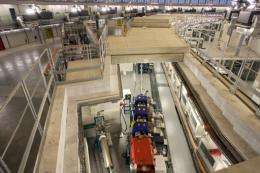
A French particle accelerator is pictured in 2006. Plans to build a 1.6-billion-euro particle accelerator in Germany cleared the first main hurdle when authorities gave the go-ahead for construction to begin.

Plans to build a 1.6-billion-euro ($2 billion) particle accelerator in Germany cleared the first main hurdle Tuesday when authorities gave the go-ahead for construction to begin.

The environment minister for the regional state of Hesse, Lucia Puttrich, officially gave the green light for a new giant Facility for Antiproton and Ion Research in Europe (FAIR), which is to built on a 20-hectare site in Darmstadt, not far from Frankfurt.

In what is being described as one of the biggest research projects in the world, more than 3,000 scientists from more than 50 countries will work at FAIR from 2018, studying the nature and .

FAIR is being financed by eight different countries, including France, Russia and India.

Explore further: New X-ray method shows how frog embryos could help thwart disease

add to favorites email to friend print save as pdf

Related Stories

FAIR particle accelerator kick-off event

Nov 07, 2007

Nuclear physicists from around the world are today celebrating the official launch of the particle accelerator FAIR with a gala event and a scientific symposium. The Facility for Antiproton and Ion Research is being set up ...

Multimedia creates the buzz at Frankfurt book fair

Oct 05, 2010

The world's biggest book fair was inaugurated on Tuesday, with an increased number of exhibitors expected to focus on the digital and multimedia sectors that are rapidly transforming the industry.

Turkey touts tech credentials at CeBIT fair

Feb 28, 2011

Prime Minister Recep Tayyip Erdogan talked up the Turkish technology industry Monday ahead of the world's largest IT fair in Germany, where Turkey is this year "partner country." ...

Recommended for you

Breakthrough calls time on bootleg booze

2 hours ago

(Phys.org) —Using a laser, the St Andrews scientists can now carry out detailed analysis of a spirit sample no bigger than a teardrop and can even confirm whether it is toxic or not. It's hoped the testing ...

Bringing life into focus

May 17, 2013

Spinning-disk confocal microscopy is an optical imaging technique that can be used to generate detailed three-dimensional fluorescence images of living cells and their contents. Although a powerful tool for ...

World's smallest droplet

May 17, 2013

(Phys.org) —Physicists may have created the smallest drops of liquid ever made in the lab. That possibility has been raised by the results of a recent experiment conducted by Vanderbilt physicist Julia Velkovska and her ...

User comments : 7

Adjust slider to filter visible comments by rank

Display comments: newest first

Deesky
5 / 5 (6) Jun 12, 2012
It would have been good if more details were provided about this accelerator, as I've not heard much about it before and how it compares to CERN.

Press info seems to be hard to come by, but here's their official website:
http://www.fair-c...php?id=1
runrig
not rated yet Jun 13, 2012
Why is this necessary when the world has CERN ? Surely that can do all and much more science.
Satene
1 / 5 (2) Jun 13, 2012
Because the public feedback for these research is missing. A two billion collider is useless in the situation, when LHC found essentially nothing and the cold fusion research is delayed by twenty years.
aennen
1 / 5 (1) Jun 13, 2012
wonder who is paying for this ?
Gagarin
5 / 5 (1) Jun 13, 2012
wonder who is paying for this ?

Concerning the cost of the construction, it is about one day of military expenses in the world!
Gagarin
not rated yet Jun 13, 2012
Because the public feedback for these research is missing. A two billion collider is useless in the situation, when LHC found essentially nothing and the cold fusion research is delayed by twenty years.

FAIR would be specialized in the antimatter research; in CERN only a limited antimatter research is possible. The physics of the 21st century would be probably dominated by the antimatter research and the understanding of the quantum vacuum.
Deesky
5 / 5 (1) Jun 13, 2012
Because the public feedback for these research is missing. A two billion collider is useless in the situation, when LHC found essentially nothing and the cold fusion research is delayed by twenty years.

Oh look! A new Zephir clone!

More news stories

Breakthrough calls time on bootleg booze

(Phys.org) —Using a laser, the St Andrews scientists can now carry out detailed analysis of a spirit sample no bigger than a teardrop and can even confirm whether it is toxic or not. It's hoped the testing ...

Competition in the quantum world

Innsbruck physicists led by Rainer Blatt and Peter Zoller experimentally gained a deep insight into the nature of quantum mechanical phase transitions. They are the first scientists that simulated the competition ...

New principle may help explain why nature is quantum

Like small children, scientists are always asking the question 'why?'. One question they've yet to answer is why nature picked quantum physics, in all its weird glory, as a sensible way to behave. Researchers ...

Computer model predicts when viruses become infectious

A new computer model could help scientists predict when a particular strain of avian influenza might become infectious from bird to human, according to a report to be published in the International Journal Data Mining an ...