Astronomers pinpoint elusive galaxy - and find it is not alone
Jun 18, 2012 By Daniel Stolte
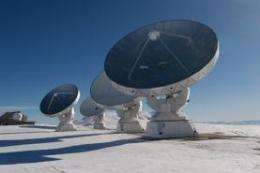
Four antennas of the IRAM telescope on the Plateau de Bure in the French Alps. With this compound telescope, the research team identified the first of the spectral lines of the galaxy HDF850.1 allowing them to determine the galaxy's distance. Credi: IRAM/Rebus

An international team of astronomers has for the first time determined the distance of the galaxy HDF850.1. The discovery challenges and expands our understanding of how galaxies are born and develop over time.

An international team of has managed for the first time to determine the distance of the galaxy HDF850.1, well-known among astronomers as being one of the most productive star-forming in the .

The galaxy is at a distance of 12.5 billion . Hence, we see it as it was 12.5 billion years ago, when the universe was less than 10 percent of its current age.

Even more of a surprise, HDF850.1 turns out to be part of a group of around a dozen protogalaxies that formed within the first billion years of – only one of two such primordial clusters known to date. The work is published in the journal Nature.

"This galaxy is special because it's so young, it's massive, and it churns out stars at an unexpectedly high rate," said Brant Robertson, an assistant professor at the University of Arizona's Steward Observatory and department of astronomy who studies how galaxies come to be and how they evolve over time.

"Any clue we can get about how those early galaxies formed helps us better understand this process," Robertson said. "We can use them to test our models."

The galaxy HDF850.1 was discovered in 1998. It is famous for producing new stars at a rate that is near-incredible even on astronomical scales: a combined mass of a thousand Suns per year. For comparison: an ordinary galaxy such as our own produces no more than 1 to 4 solar mass's worth of new stars per year.

Yet for the past 14 years, HDF850.1 has remained strangely elusive. Its location in space, specifically its distance from Earth – the subject of many studies – ultimately remained unknown.

How was that possible?
Astronomers pinpoint elusive galaxy - and find it is not alone
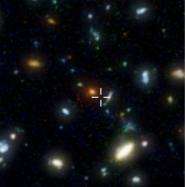
The region of the Hubble Deep Field where HDF850.1 is located (cross) is a glimpse into the abyss of space and time, 12.5 billion light years away. For observations with ordinary, visible light telescopes such as the Hubble Space Telescope, the galaxy is invisible. Credit: STScI/NASA, F. Walter (MPIA

"A vast cloud of dust keeps HDF850.1 hidden from telescopes searching the universe in the visible light range, so even the Hubble Space Telescope can't see it," Robertson said. "If it wasn't for the dust layer, this galaxy would shine bright and blue with the intense light from the newly forming stars."

The "Hubble Deep Field," where HDF850.1 is located, is a region in the sky that affords an almost unparalleled view into the deepest reaches of space. It was first studied extensively using the Hubble Space Telescope.

Yet observations using visible light only reveal part of the cosmic picture, and astronomers were quick to follow-up at different wavelengths.

In the late 1990s, astronomers using the James Clerk Maxwell Telescope on Hawai'i surveyed the region using submillimeter radiation. This type of radiation, with wavelengths between a few tenths of a millimeter and a millimeter, is particularly suitable for detecting cool clouds of gas and dust.

"The galaxy's invisibility is no great mystery," explained team leader Fabian Walter of the Max Planck Institute for Astronomy in Heidelberg, Germany.

"Stars form in dense clouds of gas and dust. These dense clouds are opaque to visible light, hiding the galaxy from sight. Submillimeter radiation passes through the dense dust clouds unhindered, showing what is inside," Walter said. "But the lack of data from all but a very narrow range of the spectrum made it very difficult to determine the galaxy's redshift, and thus its place in cosmic history."

Robertson, together with UA astronomer Daniel Stark, was part of the team and said: "We knew where to look but we didn't know how far away it was."

Taking advantage of recent upgrades to the IRAM interferometer on the Plateau de Bure in the French Alps, which combines six radio antennas that then act as a gigantic millimeter-wavelength telescope, the team identified the characteristic features ("spectral lines") necessary for an accurate distance determination.

The researchers were taken by surprise when they realized that HDF850.1 was the brightest source of submillimeter emission in the field by far, a galaxy that was evidently forming as many stars as all the other galaxies in the Hubble Deep Field combined – and which was completely invisible in the observations of the Hubble Space Telescope.
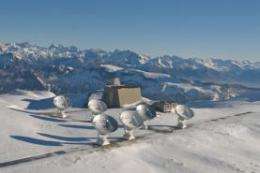
IRAM's antennas are mounted on rails, combining their signals into the resolving power of a much larger "virtual antenna." At maximum separation, they can resolve 0.5 arcseconds of sky at an observing wavelength of 1.3 mm (230 GHz), equal to the apparent size of an apple at a distance of 60 km, or about 37 miles. Credit: IRAM/Rebus

A combination with observations obtained at the National Science Foundation's Karl Jansky Very Large Array (VLA) in Socorro, New Mexico, then revealed that a large fraction of the galaxy's mass is in the form of molecules – the raw material for future stars. The fraction is much higher than what is found in galaxies in the local universe.

Once the distance was known, the researchers were also able to put the galaxy into context. Using additional data from published and unpublished surveys, they were able to show that the galaxy is part of what appears to be an early form of galaxy cluster – one of only two such clusters known to date.

Previous work by Stark, now a Hubble Fellow at the UA's Steward Observatory, helped place the galaxy in its cosmic context.

Together with Richard Ellis at Caltech, Stark conducted a survey along with of distant galaxies in the Hubble Deep Field, the same area of the sky which contains HDF 850.1, over the last several years. Using an optical spectrograph on the Keck Telescope in Hawai'i, they determined the distances to many galaxies in this field.

"After Fabian Walter determined the distance to HDF 850.1, he contacted us to see whether our survey revealed other galaxies in the Hubble Deep Field at exactly the same distance as HDF 850.1," Stark said. "I looked through my database and quickly found that HDF 850.1 isn't alone. Our Keck survey, combined with the work of another team, contained nearly a dozen galaxies at the same distance, implying that we are witnessing the formation of an early cluster of galaxies." 

Another surprise came when the group detected large amounts of carbon monoxide in HDF850.1's dust cloud, a gas that can only be produced by exploding stars ending their lives as supernovae.

"This tells us that even at the young age that we see this galaxy, it has been forming stars for a long time," Robertson said. "A lot of dust means a lot of stars."

At this point, researchers can't be quite sure how representative galaxies like HDF850.1 are of the whole universe, which is why more deep field observations are required to obtain a more complete picture and will greatly improve our understanding of galaxies in general.

"We are only beginning to understand galaxies at that time in the universe, and seeing one with this much dust and star-forming activity throws a wrench into what we currently believe," Robertson said.

The new work highlights the importance of future, more powerful interferometers operating at millimeter and submillimeter wavelengths.

Both NOEMA, the future extension of the Plateau de Bure interferometer, and ALMA, a new interferometer array currently being built by an international consortium in the Atacama Desert in Chile, will cover these wavelengths in unprecedented detail. They should allow for distance determinations and more detailed study of many more galaxies, invisible at optical wavelengths, that were actively forming stars in the early universe.

Robertson said about 10 or 20 such deep field observations would be required, demanding hundreds of hours of observing time, which would be prohibitively costly especially with space telescopes. UA astronomers are heavily involved in learning more about how the earliest galaxies form.

"We are continuing to catalog the distances and properties of some of the earliest-known galaxies," Stark said. "As more ‘optically-invisible' systems like HDF 850.1 are discovered, this work will continue to be important for determining the cosmic environments that these early vigorously-forming galaxies are situated in."

Robertson and Stark are part of a different team planning to make the deepest field image ever taken with any telescope, going back about 13.2 billion years in time, when the universe was just about 500 million years old.

So what does HDF850.1 look like today? Given that by the time its light gets here, the Sun will have long swallowed Earth and flickered out, what is the astronomers' best guess?

"The galaxy is probably extremely big by now," Robertson said. "With all those other galaxies that surround it, it would just get big and bigger and bigger. There is not much else it could do."

Explore further: After ten years of trying, researchers measure distance to starburst galaxy HDF 850.1

add to favorites email to friend print save as pdf

Related Stories

'Big baby' galaxy found in newborn Universe

Sep 28, 2005

The NASA/ESA Hubble Space Telescope and NASA’s Spitzer Space Telescope have teamed up to 'weigh' the stars in distant galaxies. One of these galaxies is not only one of the most distant ever seen, but it appears to be unusually ...

Survey Reveals Building Block Process For Biggest Galaxies

Apr 12, 2006

A new study of the universe's most massive galaxy clusters shows how mergers play a critical role in their evolution. Astronomers used the twin Gemini Observatory instruments in Hawaii and Chile, and the Hubble Space Telescope ...

Strange new 'species' of ultra-red galaxy discovered

Dec 01, 2011

In the distant reaches of the universe, almost 13 billion light-years from Earth, a strange species of galaxy lay hidden. Cloaked in dust and dimmed by the intervening distance, even the Hubble Space Telescope ...

Mysterious red galaxies

Dec 12, 2011

(PhysOrg.com) -- Perhaps the most astonishing and revolutionary discovery in cosmology was Edwin Hubble's observation that galaxies are moving away from us with velocities that are proportional to their distances. ...

Recommended for you

Galaxies fed by funnels of fuel

12 hours ago

(Phys.org) —Computer simulations of galaxies growing over billions of years have revealed a likely scenario for how they feed: a cosmic version of swirly straws.

Hubble reveals the ring nebula's true shape

May 23, 2013

(Phys.org) —The Ring Nebula's distinctive shape makes it a popular illustration for astronomy books. But new observations by NASA's Hubble Space Telescope of the glowing gas shroud around an old, dying, ...

User comments : 12

Adjust slider to filter visible comments by rank

Display comments: newest first

kevinrtrs
1.3 / 5 (18) Jun 18, 2012
Another surprise came when the group detected large amounts of carbon monoxide in HDF850.1's dust cloud, a gas that can only be produced by exploding stars ending their lives as supernovae.

"This tells us that even at the young age that we see this galaxy, it has been forming stars for a long time," Robertson said. "A lot of dust means a lot of stars."

So it's quite mature, then, irrespective of the assumption that it is being observed at a time when the universe was still "young".

"We are only beginning to understand galaxies at that time in the universe, and seeing one with this much dust and star-forming activity throws a wrench into what we currently believe," Robertson said.

So what exactly were you expecting, sir? What does the big bang theory predict should be there? What do you currently believe and are you willing to re-examine those beliefs?
El_Nose
5 / 5 (10) Jun 18, 2012
@kev

No its not mature -- you said that -- they are stating that a good number of stars have already exploded in this galaxy. That does not mean mature, your time scales are off.

--

This doesn't impact the big bang theory -- it impacts star formation theory and galaxy formation theory -- because the best guess and best models are constantly disproven with observable evidence. The big bang theory is not in jeopardy, the big bang is pretty darn solid -- what is not solid is what happened after the reionization period to galaxy formation, we haven't figured out how to 'look' for that evidence.

--

and that's science, facts are only facts until they are disproven... science is mutable with enough contrary evidence. Science changes -- math is the only discipline that never changes and only gets added to. Everything else is up to debate if you can find exceptions to the rule.
El_Nose
5 / 5 (3) Jun 18, 2012
As to expectations -- galaxy formation theory would have us to believe that almost no stars should have exploded in a galaxy that is within a billion years of the big bang.

So why is there so much dust -- so much carbon monoxide a relatively heavy molecule at the date of 1 - 1.5 billion years since the epoch of time.

could he be measuring the dust that is in between us and that galaxy? could his reading be off because of shear distance ? Could there have just been different physics at that point in time than what we experience today? -- How do you test any of those scenarios?? Can you find other examples from that time period that create even more exceptions to the rules we think galaxies formed by??

Apparently there are more examples that the evidence is different than what the rules expected... And science is becoming open to thinking out different models. This takes time. Galileo proposed heliocentrism was the correct model but it took years to catch on.
El_Nose
3.5 / 5 (8) Jun 18, 2012
honestly I believe the Big bang implies a creator -- but there is no evidence for or against -- just my belief based on nothing but faith

if they got it right? and this galaxy is 12.5 lyr away then 13.7 - 12.5 = 1.5 -- current models put star formation at about 350-500 million years after BB this implies that there is a mechanism for heavy element production other than supernova at work OR stars exploded a lot -- either answer gives rise to more questions

trying to attack every piece of science seems silly to me, especially since you must use a computer to do it. Using a computer means that you implicitly believe 95% of physics is correct
antialias_physorg
4.3 / 5 (6) Jun 18, 2012
trying to attack every piece of science seems silly to me,

The point is not to disprove the science presented inthe articles he comments on.
The point is to derail/stifle any scientific discussion to the point where there isn't any.

And in that he is arguably 100 percent successful.
He wins. We lose.
El_Nose
3.3 / 5 (3) Jun 18, 2012
The real issue Kevin is that scientists have never created a model of super big stars exploding that is correct.

We know by observation that stars explode sometimes. We know this. We know that heavy elements are formed when stars explode. We know this.

We don't know why stars explode. There is NO MODEL in existence that makes stars overcome gravity and explode on a computer.

We cannot rule out heavy elements can be formed in other ways -- cause we only know of how to make them if stars explode -- yet we keep finding more heavy elements where it would be unlikely IF they ONLY formed from explosions.

that is the science you should attack. Those are weaknesses that need to be fixed. But you NEED to KNOW SCIENCE before you attack blindly.
frajo
5 / 5 (2) Jun 18, 2012
math is the only discipline that never changes and only gets added to.

I don't think David Hilbert agreed with this statement when his project - "Hilbert's Program" - was confronted with Kurt Gödel's incompleteness theorems.
And then, there are things like the Banach-Tarski paradox which is a rather high price to pay for the comfort delivered by the axiom of choice.
Torbjorn_Larsson_OM
2.3 / 5 (3) Jun 18, 2012
Creationists shouldn't comment on science. These observations can't reject standard cosmology in a test and they don't see it, like when they don't see how a precambrian rabbit would reject standard biology.

@ frajo:

Yes, it is a simplistic view of "addition", since non-euclidean geometries stood for an upheaval. Not to mention the non-axiomatic (hence "unproven" if not untested) heuristics used in proofs, rejected hypotheses (aka conjectures), errors, the quasiempirical math results and theory of Chaitin, and modern computer proofs. All of these show how mathematics isn't "proven" but developed and tested as other sciences.

But creationists are stuck with prescience philosophical notions which better support their anti-science than, naturally, modern observations do.

El_Nose
5 / 5 (2) Jun 18, 2012
Wow -- excellent retort - frajo

And this conversation is now over the head of most in this forum.

on the latter:

My only issue is that the axiom of choice is up to debate by the greatest minds. I have no opinion on the matter. I am a low level functionary drone that will use all tools. But the Banach-Tarski paradox is not a paradox, if you allow axiom of choice.

My retort is the same used elsewhere -- if you split infinity in half it stays the same size.

on the former:

Formalism is dead, long live Formalism!!

Gdel's proof shows that systems such as the one Hilbert was trying to prove would not be able to derive arithmetic. The compatibility of the arithmetical axioms ( the formal name of Hilbert's second problem) was a failure... but this was not a change, this was a problem statement, and Gdel proved it wasn't possible. So I argue that this is not a refute of my earlier statement. ~QED (quod erat demonstrandum for the uninitiated )

------
and i disagree with Tor
El_Nose
5 / 5 (3) Jun 18, 2012
@tor

the correct analogy is that a precambrian rabbit wouldn't reject biology - it wouldn't give a darn -- that hard shelled rabbit would have tried to eat bug's bunny instead of trying to live with it.

that analogy gets your point across without breaking the analogy.

;-)

Scientists never assume other scientists aren't creationists, only non-scientists do that. But I will argue that kev is probably not a scientist. So attack me, i welcome challenges.

Not to mention the non-axiomatic (hence "unproven" if not untested) heuristics used in proofs, rejected hypotheses (aka conjectures)


?? unproven heuristic used in proofs? which ones are u referring to.. be explicit

rejected hypotheses ?? you mean they were disproven, was proof used to do this? did it use an unproven heuristic? be specific

Chaitin -- definable but not computable -- very specific, yet humans can solve these problems.. at least most -- but not a good retort, some problems will never be solved empirically
Husky
5 / 5 (2) Jun 18, 2012
maybe, at this distance/lifetime, proof, (or disproof) could be found for the much hypothised, short lived Population 3 stars, maybe all the CO is from their funerals...
Shinichi D_
5 / 5 (5) Jun 18, 2012

if they got it right? and this galaxy is 12.5 lyr away then 13.7 - 12.5 = 1.5 -- current models put star formation at about 350-500 million years after BB this implies that there is a mechanism for heavy element production other than supernova at work OR stars exploded a lot -- either answer gives rise to more questions


No problem there. Your numbers are (probably) correct. You just have to add main sequence life of giant stars. Which is 3-30 million years. So if the first stars formed 350 million y. after BB, the first supernovae occured at 353-380 million y. At cosmological timescale, the formation of massive stars practically coincides with supernova explosions.

More news stories

Galaxies fed by funnels of fuel

(Phys.org) —Computer simulations of galaxies growing over billions of years have revealed a likely scenario for how they feed: a cosmic version of swirly straws.

Source of life running out: water scientists

The majority of people on Earth people will face severe water shortages within a generation or two if pollution and waste continues unabated, scientists warned at a conference in Bonn Friday.

Dark, massive asteroid to fly by Earth on May 31

It's 1.7 miles long. Its surface is covered in a sticky black substance similar to the gunk at the bottom of a barbecue. If it impacted Earth it would probably result in global extinction. Good thing it is ...