May 23, 2012 report
Research pair theorize metamaterials that exhibit negative compressibility transitions
(Phys.org) -- In the real world of so called “normal” materials, people expect certain things to occur as a result of certain actions. Covering an object with a cloak for example, should hide the object, but the cloak should still be visible (or vice-versa), or if you push or sit on a couch cushion, it should contract. Lately though, new science has been changing our perception of how materials should behave. For example, recent research into metamaterials; materials that aren’t normally found in nature, has been turning some of what we see as normal, on its head. The development of cloaking devices that hide objects and are themselves invisible, is one example.
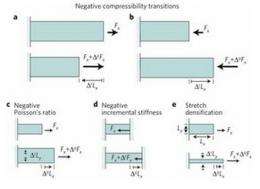
Now, two researchers Zachary Nicolaou and Adilson Motter, from Northwestern University have proposed another material that doesn’t behave the way we’ve come to expect. They are proposing a metamaterial that reacts contrary to the expected norm, to pressure. When pushed on, it expands, when pulled, it contracts. The two have written a paper describing how such a matermaterial could be made and have had it published in the journal Nature Materials.
While such a material might seem contrary to the laws of nature, the two explain how a metamaterial could be made that actually exploits such laws, rather than changes them. They suggest that if a material were constructed out of a row of four, as yet undetermined elements, where each was made of groups of molecules that are attracted to one another, then, if a force was applied to the inner particles that would be weak enough such that pulling on the metamaterial would cause those bonds to break, then the outer particles would become more strongly attracted to one another, causing compression. If on the other hand the material is squeezed, the inner particles would be brought closer together strengthening those bonds, causing the material to expand.
The two have not yet made an actual metamaterial that exhibits such behavior, but it’s not difficult to see how it could be put to practical use if real ones are constructed; in fact, it’s not a far cry from the properties of the shield Captain America uses to ward off violent attacks. Military vehicles with such a material could expand out when driving over an IED, for example, preventing injury to occupants or car cushions could be fashioned creating perhaps, the smoothest ride ever.
More information: Mechanical metamaterials with negative compressibility transitions, Nature Materials (2012) doi:10.1038/nmat3331
Abstract
When tensioned, ordinary materials expand along the direction of the applied force. Here, we explore network concepts to design metamaterials exhibiting negative compressibility transitions, during which a material undergoes contraction when tensioned (or expansion when pressured). Continuous contraction of a material in the same direction of an applied tension, and in response to this tension, is inherently unstable. The conceptually similar effect we demonstrate can be achieved, however, through destabilizations of (meta)stable equilibria of the constituents. These destabilizations give rise to a stress-induced solid–solid phase transition associated with a twisted hysteresis curve for the stress–strain relationship. The strain-driven counterpart of negative compressibility transitions is a force amplification phenomenon, where an increase in deformation induces a discontinuous increase in response force. We suggest that the proposed materials could be useful for the design of actuators, force amplifiers, micromechanical controls, and protective devices.
Journal information: Nature Materials
© 2012 Phys.Org


