NASA's NuSTAR gearing up for launch
May 23, 2012 By Whitney Clavin
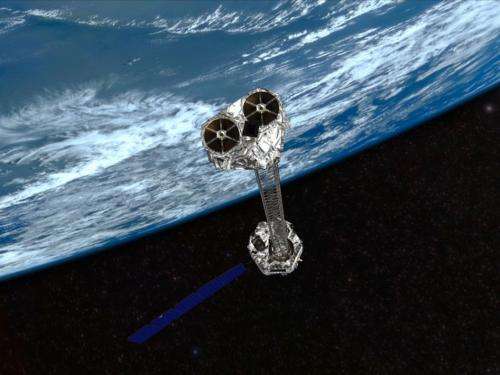
Artist's concept showing NASA's NuSTAR mission orbiting Earth. NuSTAR will hunt for hidden black holes and other exotic cosmic objects. Credit: NASA/JPL-Caltech

(Phys.org) -- Final pre-launch preparations are underway for NASA's Nuclear Spectroscopic Telescope Array, or NuSTAR. The mission, which will use X-ray vision to hunt for hidden black holes, is scheduled to launch no earlier than June 13 from Kwajalein Atoll in the Marshall Islands. The observatory will launch from the belly of Orbital Sciences Corporation's L-1011 "Stargazer" aircraft aboard the company's Pegasus rocket.

Technicians at Vandenberg Air Force Base in central California are busy installing the rocket's fairing, or nose cone, around the observatory. A flight computer software evaluation is also nearing completion and should be finished before the Review, which is scheduled for June 1. A successful launch simulation of the Orbital Sciences' Pegasus XL rocket was conducted last week.

The mission plan is for NuSTAR and its rocket to be attached to the Stargazer plane on June 2. The aircraft will depart California on June 5 and arrive at the Kwajalein launch site on June 6. The of NuSTAR from the plane is targeted for 8:30 a.m. PDT (11:30 a.m. EDT) on June 13.

NuSTAR is a Small Explorer mission led by the California Institute of Technology in Pasadena and managed by NASA's Jet Propulsion Laboratory, also in Pasadena, for NASA's Science Mission Directorate in Washington.

Explore further: Mice, gerbils perish in Russia space flight

add to favorites email to friend print save as pdf

Related Stories

Engineers tuck nuSTAR in its nose cone

Mar 05, 2012

(PhysOrg.com) -- Technicians at Vandenberg Air Force Base in central California are placing the two halves of the rocket nose cone, or fairing, around NASA's Nuclear Spectroscopic Telescope Array (NuSTAR), ...

NuSTAR mated to its rocket

Feb 20, 2012

(PhysOrg.com) -- NASA's Nuclear Spectroscopic Telescope Array (NuSTAR) is being mated, or attached, to its Pegasus XL rocket today at Vandenberg Air Force Base in central California.

Launch of NASA's nuSTAR mission postponed

Mar 19, 2012

(PhysOrg.com) -- The planned launch of NASA's Nuclear Spectroscopic Telescope Array (NuSTAR) mission has been postponed after a March 15 launch status meeting. The launch will be rescheduled to allow additional ...

NuSTAR spacecraft arrives in California

Jan 30, 2012

(PhysOrg.com) -- NASA's Nuclear Spectroscopic Telescope Array, or NuSTAR, mission arrived at Vandenberg Air Force Base in California Friday morning after a cross-country trip by truck from the Orbital Sciences Corporation ...

NASA's NuSTAR ships to Vandenberg for March 14 launch

Jan 25, 2012

(PhysOrg.com) -- NASA's Nuclear Spectroscopic Telescope Array, or NuSTAR, shipped to Vandenberg Air Force Base, Calif., on Tuesday, to be mated to its Pegasus launch vehicle. The observatory will detect X-rays ...

Recommended for you

Mice, gerbils perish in Russia space flight

13 hours ago

A number of mice and eight gerbils sent into space in a Russian capsule destined to find out how well organisms can withstand extended flights perished during their journey, scientists said Sunday as the ...

Mars rover Opportunity examines clay clues in rock

May 18, 2013

(Phys.org) —NASA's senior Mars rover, Opportunity, is driving to a new study area after a dramatic finish to 20 months on "Cape York" with examination of a rock intensely altered by water.

NASA's STEREO detects a CME from the sun

May 17, 2013

On 5:24 a.m. EDT on May 17, 2013, the sun erupted with an Earth-directed coronal mass ejection or CME, a solar phenomenon that can send billions of tons of solar particles into space that can reach Earth ...

Nine-year-old Mars rover passes 40-year-old record

May 17, 2013

While Apollo 17 astronauts Eugene Cernan and Harrison Schmitt visited Earth's moon for three days in December 1972, they drove their mission's Lunar Roving Vehicle 19.3 nautical miles (22.210 statute miles ...

Bright explosion on the Moon

May 17, 2013

For the past 8 years, NASA astronomers have been monitoring the Moon for signs of explosions caused by meteoroids hitting the lunar surface. "Lunar meteor showers" have turned out to be more common than anyone ...

User comments : 0

More news stories

Heat-related deaths in Manhattan projected to rise

Residents of Manhattan will not just sweat harder from rising temperatures in the future, says a new study; many may die. Researchers say deaths linked to warming climate may rise some 20 percent by the 2020s, ...

Mice, gerbils perish in Russia space flight

A number of mice and eight gerbils sent into space in a Russian capsule destined to find out how well organisms can withstand extended flights perished during their journey, scientists said Sunday as the ...

Kinks and curves at the nanoscale

One of the basic principles of nanotechnology is that when you make things extremely small—one nanometer is about five atoms wide, 100,000 times smaller than the diameter of a human hair—they are going ...

Honeybees trained in Croatia to find land mines

(AP)—Mirjana Filipovic is still haunted by the land mine blast that killed her boyfriend and blew off her left leg while on a fishing trip nearly a decade ago. It happened in a field that was supposedly ...