A deeper look at Centaurus A
May 16, 2012
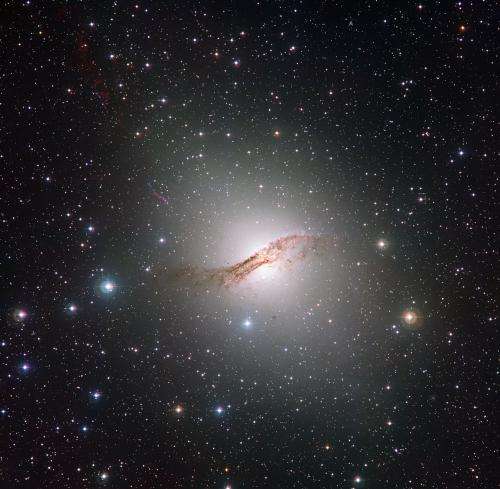
The peculiar galaxy Centaurus A (NGC 5128) is pictured in this image taken with by the Wide Field Imager attached to the MPG/ESO 2.2-meter telescope at the La Silla Observatory in Chile. With a total exposure time of more than 50 hours this is probably the deepest view of this peculiar and spectacular object every created. Credit: ESO

(Phys.org) -- The strange galaxy Centaurus A is pictured in a new image from the European Southern Observatory. With a total exposure time of more than 50 hours this is probably the deepest view of this peculiar and spectacular object ever created. The image was produced by the Wide Field Imager of the MPG/ESO 2.2-metre telescope at ESO’s La Silla Observatory in Chile.

Centaurus A, also known as NGC 5128, is a peculiar massive elliptical galaxy with a supermassive black hole at its heart. It lies about 12 million light-years away in the southern constellation of Centaurus (The Centaur) and has the distinction of being the most prominent radio galaxy in the sky. Astronomers think that the bright nucleus, strong radio emission and jet features of Centaurus A are produced by a central black hole with a mass of about 100 million times that of the Sun. Matter from the dense central parts of the galaxy releases vast amounts of energy as it falls towards the black hole.

This (WFI) picture allows us to appreciate the galaxy's elliptical nature, which shows up as the elongated shape of the fainter outer parts. The glow that fills much of the picture comes from hundreds of billions of cooler and older stars. Unlike most elliptical galaxies, however, Centaurus A's smooth shape is disturbed by a broad and patchy band of dark material that obscures the galaxy's centre.

The dark band harbours large amounts of gas, dust and young stars. Bright young star clusters appear at the upper-right and lower-left edges of the band along with the red glow of star-forming clouds of hydrogen, whilst some isolated dust clouds are silhouetted against the stellar background. These features, and the prominent radio emission, are strong evidence that Centaurus A is the result of a merger between two galaxies. The dusty band is probably the mangled remains of a spiral galaxy in the process of being ripped apart by the gravitational pull of the giant elliptical galaxy.

The new set of images from WFI include long exposures through red, green and blue filters as well as filters specially designed to isolate the light from glowing hydrogen and oxygen. The latter help us to spot the known optical jet features around Centaurus A, which were barely visible in a previous image from the Wide Field Imager.

Extending from the galaxy to the upper left corner of the image are two groups of reddish filaments, which are roughly lined up with the huge jets that are prominent in radio images. Both sets of filaments are stellar nurseries, containing hot young stars [2]. Above the left side of the dusty band, we find the inner filaments, lying about 30 000 light-years away of the nucleus. Further out, around 65 000 light-years away from the galaxy's nucleus and close to the upper left corner of the image, the outer filaments are visible. There is also possibly a very much fainter trace of a counter jet extending to the lower right.

Centaurus A has been extensively studied at wavelengths ranging from radio all the way to gamma-rays. In particular, radio and X-ray observations have been crucial for studying the interaction between the energetic output of the central supermassive black hole and its surroundings, see eso0903. Studies of Centaurus A with ALMA are just beginning.

Many of the observations of Centaurus A used to make this image were taken to see whether it was possible to use ground-based surveys to detect and study variable stars in galaxies like Centaurus A outside the local group [3]. More than 200 new variable stars in Centaurus A were discovered.

Explore further: Hubble reveals the ring nebula's true shape

Related Stories

Image: Active Galaxy Centaurus A

Jan 04, 2012

(PhysOrg.com) -- Resembling looming rain clouds on a stormy day, dark lanes of dust crisscross the giant elliptical galaxy Centaurus A.

Black hole outflows from Centaurus A detected with APEX

Jan 28, 2009

(PhysOrg.com) -- Astronomers have a new insight into the active galaxy Centaurus A (NGC 5128), as the jets and lobes emanating from the central black hole have been imaged at submillimetre wavelengths for ...

Spectacular Hubble View of Centaurus A

Jun 16, 2011

(PhysOrg.com) -- The NASA/ESA Hubble Space Telescope has produced a close-up view of the galaxy Centaurus A. Hubble’s out-of-this-world location and world-class Wide Field Camera 3 instrument reveal a ...

A cannibalistic galaxy with a powerful heart

Apr 04, 2012

Observations by the two of the European Space Agency's space observatories have provided a multi-wavelength view of the mysterious galaxy Centaurus A. The new images, from the Herschel Space Observatory and ...

Watching a Cannibal Galaxy Dine

Nov 20, 2009

(PhysOrg.com) -- A new technique using near-infrared images, obtained with ESO’s 3.58-metre New Technology Telescope (NTT), allows astronomers to see through the opaque dust lanes of the giant cannibal galaxy ...

Recommended for you

Hubble reveals the ring nebula's true shape

3 hours ago

(Phys.org) —The Ring Nebula's distinctive shape makes it a popular illustration for astronomy books. But new observations by NASA's Hubble Space Telescope of the glowing gas shroud around an old, dying, ...

A hidden population of exotic neutron stars

8 hours ago

(Phys.org) —Magnetars – the dense remains of dead stars that erupt sporadically with bursts of high-energy radiation - are some of the most extreme objects known in the Universe. A major campaign using ...

Very Large Telescope celebrates 15 years of success

13 hours ago

(Phys.org) —With this new view of a spectacular stellar nursery ESO is celebrating 15 years of the Very Large Telescope—the world's most advanced optical instrument. This picture reveals thick clumps ...

Fragile mega-galaxy is missing link in history of cosmos

May 22, 2013

Two hungry young galaxies that collided 11 billion years ago are rapidly forming a massive galaxy about 10 times the size of the Milky Way, according to UC Irvine-led research published Wednesday in the journal ...

User comments : 0

More news stories

Hubble reveals the ring nebula's true shape

(Phys.org) —The Ring Nebula's distinctive shape makes it a popular illustration for astronomy books. But new observations by NASA's Hubble Space Telescope of the glowing gas shroud around an old, dying, ...

NASA head views progress on asteroid lasso mission

Surrounded by engineers, NASA chief Charles Bolden inspected a prototype spacecraft engine that could power an audacious mission to lasso an asteroid and tow it closer to Earth for astronauts to explore.

A hidden population of exotic neutron stars

(Phys.org) —Magnetars – the dense remains of dead stars that erupt sporadically with bursts of high-energy radiation - are some of the most extreme objects known in the Universe. A major campaign using ...

Controlling mood through the motions of mitochondria

(Medical Xpress)—Regulating the distribution of power in neurons is done by a system that makes the national electric grid look simple by comparison. Each neuron has several thousand mitochondria confined ...

Google Drive sports new view and scan enhancements

(Phys.org) —Google Drive has a new look and functions. The makeover in Google Drive features scanning and interface enhancements that put the user into "card" mode. The enhancements make it easy for the ...