Several antennas in one: A major innovation for mobile communications
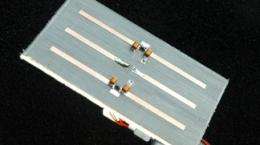
(Phys.org) -- Scientists at EPFL have developed a single antenna that is capable of transmitting the same data as a two-antenna system. This achievement will be more than useful for future communication systems.
How can the challenges presented by the ever-growing number of wireless mobile devices and the demand for increasingly high data be met without increasing energy consumption and emission power? Currently MIMO (multiple-input, multiple outputs) uses several antennas to transmit and receive signals. This technique is progressively being implemented in devices such as wireless modems and is to be used for the next generation of mobile phones. However, it poses problems because it is costly and difficult to integrate into hardware.
At EPFL, Julien Perruisseau-Carrier’s group has demonstrated that a single antenna can simultaneously transmit two separate signals that have the same throughput as a MIMO solution. The results were published at the beginning of the year, and part of the new findings will be presented by Julien Perruisseau-Carrier, at the IEEE International Symposium on Antennas and Propagation in Chicago, at the beginning of July.
The problems of a multi-antenna system
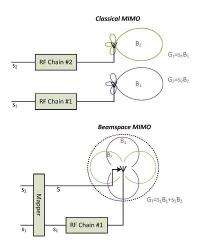
In a MIMO system, antennas generally have to be placed at a certain distance from each other, which makes inserting them into mobile and miniature devices a complicated process. An even greater problem with this technique is that each separate transmitting antenna must have its own encoding and amplifying signal device, which is costly and energy-consuming.
One antenna, two signals
As part of collaboration with researchers from Athens Information Technology (AIT), Julien Perruisseau-Carrier’s team developed an antenna capable of emitting simultaneously two information flows, transmitting two independent signals with the same throughput, just as two antennas would do in a MIMO system. This technique called "Beamspace MIMO" allows to significantly reduce the number of physical antennas.
Contrary to what one might think, an antenna does not emit signals in a homogeneous and circular manner. Instead, the repartition of the antenna's radiation is called "radiation pattern." Scientists have managed to decompose this pattern in two, allowing simultaneous emission of two distinct information flows.
Another advantage of this technique is that only one coding and amplifying device is required to treat the first information flow. The second signal is treated only upstream and then used to make the radiation pattern decomposable. The latter signal acts therefore both as an information carrier and as a mean to decompose the principal pattern. "This technique allows us to get rid of part of the usual hardware," says Julien Perruisseau-Carrier. The process is however difficult and complex. "One of the biggest challenges is to ensure that each pattern is really independent, to allow an efficient treatment of the information.”
Success thanks to a global approach
The results were obtained through a cross-disciplinary approach. "This work required us to look at both antennas, particularly reconfigurable ones, and radio coding. Although they are closely linked, these two disciplines are unfortunately often considered separately, which hinders this kind of innovative work," explains the scientist.
Julien Perruisseau-Carrier and his doctoral student Moshen Yousefbeiki are now focusing on a new antenna prototype that will be much more compact and adapted to small mobile devices, such as cell phones and miniature antennas that can be implanted for medical purposes.
More information: O. N. Alrabadi, et al, "MIMO Transmission using a Single RF Source: Theory and Antenna Design," IEEE Trans. Microw. Theory Tech. and IEEE Trans. Antennas Propag. Joint Special Issue on MIMO Technology, vol. 60, pp. 654-664, 2012.
Provided by Ecole Polytechnique Federale de Lausanne


