Signs of ancient flowing water on Mars
May 07, 2012
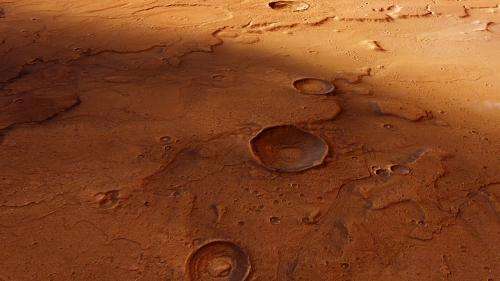
The transition between Acidalia Planitia and Tempe Terra is shown here in a computer-generated perspective view. The image was created using data obtained from the High-Resolution Stereo Camera (HRSC) on ESA’s Mars Express spacecraft. Centred at around 37°N and 306°E, this image has a ground resolution of about 15 m per pixel. The foreground craters are believed to come from a younger phase in Mars history, evidenced by a lack of erosion and infilling seen in the background craters, which are believed to have once held liquid water. Credits: ESA/DLR/FU Berlin (G. Neukum)

(Phys.org) -- ESA’s Mars Express has returned images of a region on the Red Planet that appears to have been sculpted in part by flowing liquid. This again adds to the growing evidence that Mars had large volumes of water on its surface in the distant past.

On 21 June last year, pointed its high-resolution stereo camera at the western part of Acidalia Planitia, a gigantic basin in the planet’s northern lowlands, at the interface with Tempe Terra, an older, higher terrain.

Acidalia Planitia is a region so vast that it can be seen from Earth by amateur astronomers.

The famous observer Giovanni Schiaparelli named this large dark feature on his map of Mars after the mythical Acidalian (or Venusian) fountain in Boeotia, where the three graces of ancient Greek myth bathed.  

The images taken cover part of the western edge of the region, where some of the numerous valleys descending from Tempe Terra show subtle evidence for ‘dendritic’ drainage patterns emanating from them.
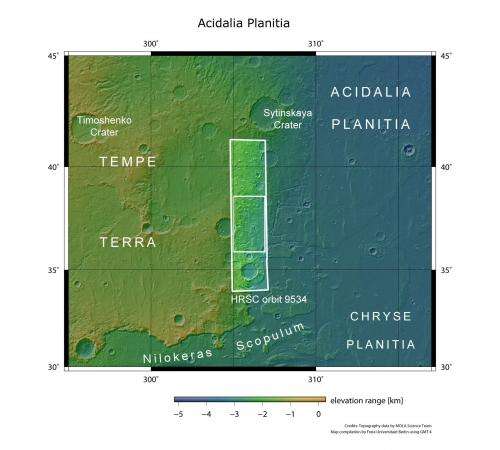
Acidalia Planitia in a broader context. Here we see Acidalia Planitia in a wider context, and the interface between it and Tempe Terra. The smaller rectangle shows the region covered in this Mars Express HRSC image release. Credits: NASA MGS MOLA Science Team

The word dendritic comes from the Greek for tree and the channels in the images are believed to have been formed by the surface run-off of flowing water from rain or melting snow during some distant martian epoch.

The presence of deep valleys, with very few tributaries in the form of smaller valleys further downstream, shows that the region itself probably formed by a process called ‘sapping’ or ‘undermining’, which occurs when erosion along the base of a cliff wears away softer layers of material.

Sapping removes support for the upper harder rock which breaks off into large blocks, and falls from the cliff face.

This way, deep valleys can erode progressively upwards, as can be seen in the Colorado Plateau on Earth.

The lower-left part of the image appears to be in shadow, but this darkening is in fact is due to differences in surface material: the left-hand side is covered with dark sand, probably of volcanic origin, while the right side is covered with brighter dust.

The images also show faults in the martian crust, extending towards the Idaeus Fossae region. They are believed to have played a vital role in releasing water by exposing subsurface reservoirs, possibly forming lakes in nearby craters.

Apparent sediments covering the floors of some of the older, more eroded craters are of particular interest for scientists, as they again point to the existence of surface water at some stage.

In some cases, valleys start at the rim of the craters, suggesting that water was released from them into the surrounding terrain.

Some newer craters are seen in the central areas of the image. Their relatively young age is demonstrated by the lack of erosion and the fact that they lie on top of older features.

These Express images give scientists yet more evidence of a watery past for the Red Planet, and will help them to decode how the ebbed, flowed and eroded the surface at different times.

Explore further: NASA's STEREO detects a CME from the sun

Related Stories

Mountains and buried ice on Mars

Dec 05, 2011

(PhysOrg.com) -- New images from Mars Express show the Phlegra Montes mountain range, in a region where radar probing indicates large volumes of water ice are hiding below. This could be a source of water ...

Mars Express reveals wind-blown deposits on Mars

Feb 06, 2012

(PhysOrg.com) -- New images from ESA’s Mars Express show the Syrtis Major region on Mars. Once thought to be a sea of water, the region is now known to be a volcanic province dating back billions of years.

Schiaparelli on Mars shaped by wind, water

Dec 10, 2010

The small crater embedded in the northwestern rim of the Schiaparelli impact basin features prominently in this new image from ESA’s Mars Express. All around is evidence for past water and the great martian ...

Just how low can Mars go?

Oct 08, 2010

There are few places on Mars lower than this. On the left of this image, the floor of Melas Chasma sinks nine kilometres below the surrounding plains. New images from ESA’s Mars Express highlight the ...

Recommended for you

Mars rover Opportunity examines clay clues in rock

1 hour ago

(Phys.org) —NASA's senior Mars rover, Opportunity, is driving to a new study area after a dramatic finish to 20 months on "Cape York" with examination of a rock intensely altered by water.

NASA's STEREO detects a CME from the sun

14 hours ago

On 5:24 a.m. EDT on May 17, 2013, the sun erupted with an Earth-directed coronal mass ejection or CME, a solar phenomenon that can send billions of tons of solar particles into space that can reach Earth ...

Nine-year-old Mars rover passes 40-year-old record

22 hours ago

While Apollo 17 astronauts Eugene Cernan and Harrison Schmitt visited Earth's moon for three days in December 1972, they drove their mission's Lunar Roving Vehicle 19.3 nautical miles (22.210 statute miles ...

Bright explosion on the Moon

23 hours ago

For the past 8 years, NASA astronomers have been monitoring the Moon for signs of explosions caused by meteoroids hitting the lunar surface. "Lunar meteor showers" have turned out to be more common than anyone ...

User comments : 0

More news stories

Alaska volcano shoots ash 15,000 feet into the air

(AP)—One of Alaska's most restless volcanoes has shot an ash cloud 15,000 feet into the air in an ongoing eruption that has drawn attention from a nearby community but isn't expected to threaten air traffic.

Chinese, Indian airlines face EU pollution fines

Eight Chinese and two Indian airlines face fines of up to several million euros for not paying for their greenhouse gas emissions during flights within the bloc, the European Commission said on Friday.

Bright explosion on the Moon

For the past 8 years, NASA astronomers have been monitoring the Moon for signs of explosions caused by meteoroids hitting the lunar surface. "Lunar meteor showers" have turned out to be more common than anyone ...

US seizes Bitcoin operator accounts

US authorities seized the accounts of a Bitcoin digital currency exchange operator, claiming it was functioning as an "unlicensed money service business," court documents showed Friday.