Wageningen UR investigates plant disease suppression by Lysobacter
Apr 20, 2012 By Joeke Postma

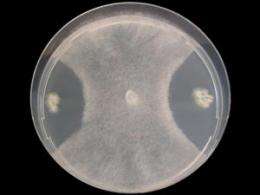
Lysobacter bacteria were frequently found in disease-suppressive soils. Wageningen UR has started a project to study the diversity of Lysobacter populations and the mode of action of this bacterium to suppress plant diseases.  The acquired knowledge will enable the development of alternative methods for the protection of plants against pathogens.

Scientists of Wageningen University and Plant Research International (PRI) are collaborating to acquire more fundamental knowledge about Lysobacter because little is known about the genetics and neither about the metabolites produced by Lysobacter.

The Phytopathology Group, part of Wageningen University, studies the genome sequences of various Lysobacter species and their significance for the functioning of the . The Group is cooperating with Rutgers University from the United States and with the business unit Biointeractions and Plant Health of PRI. This business unit investigates the conditions under which Lysobacter is active.

Earlier PRI studies showed the suppressiveness of Lysobacter towards the fungal pathogen Rhizoctonia solani as well as stimulation of the activity of Lysobacter by chitin and cheap protein-rich waste products. Until now, however, the mechanisms of  this suppressiveness and the role of Lysobacter in these processes were unclear. Fundamental research will lead to more knowledge about the metabolites produced by Lysobacter and the condition under which this bacterium is active.

Explore further: New discovery of ancient diet shatters conventional ideas of how agriculture emerged

Provided by Wageningen University

5 /5 (1 vote)
add to favorites email to friend print save as pdf

Related Stories

Soil bacteria plant bodyguards against fungal infections

May 12, 2011

With up to 33,000 ‘taxa’, plant roots are home to an unprecedentedly large diversity of bacteria. Some of these bacteria can function as a type of bodyguard for plants, protecting them against infection ...

Medicinal honey kills MRSA

Feb 25, 2011

Medicinal honey kills the bacteria that cause infections in wounds, such as the antibiotic-resistant MRSA. This has been ascertained by tests by Amsterdam and Wageningen researchers.

Smaller genome, greater applications

Mar 26, 2012

Bacteria are often the ideal machines in industry. The inputs they require are cheap substances such as amino acids and sugar, and their outputs are valuable products such as bioplastics.

Recommended for you

Turning up the heat on biofuels

May 16, 2013

(Phys.org) —The production of biofuels from lignocellulosic biomass would benefit on several levels if carried out at temperatures between 65 and 70 degrees Celsius. Researchers with the Energy Biosciences ...

Getting to the root of better crops

May 16, 2013

(Phys.org) —The more crop scientists know about how plant roots take up water and nutrients, the better able they will be to develop crop plants with roots that can cope with challenging soil and environmental ...

User comments : 0

More news stories

Front-row seats to climate change

By day, insects provide the white noise of the South, but the night belongs to the amphibians. In a typical year, the Southern air hangs heavy from the humidity and the sounds of wildlife.

New colonoscope provides ground-breaking view of colon

A ground-breaking advance in colonoscopy technology signals the future of colorectal care, according to research presented today at Digestive Disease Week(DDW). Additional research focuses on optimizing the minimal withdrawal ...

Yahoo Japan suspects 22 million IDs stolen

Yahoo Japan Corp. has said it suspects up to 22 million user IDs may have been stolen during an unauthorised attempt to access the administrative system of its Yahoo! Japan portal.

US seizes Bitcoin operator accounts

US authorities seized the accounts of a Bitcoin digital currency exchange operator, claiming it was functioning as an "unlicensed money service business," court documents showed Friday.