Finding a new Earth: Holy grail of astronomy
Apr 27, 2012
Finding a new Earth: Holy grail of astronomy
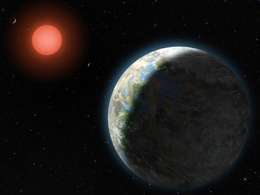
Artist's impression of an exoplanet. Credit: Lynette R. Cook.

(Phys.org) -- Determining the habitability of rocky, Earth-like planets in the universe will be crucial for us as a species, according to scientists from The Australian National University.

But the good news is that these planets are probably more abundant than stars, researchers from the ANU Planetary Science Institute have discovered. The institute is a joint venture of the Research School of and the Research School of .

“Determining whether these planets are habitable has become the new holy grail of astronomy,” said planetary scientist Dr. Charley Lineweaver, lead author of the study.

“The new-found abundance of planets, combined with the much larger range of inhabited terrestrial environments suggests that habitable are common. This increases the probability of finding some kind of extraterrestrial life,” he said.

Fellow researcher and PhD student Aditya Chopra said our best estimates of come from the planet we know best: .

“By comparing the inhabited and uninhabited regions of Earth, we can identify the most important factors that determine habitability. For terrestrial life, those factors are liquid water, a narrow range of temperature, and an energy source,” he said.

Dr. Lineweaver added: “Habitability is not just a question of abiotic environmental conditions – the presence of life may be required to maintain the habitability of a planet over billions of years. The study of the habitability of other Earths is the major focus of astrobiology – and increasingly planetary science and astronomy.

“Planetary habitability is a complex and confusing concept that we are only beginning to get our heads around, but as a species that wants to survive, it is in our interest to get our heads around it soon.”

Explore further: Unusual supernova is doubly unusual for being perfectly normal

More information: The research has been published in the paper, The Habitability of Our Earth and Other Earths: Astrophysical, Geochemical, Geophysical, and Biological Limits on Planet Habitability, online in the Annual Reviews of Earth and Planetary Sciences: www.annualreviews.org/doi/abs/10.1146/annurev-earth-042711-105531

add to favorites email to friend print save as pdf

Related Stories

Coming to a solar system near you… super-Earth!

Aug 08, 2011

It is our general understanding of solar system composition that planets fall into two categories: gas giants like Jupiter, Saturn, Neptune and Uranus… and rocky bodies that support some type of atmosphere ...

Islands of Life Across Space and Time

Oct 06, 2009

A new study by the University of Puerto Rico at Arecibo shows the first quantitative evaluation of planetary habitability. The study identifies some potential habitats in the solar system and also shows how ...

Goldilocks moons

Jan 16, 2012

The search for extraterrestrial life outside our Solar System is currently focused on extrasolar planets within the ‘habitable zones’ of exoplanetary systems around stars similar to the Sun. Finding ...

HARPS tunes in on habitable planet

Sep 05, 2011

Using the High Accuracy Radial velocity Planet Searcher (HARPS), a team of scientists at University of Geneva, Switzerland, led by the Swiss astronomer Stephane Udry made a sound discovery… an Earth-like ...

'Tidal Venuses' may have been wrung out to dry

Mar 29, 2012

Earth-sized exoplanets within a distant star’s habitable zone could still be very much uninhabitable, depending on potential tidal stresses — either past or present — that could have "squeezed ...

Recommended for you

Three centaurs follow Uranus through the solar system

Jun 18, 2013

Astrophysicists from the Complutense University of Madrid have confirmed that Crantor, a large asteroid with a diameter of 70 km has an orbit similar to that of Uranus and takes the same amount of time to ...

Final curtain for Europe's deep-space telescope

Jun 17, 2013

The deep-space telescope Herschel took its final bow on Monday, climaxing a successful four-year mission to observe the birth of stars and galaxies, the European Space Agency (ESA) said.

Hubble spots a very bright contortionist

Jun 17, 2013

(Phys.org) —The contorted object captured by Hubble in this picture is IRAS 22491-1808, also known as the South America Galaxy. It is an ultra-luminous infrared galaxy (ULIRG) that emits a huge amount of ...

Study explains decades of black hole observations

Jun 14, 2013

(Phys.org) —A new study by astronomers at NASA, Johns Hopkins University and Rochester Institute of Technology confirms long-held suspicions about how stellar-mass black holes produce their highest-energy ...

User comments : 0

More news stories

China astronauts float water blob in kids' lecture

Astronauts struck floating martial arts poses, twirled gyroscopes and manipulated wobbling globes of water during a lecture Thursday from China's orbiting space station that's part of efforts to popularize ...

Metamorphosis of moon's water ice explained

Using data gathered by NASA's Lunar Reconnaissance Orbiter (LRO) mission, scientists believe they have solved a mystery from one of the solar system's coldest regions—a permanently shadowed crater on the ...

Danish chemists in molecular chip breakthrough

Electronic components built from single molecules using chemical synthesis could pave the way for smaller, faster and more green and sustainable electronic devices. Now for the first time, a transistor made ...

LA to give every student an iPad; $30M order

Los Angeles' school system, the second largest in the United States, is ordering iPads for all its students, handing Apple a major success in its quest to make the tablet computer a replacement for textbooks.