Carbon-consuming life-forms in Antarctica
Apr 23, 2012
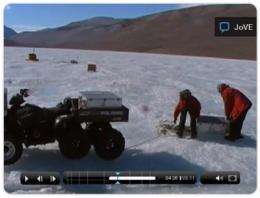
This image shows scientists loading research materials in Antarctica. Credit: The Journal of Visualized Experiments

Lake Bonney in Antarctica is perennially covered in ice. It is exposed to severe environmental stresses, including minimal nutrients, low temperatures, extreme shade, and, during the winter, 24-hour darkness. But, for the single-celled organisms that live there, the lake is home. To study them, Dr. Rachel Morgan-Kiss from the University of Miami, Ohio, and her team went to Antarctica to sample the ice-covered lake. The article describing her method will be published April 20, in the JoVE (the Journal of Visualized Experiments).

"Our laboratory has a focus on understanding adaptations in ," said Dr. Morgan-Kiss. "Ice-covered lakes are much simpler to study than typical because all of the organisms in the lake are microbial. They are at both the top and the bottom of the food chain."

Despite being microscopic, these organisms may play a big role in . Many of them have a mixotrophic metabolism, meaning that they survive either by fixing carbon, like plants, or by eating other protists (single-celled microbial eukaryotes). However, it's not known what causes these organisms to display one type of metabolism over another.

Moreover, it is not known how the this metabolic switch. If climate change causes more episodic (like storms), nutrients will be stirred up from the bottom of lakes and oceans. This could have a huge impact on protist metabolism and climate change overall.

To help answer this question, Dr. Morgan-Kiss and her team took samples from different parts of the lake— the top, middle, and bottom— where the nutrient to sunlight ratios in the lake vary. The top gets plenty of sunlight, but there are few nutrients; the middle of the lake has moderate amounts of both; and the bottom gets little sunlight but is nutrient-rich.

"This interesting video-article produced by the JoVE Video team helps show exactly how scientists navigate in this challenging environment" says Dr. Beth Hovey, JoVE Editorial Director. "Research in Antarctica can add a great deal of insight in the realm of climate change. By opening a window into how to conduct science in extreme environments, Dr. Morgan-Kiss and her colleagues are helping advance this field of study."

Explore further: Minus environment, patterns still emerge: Computational study tracks E. coli cells' regulatory mechanisms

add to favorites email to friend print save as pdf

Related Stories

Lake Erie algae, ice, make a nice mix in winter

Jan 11, 2012

Clarkson University Biology Professor Michael R. Twiss has been working with colleagues and students from Ohio, Pennsylvania, Tennessee and Ontario, to study Lake Erie over the past five winters during mid-winter, ...

Lake Vostok life to be studied

Jan 15, 2007

U.S. researchers say they will analyze microorganisms from a vast Antarctic lake to determine how life adapts to extremely harsh environments.

Climate change threatens Lake Baikal's unique biota

May 01, 2009

Siberia's Lake Baikal, the world's largest and most biologically diverse lake, faces the prospect of severe ecological disruption as a result of climate change, according to an analysis by a joint US-Russian team in the May ...

Recommended for you

Wound healing: 'See-saw' switch sends cells on the march

27 minutes ago

Many genes are transcribed into messenger RNA (mRNA) molecules that provide instructions for protein synthesis. Other genes encode regulatory RNAs known as 'microRNAs', which can block protein translation ...

Single-cell sequencing

44 minutes ago

When studying any kind of population—people or cells—averaging is a useful, if flawed, form of measurement. According to the US Census Bureau, the average American household size in 2010 was 2.59. Of ...

User comments : 0

More news stories

Coral reefs 'ruled by earthquakes and volcanoes'

(Phys.org) —Titanic forces in the Earth's crust explain why the abundance and richness of corals varies dramatically across the vast expanse of the Indian and Pacific Oceans, a world-first study from the ...

Coccoliths thrive despite ocean acidification

Ocean acidification is damaging some marine species while others thrive, say scientists. An international team studied the effect of ocean acidification on plankton in the North Sea over the past forty years, ...

Single-cell sequencing

When studying any kind of population—people or cells—averaging is a useful, if flawed, form of measurement. According to the US Census Bureau, the average American household size in 2010 was 2.59. Of ...

Italy approves law on controversial stem cell therapy

Italian lawmakers on Wednesday gave their final approval to a law that allows limited use of a controversial type of stem cell therapy which has been condemned by many scientists but has given hope to families of terminally-ill ...