The stellar superhighway in the Milky Way
Mar 21, 2012
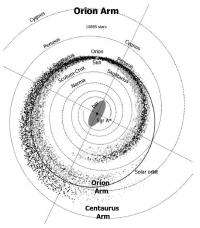
Two-armed spiral with a pitch angle of 5.56°, showing the solar orbit (eccentricity 0.159). Orion stream stars are shown at a random position on the inward part of the orbit. Stars in with quality index 1 for stream membership are shown in black, stars with quality indices 2 - 4 are have paler grey for a higher index. Image from MNRAS paper.

Conventional wisdom suggests that, like planets round the Sun, stars follow approximately circular orbits which cross the spiral arms, and that the Sun presently lies in a spur rather than a major spiral arm.

A new study published in (MNRAS) shows that contrary to this belief, nearly half of , including the Sun, have orbits aligned with the Orion arm, one of two major spiral arms.

Of the remainder, one third have orbits aligned with the Centaurus arm, and are currently crossing the Orion arm on their way outwards to rejoining the Centaurus arm later in their orbit. Another third have more eccentric orbits straddling both arms.

According to this research spiral arms are highways for the stars. Stars join the arms in the furthest part of their orbit from the Galactic centre, attracted by the gravity of the arm. They then follow the arm inwards, picking up speed as they go, analogous to marbles in a marble run. Eventually they pick up so much speed that they break free of the gravity of the arm, cross outwards over the other arm and rejoin their original arm to repeat a similar orbit.

The research demonstrates that the Milky Way is a more tightly wound, more extensive, and more regular, two armed spiral than has been thought. The researchers have traced the spiral pattern in the distribution of stars found by the Two Micron All-Sky Survey (2MASS), finding that it extends inwards to about 2.1 kpc from the - the length of the short bar, or "bulge", originally observed by satellite (COBE) in the 1990's. This is about half the length of the so called "long bar", seen now as an artefact due to increased star formation in the near the ends of the short bar.

Explore further: Dusty surprise around giant black hole

More information: The paper is available at onlinelibrary.wiley.com/doi/10.1111/j.1365-2966.2012.20693.x/abstract

add to favorites email to friend print save as pdf

Related Stories

New theory of evolution for spiral galaxy arms

Apr 21, 2011

(PhysOrg.com) -- A study of spiral patterns found in galaxies like our Milky Way could overturn the theory of how the spiral arm features form and evolve. The results are being presented by postgraduate student, ...

A new, distant arm of the Milky Way galaxy

Jun 13, 2011

(PhysOrg.com) -- Our Milky Way galaxy, like other spiral galaxies, has a disk with sweeping arms of stars, gas, and dust that curve around the galaxy like the arms of a huge pinwheel.

Astrophysicists map the Milky Way's 4 spiral arms

Jan 05, 2009

Iowa State University's Martin Pohl is part of a research team that has developed the first complete map of the Milky Way galaxy's spiral arms. The map shows the inner part of the Milky Way has two prominent, symmetric spiral ...

Milky Way stars move in mysterious ways

Nov 30, 2010

Rather than moving in circles around the center of the Milky Way, all the stars in our Galaxy are travelling along different paths, moving away from the Galactic center. This has just been evidenced by Arnaud ...

New arm discovered in outer edge of the Milky Way Galaxy

May 23, 2011

(PhysOrg.com) -- In a surprising twist, if you will, Thomas Dame and Patrick Thaddeus, both of the Harvard-Smithsonian Center for Astrophysics, have put forth in a paper to be published in an upcoming issue ...

Spiral arms hint at the presence of planets

Oct 19, 2011

A new image of the disk of gas and dust around a sun-like star has spiral-arm-like structures. These features may provide clues to the presence of embedded but as-yet-unseen planets.

Recommended for you

Dusty surprise around giant black hole

23 minutes ago

(Phys.org) —ESO's Very Large Telescope Interferometer has gathered the most detailed observations ever of the dust around the huge black hole at the centre of an active galaxy. Rather than finding all of ...

Three centaurs follow Uranus through the solar system

Jun 18, 2013

Astrophysicists from the Complutense University of Madrid have confirmed that Crantor, a large asteroid with a diameter of 70 km has an orbit similar to that of Uranus and takes the same amount of time to ...

Final curtain for Europe's deep-space telescope

Jun 17, 2013

The deep-space telescope Herschel took its final bow on Monday, climaxing a successful four-year mission to observe the birth of stars and galaxies, the European Space Agency (ESA) said.

Hubble spots a very bright contortionist

Jun 17, 2013

(Phys.org) —The contorted object captured by Hubble in this picture is IRAS 22491-1808, also known as the South America Galaxy. It is an ultra-luminous infrared galaxy (ULIRG) that emits a huge amount of ...

User comments : 1

Adjust slider to filter visible comments by rank

Display comments: newest first

borc
4.7 / 5 (3) Mar 22, 2012
I would love to see a supercomputer model the movement of the stars. I think it would be beautiful to watch them dance. ;)

More news stories

Dusty surprise around giant black hole

(Phys.org) —ESO's Very Large Telescope Interferometer has gathered the most detailed observations ever of the dust around the huge black hole at the centre of an active galaxy. Rather than finding all of ...

China astronauts float water blob in kids' lecture

Astronauts struck floating martial arts poses, twirled gyroscopes and manipulated wobbling globes of water during a lecture Thursday from China's orbiting space station that's part of efforts to popularize ...

Singapore haze at worst yet, Malaysia schools shut

Singapore urged people to remain indoors amid unprecedented levels of air pollution Thursday as a smoky haze wrought by forest fires in neighboring Indonesia worsened dramatically. Nearby Malaysia closed ...

Philippines financial capital bans plastic bags

The Philippines financial capital banned disposable plastic shopping bags and styrofoam food containers on Thursday, as part of escalating efforts across the nation's capital to curb rubbish that exacerbates ...

How do bees make honey? It's not just bee barf

(Phys.org) —Last weekend, my daughter asked me how bees made honey, and I realized that I didn't know the answer. How do bees make honey? I did some homework, and can now explain it to her – and to you.