Space image: Compact planetary system
Mar 15, 2012
Credit: NASA/JPL-Caltech

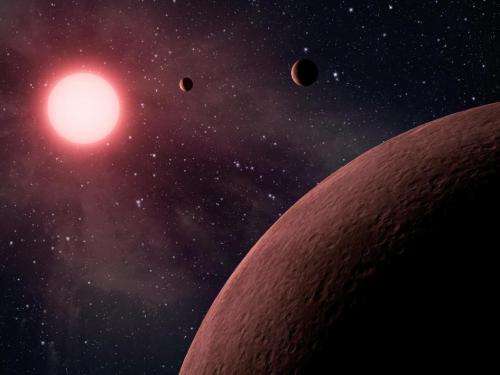
(PhysOrg.com) -- This artist's concept depicts a planetary system so compact that it's more like Jupiter and its moons than a star and its planets. Astronomers using data from NASA's Kepler mission and ground-based telescopes recently confirmed that the system, called KOI-961, hosts the three smallest exoplanets currently known to orbit a star other than our sun. An exoplanet is a planet that resides outside of our solar system.

The star, which is located about 130 light-years away in the Cygnus constellation, is a that is one-sixth the size of the sun, or just 70 percent bigger than Jupiter. The star is also cooler than our sun, and gives off more red light than yellow.

The smallest of the three planets, called KOI-961.03, is actually located the farthest from the star, and is pictured in the foreground. This planet is about the size of Mars, with a radius of 0.57 times that of Earth. The next planet to the upper right is KOI-961.01, which is 0.78 times the radius of Earth. The planet closest to the star is KOI-961.02, with a radius 0.73 times the Earth's.

All three planets whip around the star in less than two days, with the closest planet taking less than half a day. Their close proximity to the star also means they are scorching hot, with temperatures ranging from 350 to 836 degrees Fahrenheit (176 to 447 degrees Celsius). The star's , or the region where liquid water could exist, is located far beyond the planets.

The ground-based observations contributing to these discoveries were made with the Palomar Observatory, near San Diego, Calif., and the W.M. atop Mauna Kea in Hawaii.

Explore further: NASA's STEREO detects a CME from the sun

add to favorites email to friend print save as pdf

Related Stories

Two more kepler planets confirmed

Aug 08, 2011

Hot on the heels of confirming one Kepler planet, the Hobby-Eberly Telescope announces the confirmation of another planet. Another observatory, the Nordic Optical Telescope, confirms its first Kepler planet ...

Scientists discover 10 new planets

Jul 19, 2011

A total of 10 new planets have been unearthed by an international team of scientists, and one of these is orbiting a star just a few tens of millions years old.

Discovery of an extrasolar earth-sized planet

Oct 08, 2010

(PhysOrg.com) -- There are now over 490 confirmed extrasolar planets. The vast majority are gas giants like Jupiter, but they are much stranger because many orbit close to their stars and so are much hotter ...

Recommended for you

NASA's STEREO detects a CME from the sun

10 hours ago

On 5:24 a.m. EDT on May 17, 2013, the sun erupted with an Earth-directed coronal mass ejection or CME, a solar phenomenon that can send billions of tons of solar particles into space that can reach Earth ...

Nine-year-old Mars rover passes 40-year-old record

19 hours ago

While Apollo 17 astronauts Eugene Cernan and Harrison Schmitt visited Earth's moon for three days in December 1972, they drove their mission's Lunar Roving Vehicle 19.3 nautical miles (22.210 statute miles ...

Bright explosion on the Moon

19 hours ago

For the past 8 years, NASA astronomers have been monitoring the Moon for signs of explosions caused by meteoroids hitting the lunar surface. "Lunar meteor showers" have turned out to be more common than anyone ...

User comments : 0

More news stories

Chinese, Indian airlines face EU pollution fines

Eight Chinese and two Indian airlines face fines of up to several million euros for not paying for their greenhouse gas emissions during flights within the bloc, the European Commission said on Friday.

Alaska volcano shoots ash 15,000 feet into the air

(AP)—One of Alaska's most restless volcanoes has shot an ash cloud 15,000 feet into the air in an ongoing eruption that has drawn attention from a nearby community but isn't expected to threaten air traffic.

Fracking risks to ground water assessed

(Phys.org) —Extraction of "unconventional" gas from sedimentary rocks such as shale could provide a clean energy source and help some regions to become energy independent, but concerns have been raised ...

Bright explosion on the Moon

For the past 8 years, NASA astronomers have been monitoring the Moon for signs of explosions caused by meteoroids hitting the lunar surface. "Lunar meteor showers" have turned out to be more common than anyone ...

US seizes Bitcoin operator accounts

US authorities seized the accounts of a Bitcoin digital currency exchange operator, claiming it was functioning as an "unlicensed money service business," court documents showed Friday.