First-ever use of airborne resistivity system in Antarctica allows researchers to look beneath surface in untapped terri
(PhysOrg.com) -- National Science Foundation- (NSF) funded researchers have successfully tested equipment to map the hidden distribution of groundwater and ice in the McMurdo Dry Valleys region for the first time in Antarctica.
The mapping technique, an airborne electrical resistivity instrument, will enable researchers to study microbial ecosystems in sub-glacial environments.
"For decades, geophysicists have tried to obtain images of Antarctic groundwater but have been frustrated in their efforts by thick permafrost and/or glacial ice cover," said Slawek Tulacyk of the University of California at Santa Cruz.
"In a matter of a few weeks, SkyTEM has revealed more about deep hydrological systems in the McMurdo Dry Valleys than what has been gleaned from a long series of heroic drilling and geophysical campaigns since the 1970s."
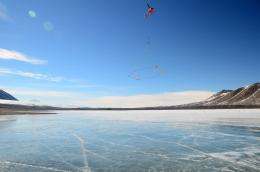
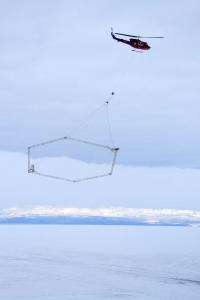
The technology package, SkyTEM, which was developed by a Danish research team, is suspended beneath a helicopter and enables researchers to map features under the ice that were formerly inaccessible by other methods.
SkyTEM consists of a large antennae suspended below the helicopter. The antenna produces electrical currents focused on the ground whose induced magnetic field is measured to determine resistivity of the subsurface material. Researchers use these data to map the character of the subsurface--groundwater, permafrost, rock, ice, glaciers, etc.--to depths of approximately 300 meters, or 984 feet.
By using this non-invasive system in environments such as Antarctica, and combining that with traditional research on subsurface microbial ecosystems, scientists can gain insights to the potential for life on other planets that might have had similar environmental conditions.
"The ice cover in Antarctica means that researchers need to use creative technologies to study the processes operating there," said Alexandra Isern, Antarctic Earth Sciences program director in NSF's Office of Polar Programs. "It is impressive that an early career researcher successfully applied this technology and was successful in receiving funding for its implementation."
NSF's Office of Polar Programs funded the project, led by Jill Mikucki of the University of Tennessee. The Aarhus University in Denmark; Dartmouth College; the New Mexico Institute of Mining and Technology and University of California Santa Cruz rounded out the team.
NSF manages the U.S. Antarctic Program through which it coordinates all U.S. scientific research on the southernmost continent and aboard ships in the Southern Ocean as well as related logistical support.
"We have deployed this instrumentation in many different parts of the world, the Galapagos Island and Mayotte Island just to mention a few, however we have never experienced such a challenging environment as working from McMurdo Station and in the Dry Valleys," said Esben Auken from Aarhus University in Denmark.
Researchers probed diverse areas of Antarctica during the project. They chose the Dry Valleys because of the frozen ground there with little to no glacier ice and it is one of a global network of NSF-funded Long Term Ecological Research (LTER) program sites.
In addition, scientists probed the Taylor Glacier, which terminates in the Dry Valleys and contains a subglacial microbial ecosystem whose cold and dark uniqueness allows researchers to further study microbes in an environment that may have existed on Mars, thus providing insight to the potential for life on Mars.
"The LTER is studying the past and present climate to, in part, understand how climate change in the future will affect biodiversity and ecosystem processes of the dry valleys as an integrated system," said Ross Virginia of Dartmouth College. "This fantastic new view beneath the surface will help us sort out competing ideas and theories about how the valleys have changed with time and how this history influences what we see today."
This geophysical survey produced 1,000 linear kilometers (621 miles) of resistivity profiles over three separate areas covering approximately 295 sq. kilometers (114 sq. miles).
"It was a unique experience having the helicopter pilots assist in our data collection," said Mikucki. "The success of our McMurdo SkyTEM project was truly a collaborative effort among scientists with diverse research interests and dedicated polar logistics personnel, all working together in the challenging Antarctic environment."
Provided by National Science Foundation


