'Texting cow' technology boost for farmers
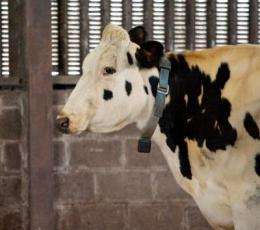
A smart collar which closely monitors the health of cows and sends the results back to farmers using mobile phone technology is being developed as part of a three-year-project co-funded by the Technology Strategy Board.
The Technology Strategy Board has given a substantial grant towards the £1.4 million project to develop the technology, which could make huge savings for farmers. It is the result of a joint project between The University of Strathclyde, Morrisons, Scottish Agricultural College (SAC), NMR, Harbro, Well Cow and Embedded Technology Solutions (a Strathclyde spin-out company) – who are developing the technology.
The equipment involves each cow wearing an intelligent collar that picks up on subtle movements with the same sensor used in Wii gaming and generates a continuous record of their activity patterns.
Results will then be sent back using a range of wireless technologies like 3G, with a full update accessible via a hub or even through a mobile phone. It is envisaged that farmers can set up alerts for their phone to receive a text when a cow is in distress, coming in to heat or entering labour.
Wireless technology means that the signal from the cow's collar would be accessible from anywhere, so farmers can check on their cattle's status using their phone wherever they are.
It will provide vital improvements in the important areas of cow illness and streamline the insemination process.
By accurately sensing the cow's head positions in three dimensions, the collar will be able to detect if the animal's hind legs begin to lower – one of the initial signs of illness.
The sensor on the collar will also detect when a cow is coming into heat and alert the farmer so he can optimise the process of insemination, increasing cow pregnancy rates. Without this technology, close monitoring of each cow, which can take hours every day, is required to look for the signs of heat.
With both efficient insemination and cow health crucial for farm profitability – the development could help to sustain the financial future of farms.
The collar technology is now entering its next phase thanks to a grant from the Technology Strategy Board and a commitment by Morrisons to provide its farm at Dumfries House in Scotland for the testing of the technology.
Professor Jim McDonald, Principal of the University of Strathclyde, said: "It is essential that technology innovation, positive social impact and economic development go hand in hand. This exciting project will contribute to all of these themes. I am delighted to see Embedded Technology Solutions Ltd progress so well and continue Strathclyde's extensive record of translating ground-breaking research into high value, high quality products."
Annette MacDougall, Embedded Technology Solutions Ltd CEO, said: "The Silent Herdsman platform is a decision support tool for farmers, alerting them to take action on specific animals within their herd. By advancing the platform to the next generation alongside our industry partners, we are leading in this segment by continuing to produce innovative solutions that are relevant for farmers today and the global dairy industry at large.
"Meeting the demands of traceability and sustainability in the food chain can be addressed long term using wireless and sensor technologies at the core."
David Evans, Morrisons Head of Agriculture at Morrisons, said: "The future of farming is extremely important to us as a business, as is animal welfare. This technology can help secure it by allowing farmers to monitor the health conditions of individual cows far more easily and accurately.
"Not only can this development help to save the farmer money, it can also help to keep food affordable."
Andy Warne, Managing Director at NMR Plc, said: "It is rare to come across a development such as Silent Herdsman which has 'game changing' potential for dairy farmers. NMR believes this TSB initiative will strengthen the UK industries that seek to collectively promote the advancement of improved efficiency, in animal health and welfare."
David Alvis, who leads the Technology Strategy Board's work on sustainable agriculture and food, said: "We are delighted to support this innovative project.
"Addressing animal health and welfare challenges and improving animal performance monitoring are vital pieces of the food security jigsaw. The technologies developed through this project have the potential to benefit farming communities in the UK and around the world and we wish the partners every success."
Provided by University of Strathclyde


