Spin-orbit sum rule to speed up X-ray scattering research
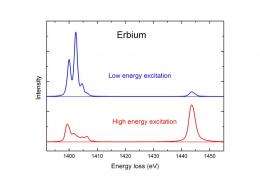
A new theory developed by Prof Gerrit van der Laan, from the Science & Technology Facilities Council (STFC) and Diamond Light Source, and published this week in the journal Physical Review Letters, provides a powerful sum rule that scientists can use to explore the properties of novel materials, such as those used for spintronics devices. Such materials require constant refinement of their physical qualities in order to keep up with the rapid advancement in a wide range of technologies, from read heads of hard drives (metal-based) to superior transistors (semiconductor-based).
In the atoms, constituting a material, the intricate coupling of the magnetic moments with the electronic orbitals is caused primarily by the spin-orbit interaction. This interaction means that the magnetization points in specific directions, which is of great importance for the material to maintain its magnetic orientation. The spin-orbit coupling is an effect of relativistic origin and for the valence electrons that form the chemical bonding the interaction is small and difficult to measure, while for the core electrons that are buried deeply inside the atoms this interaction is much larger.
The new sum rule presented provides a relation between the intensity ratio of the core electrons that are scattered by x-rays into the valence band. Since the spin-orbit interaction of the core electrons is much larger than that of the valence electrons, it acts as a magnifying glass for this tiny interaction. The theory predicts that the relative intensity ratio of the scattered x-rays for the two spin-orbit split levels can completely reverse in magnitude by changing the energy and the angle in the scattering process. The sum rule relates the changes in the intensity ratio to the magnitude of the valence spin-orbit interaction.
Scientists investigating the electronic structure of molecules and materials for use in 21st century technology are increasingly turning to large scale experimental tools found at facilities such as Diamond Light Source, the UK’s national facility for scientific research using synchrotron radiation.
A growing number of researchers are working in the field of spintronics and, with the help of advanced light source techniques such as X-ray absorption spectroscopy (XAS) and inelastic X-ray scattering (IXS), designing novel experiments that will impact on a range of areas including condensed matter physics, faster, smaller and more efficient computers, and biomedical research.
“Theory goes hand-in-hand with state-of-the-art experiments as scientists from both the physical and life sciences attempt to understand and harness the molecular world and, in doing so, bring about dramatic advances in technological materials. Sum rules are very important in this process since they allow the experimentalists to extract physical information from their measurements without the need for extensive theoretical modelling. Hence, the data offers instantaneously access to the numbers for the physical quantities.”said Prof van der Laan, STFC and Diamond Light Source.
Looking ahead, the predicted effect can become an important diagnostic tool in emerging high-energy spectroscopies. In the UK, one of Diamond’s Phase III beamlines will be a world leading Inelastic X-ray Scattering beamline where X-ray scattering experiments can be performed under varying energy and angle. The Inelastic X-ray Scattering (IXS) beamline is currently in the design phase and is due to come online in 2016. IXS beamlines are already in operation at other synchrotrons around the world including the European Synchrotron Radiation Facility (ESRF) in Grenoble, France, the Swiss Light Source (SLS), and the Advanced Photon Source (APS).
More information: Spin-orbit sum rule for electric-multipole transitions in non-resonant inelastic x-ray scattering, Physical Review Letters 108, 077401 (2012) DOI: 10.1103/PhysRevLett.108.077401
Journal information: Physical Review Letters
Provided by Diamond Light Source


