Oxford Nanopore announces groundbreaking GridION and MinION gene sequencers
February 20, 2012 by Bob Yirka report

Oxford Nanopore announces groundbreaking GridION and MinION gene sequencers

Enlarge

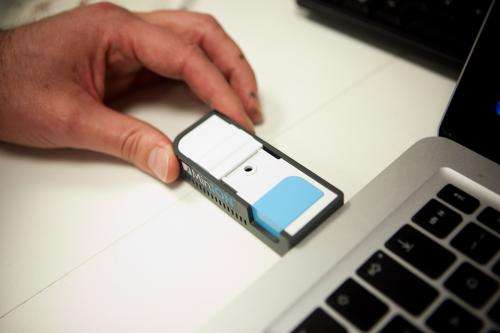
(PhysOrg.com) -- Oxford University spinoff company, Oxford Nonopore has announced at this year’s Advances in Genome Biology and Technology conference in Florida, two new machines for sequencing genes. Of particular note is the MinION, a machine small enough to fit in the hand which can be plugged into a laptop’s USB port. The other, the GridION, is a larger version that can be stacked to increase processing power. Both rely on a technology known as strand sequencing whereby a nanopore (engineered protein) is used to pull strands of DNA through a hole where a microchip measures minute changes in the electrical current in the membrane around it as individual bases, or pairs are pulled through. Because of the way it is done, much longer sections of DNA can be examined at once, doing away with the need to examine small sections independently and then knitting the results together with a computer afterwards.

Sequencing of genes is a process where the chemical order of units (T, C, G and A) are determined. Doing so helps researchers and doctors determine inherited traits in plants and animals. It is an area of science that has been in the news of late as it is a hotbed of excitement for investors. This announcement by Oxford Nonopore comes as rather a shock to the established players in the field, American companies, Illumina and Life Technologies.

In addition to their small size, the new devices are able to perform sequencing faster than previous machines. Representatives of Oxford Nonopore say if 20 units (adding up to roughly $5000) are connected together the GridION can sequence an entire human genome in just fifteen minutes. In comparison, Life Technologies’ latest product, the Ion Proton Sequencer, at a price of almost $150,000, takes twenty four hours.

But it’s the MinION that is causing the most excitement in the scientific community. At just $900, any researcher anywhere could take a sample, in the field even, slip it into the device, then plug it into a laptop, and almost instantly have information about small genome samples. Seed research companies could use it to analyze crops in a field, for example, to see if they have mixed without outside sources, meat inspectors could use it test for different types of microorganisms, biologists could use it to look for small changes in genes over generations. The number of applications are literally too many to envision.

One dark spot in an otherwise rosy picture is the fact that the devices have a four percent error rate. Too high for many applications, though the company says it believes it can get the rate down significantly before the product is released sometime this year.

More information: Company's press release

© 2011 PhysOrg.com

Filter


Move the slider to adjust rank threshold, so that you can hide some of the comments.


Display comments: newest first

antonima
Feb 20, 2012

Rank: 4 / 5 (1)
A USB DNA sequencing device!???
Four percent error is very high though. I wonder if its possible to reduce the error by running a sample multiple times, or perhaps just by extending the run time.
El_Nose
Feb 20, 2012

Rank: not rated yet
4 percent HA -- you know the error on the original human genome was way north of that number and it was considered complete.

The draft sequence covered 90 percent of the genome at an error rate of one in 1,000 base pairs, but there were more than 150,000 gaps and only 28 percent of the genome had reached the finished standard. In the April 2003 version, there are less than 400 gaps and 99 percent of the genome is finished with an accuracy rate of less than one error every 10,000 base pairs. The differences between the two versions are significant for scientists using the sequence to conduct research.


taken from http://www.genome.gov/11006943

Deesky
Feb 20, 2012

Rank: not rated yet
Wow, this is remarkable!

"if 20 units (adding up to roughly $5000) are connected together the GridION can sequence an entire human genome in just fifteen minutes."

The Human Genome Project cost about 3 billion dollars and took over 13 years to sequence a genome (roughly). Gattaca, here we come :)

dav_i
Feb 21, 2012

Rank: 5 / 5 (1)
Those are some pretty awesome computer graphics...
Rank 5 /5 (13 votes)
Relevant PhysicsForums posts

More news stories

Manufacturing genes to attack flu virus

An international research team has manufactured a new protein that can combat deadly flu epidemics.

Biology / Biotechnology

created 12 hours ago | popularity not rated yet | comments 0 | with audio podcast

Scientist: Evolution debate will soon be history

(AP) -- Richard Leakey predicts skepticism over evolution will soon be history. Not that the avowed atheist has any doubts himself.

Biology / Evolution

created May 26, 2012 | popularity 3.4 / 5 (22) | comments 98

More plant species responding to global warming than previously thought

(Phys.org) -- Far more wild plant species may be responding to global warming than previous large-scale estimates have suggested.

Biology / Ecology

created May 22, 2012 | popularity 4.6 / 5 (14) | comments 18 | with audio podcast

For monogamous sparrows, it doesn't pay to stray (but they do it anyway)

It's quite common for a female song sparrow to stray from her breeding partner and mate with the male next door, but a new study shows that sleeping around can be costly.

Biology / Plants & Animals

created May 22, 2012 | popularity 5 / 5 (2) | comments 8 | with audio podcast

Thousands of shellfish found dead in Peru

Thousands of crustaceans were found dead off the coast of Lima following the mystery mass death of dolphins and pelicans, the Peruvian Navy said Friday.

Biology / Ecology

created May 26, 2012 | popularity 4.7 / 5 (7) | comments 7


Stunning image of smallest possible five-ringed structure

Scientists have created and imaged the smallest possible five-ringed structure – about 100,000 times thinner than a human hair – and you'll probably recognise its shape.

'Unzipped' carbon nanotubes could help energize fuel cells, batteries

Multi-walled carbon nanotubes riddled with defects and impurities on the outside could replace some of the expensive platinum catalysts used in fuel cells and metal-air batteries, according to scientists at ...

Change in developmental timing was crucial in the evolutionary shift from dinosaurs to birds: study

At first glance, it's hard to see how a common house sparrow and a Tyrannosaurus Rex might have anything in common. After all, one is a bird that weighs less than an ounce, and the other is a dinosaur that ...

Computer model used to pinpoint prime materials for efficient carbon capture

When power plants begin capturing their carbon emissions to reduce greenhouse gases – and to most in the electric power industry, it's a question of when, not if – it will be an expensive undertaking.

T cells 'hunt' parasites like animal predators seek prey, study shows

By pairing an intimate knowledge of immune-system function with a deep understanding of statistical physics, a cross-disciplinary team at the University of Pennsylvania has arrived at a surprising finding: T cells use a movement ...

Yale study concludes public apathy over climate change unrelated to science literacy

Are members of the public divided about climate change because they don't understand the science behind it? If Americans knew more basic science and were more proficient in technical reasoning, would public consensus match ...