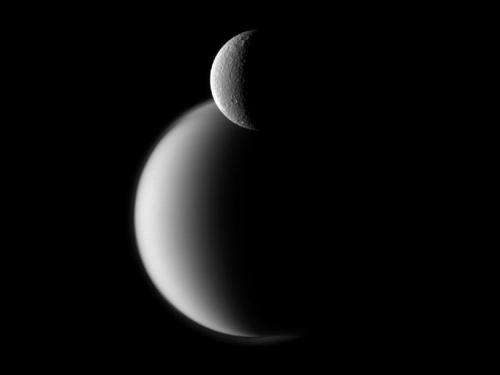
Image: Rhea before Titan
Feb 16, 2012
Credit: NASA/JPL-Caltech/Space Science Institute

(PhysOrg.com) -- Craters appear well defined on icy Rhea in front of the hazy orb of the much larger moon Titan in this Cassini spacecraft view of these two Saturn moons.

Lit terrain seen here is on the leading hemispheres of Rhea and Titan. North on the moons is up and rotated 13 degrees to the left. The limb, or edge of the visible disk, of Rhea is slightly overexposed in this view.

The image was taken in visible green light with the narrow-angle camera on Dec. 10, 2011. The view was acquired at a distance of approximately 1.2 million miles (2 million kilometers) from Titan and at a Sun-Titan-spacecraft, or phase, angle of 109 degrees. The view was acquired at a distance of approximately 810,000 miles (1.3 million kilometers) from Rhea and at a Sun-Rhea-spacecraft, or phase, angle of 109 degrees. Image scale is 8 miles (12 kilometers) per pixel on Titan and 5 miles (8 kilometers) per pixel on .

Explore further: Mice, gerbils perish in Russia space flight

add to favorites email to friend print save as pdf

Related Stories

Cassini presents Saturn moon quintet

Sep 19, 2011

(PhysOrg.com) -- With the artistry of a magazine cover shoot, NASA's Cassini spacecraft captured this portrait of five of Saturn's moons poised along the planet's rings.

Space Image: Ghostly Encounter

Jun 29, 2010

(PhysOrg.com) -- The surface of Saturn's moon Dione is rendered in crisp detail against a hazy, ghostly Titan. Visible in this image are hints of atmospheric banding around Titan's north pole.

Space Image: Welcome disruption

Jan 16, 2012

(PhysOrg.com) -- The line of Saturn's rings disrupts the Cassini spacecraft's view of the moons Tethys and Titan.

Image: Bright are Saturn's moons

Jul 06, 2011

The Cassini spacecraft observed three of Saturn's moons set against the darkened night side of the planet in this image from April 2011.

Rhea's Wisps in Color

Feb 28, 2006

Bright, wispy markings stretch across a region of darker terrain on Saturn's moon Rhea. In this extreme false-color view, the roughly north-south fractures occur within strips of material (which appear greenish ...

Image: Saturn and its moon Dione

Feb 03, 2012

(PhysOrg.com) -- Saturn and Dione appear askew in this Cassini spacecraft view, with the north poles rotated to the right, as if they were threaded along on the thin diagonal line of the planet's rings.

Recommended for you

Mice, gerbils perish in Russia space flight

14 hours ago

A number of mice and eight gerbils sent into space in a Russian capsule destined to find out how well organisms can withstand extended flights perished during their journey, scientists said Sunday as the ...

Mars rover Opportunity examines clay clues in rock

May 18, 2013

(Phys.org) —NASA's senior Mars rover, Opportunity, is driving to a new study area after a dramatic finish to 20 months on "Cape York" with examination of a rock intensely altered by water.

NASA's STEREO detects a CME from the sun

May 17, 2013

On 5:24 a.m. EDT on May 17, 2013, the sun erupted with an Earth-directed coronal mass ejection or CME, a solar phenomenon that can send billions of tons of solar particles into space that can reach Earth ...

Nine-year-old Mars rover passes 40-year-old record

May 17, 2013

While Apollo 17 astronauts Eugene Cernan and Harrison Schmitt visited Earth's moon for three days in December 1972, they drove their mission's Lunar Roving Vehicle 19.3 nautical miles (22.210 statute miles ...

Bright explosion on the Moon

May 17, 2013

For the past 8 years, NASA astronomers have been monitoring the Moon for signs of explosions caused by meteoroids hitting the lunar surface. "Lunar meteor showers" have turned out to be more common than anyone ...

User comments : 1

Adjust slider to filter visible comments by rank

Display comments: newest first

Hengine
not rated yet Feb 16, 2012
Cassini has lots of fantastic photos to look at.

More news stories

Heat-related deaths in Manhattan projected to rise

Residents of Manhattan will not just sweat harder from rising temperatures in the future, says a new study; many may die. Researchers say deaths linked to warming climate may rise some 20 percent by the 2020s, ...

Mice, gerbils perish in Russia space flight

A number of mice and eight gerbils sent into space in a Russian capsule destined to find out how well organisms can withstand extended flights perished during their journey, scientists said Sunday as the ...

Kinks and curves at the nanoscale

One of the basic principles of nanotechnology is that when you make things extremely small—one nanometer is about five atoms wide, 100,000 times smaller than the diameter of a human hair—they are going ...

Honeybees trained in Croatia to find land mines

(AP)—Mirjana Filipovic is still haunted by the land mine blast that killed her boyfriend and blew off her left leg while on a fishing trip nearly a decade ago. It happened in a field that was supposedly ...