New genus of Eugaleaspidiforms found in China
February 15, 2012

New Genus Of Eugaleaspidiforms Found From the Ludlow, Silurian Of Qujing, Yunnan, Southwestern China

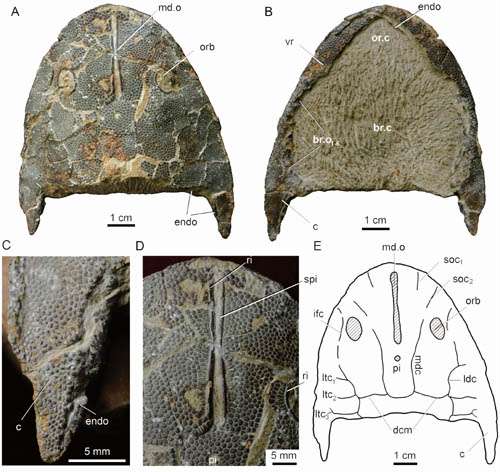
Fig.1: Cephalic shield of Dunyu longiforus gen. et sp. nov. ( holotype IVPP V 17681). A. dorsal view; B. ventral view; C. close-up view of the left corner; D. close-up view to show the regional variation of polygonal tubercles, and minute spines on the inner surface of the dermal rim encircling the median dorsal opening; E. illustrative drawing in dorsal view. (Image by ZHU Min)

In a study published in the latest issue of of Vertebrata PalAsiatic [2012(1)], paleontologists from Institute of Vertebrate Paleontology and Paleoanthropology (IVPP), Chinese Academy of Sciences in Beijing reported a new genus and species of the Eugaleaspidiformes (Agnatha: Galeaspida), Dunyu longiforus gen. et sp. nov., from the Ludlow (Silurian) Kuanti Formation of Qujing, Yunnan, southwestern China, in association with the oldest near-complete gnathostome Guiyu oneiros of the Xiaoxiang Vertebrate Fauna, providing new thread into this taxonomic puzzle.

The new genus is most suggestive of Eugaleaspis of the Eugaleaspidae by the absence of inner corners, in addition to the diagnostic features of the family, such as only 3 pairs of lateral transverse canals from lateral dorsal canals, and the U-shaped trajectory of median dorsal canals. They differ in that the new genus possesses a pair of posteriorly extending corners, the breadth/length ratio of the shield smaller than 1.1, and the posterior end of median dorsal opening beyond the posterior margin of orbits.

Dr. ZHU Min, lead author of the study, and his colleagues reexamined the type specimen of Eugaleaspis xiushanensis from the Wenlock Huixingshao Formation of Chongqing, and observed a pair of posteriorly extending lobate corners and three (instead of four in the original description) pairs of lateral transverse canals. Thus, they re-assigned it to Dunyu. The new species differs from Dunyu xiushanensis in its large cephalic shield which is longer than broad, spine-shaped corners, anteriorly positioned orbits, the length ratio between preorbital and postorbital portions of the shield less than 0.75, and large polygonal, flat-topping tubercles exceeding 2.0 mm in length.

“The discovery of the new form from the Xiaoxiang Vertebrate Fauna might provide new thread into this taxonomic puzzle”, said study coauthor LIU Yuhai, an emeritus professor of the IVPP. “In overall, the new form resembles E. xiushanensis in many aspects, such as the posteriorly extending corner and the breadth/length ratio of cephalic shield less than 1.1. However, compared with E. xiushanensis, the new form morphologically deviates more from the Devonian Eugaleaspis species. If we continue to assign this new form to Eugaleaspis, the diagnosis of the genus has to be further modified to cover a larger morphospace, e.g. the breadth/length ratio of cephalic shield ranging from 0.9 to 1.5.”

“In order to maintain the diagnostic stability of Eugaleaspis, which is the first genus of the Galeaspida described in the literature, a new (Dunyu gen. nov.) encompassing the new form and E. xiushanensis is a reasonable treatment. Among the Eugaleaspidae, Dunyu is more closely related to Eugaleaspis than either to other genera by the absence of inner corners”, said ZHU Min.

Provided by Institute of Vertebrae Paleontology and Paleoanthropology


Rank 1 /5 (1 vote)
Relevant PhysicsForums posts

More news stories

Change in developmental timing was crucial in the evolutionary shift from dinosaurs to birds: study

At first glance, it's hard to see how a common house sparrow and a Tyrannosaurus Rex might have anything in common. After all, one is a bird that weighs less than an ounce, and the other is a dinosaur that ...

Other Sciences / Archaeology & Fossils

created 11 hours ago | popularity 5 / 5 (8) | comments 0 | with audio podcast

Social welfare cuts ultimately come with heavy price, researchers say

(Phys.org) -- Slashing government funding for Medicaid, food stamps and other programs that serve the poor – while politically popular with some lawmakers and many conservatives – may do more harm ...

Other Sciences / Social Sciences

created May 24, 2012 | popularity 4.1 / 5 (23) | comments 156

Ancient Bethlehem seal unearthed in Jerusalem

Israeli archaeologists have discovered a 2,700-year-old seal that bears the inscription "Bethlehem," the Israel Antiquities Authority announced Wednesday, in what experts believe to be the oldest artifact ...

Other Sciences / Archaeology & Fossils

created May 23, 2012 | popularity 3.3 / 5 (15) | comments 24

Dollars and sense: Why are some people morally against tax?

As the U.S. presidential election campaigns heat up, the economic debate is dominated by bailouts, austerity and, inevitably, taxation. Now a new study published in Symbolic Interaction asks why tax is such an important issue ...

Other Sciences / Social Sciences

created May 23, 2012 | popularity 2.3 / 5 (3) | comments 20

Oldest Jewish archaeological evidence on the Iberian Peninsula

German archaeologists of the Friedrich Schiller University Jena found one of the oldest archaeological evidence so far of Jewish Culture on the Iberian Peninsula at an excavation site in the south of Portugal, ...

Other Sciences / Archaeology & Fossils

created May 25, 2012 | popularity 4.2 / 5 (6) | comments 12


'Unzipped' carbon nanotubes could help energize fuel cells, batteries

Multi-walled carbon nanotubes riddled with defects and impurities on the outside could replace some of the expensive platinum catalysts used in fuel cells and metal-air batteries, according to scientists at ...

Computer model used to pinpoint prime materials for efficient carbon capture

When power plants begin capturing their carbon emissions to reduce greenhouse gases – and to most in the electric power industry, it's a question of when, not if – it will be an expensive undertaking.

T cells 'hunt' parasites like animal predators seek prey, study shows

By pairing an intimate knowledge of immune-system function with a deep understanding of statistical physics, a cross-disciplinary team at the University of Pennsylvania has arrived at a surprising finding: T cells use a movement ...

Yale study concludes public apathy over climate change unrelated to science literacy

Are members of the public divided about climate change because they don't understand the science behind it? If Americans knew more basic science and were more proficient in technical reasoning, would public consensus match ...

Land and sea species differ in climate change response: study

(Phys.org) -- Marine and terrestrial species will likely differ in their responses to climate warming, new research by Simon Fraser University and Australia’s University of Tasmania has found.

Stunning image of smallest possible five-ringed structure

Scientists have created and imaged the smallest possible five-ringed structure – about 100,000 times thinner than a human hair – and you'll probably recognise its shape.