Transformational fruit fly genome catalog completed
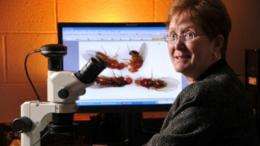
Dr. Trudy Mackay and an international team of researchers provide the holy grail of fruit fly genetics -- a reference panel of genetic variation in 192 fruit fly lines. The resource will allow more efficient study of complex traits like aggression. Credit: Roger W. Winstead, NC State University
Scientists searching for the genomics version of the holy grail more insight into predicting how an animal's genes affect physical or behavioral traits now have a reference manual that should speed gene discoveries in everything from pest control to personalized medicine.
In a paper published today in Nature, North Carolina State University genetics researchers team with scientists from across the globe to describe the new reference manual the Drosophila melanogaster Reference Panel, or DGRP. Dr. Trudy Mackay, William Neal Reynolds and Distinguished University Professor of Genetics and one of the paper's lead authors, says that the reference panel contains 192 lines of fruit flies that differ enormously in their genetic variation but are identical within each line, along with their genetic sequence data.
These resources are publicly available to researchers studying so-called quantitative traits, or characteristics that vary and are influenced by multiple genes think of traits like aggression or sensitivity to alcohol. Mackay expects the reference panel will benefit researchers studying everything from animal evolution to animal breeding to fly models of disease.
Environmental conditions also affect quantitative traits. But studying the variations of these different characteristics, or phenotypes, of inbred fruit flies under controlled conditions, Mackay says, can greatly aid efforts to unlock the secrets of quantitative traits.
"Each fly line in the reference panel is essentially genetically identical, but each line is also a different sample of genetic variation among the population," Mackay says. "So the lines can be shared among the research community to allow researchers to measure traits of interest."
The Nature paper showed that, in general, many genes were associated with three quantitative traits studied in fruit flies resistance to starvation stress, chill coma recovery time and startle response and that the effects of these genes were quite large.
"Until now, we had the information necessary to understand what makes a fruit fly different from, say, a mosquito," Mackay says. "Now we understand the genetic differences responsible for individual variation, or why one strain of flies lives longer or is more aggressive than another strain."
More information: The Drosophila melanogaster Genetic Reference Panel, Authors: Trudy F.C. Mackay, Eric A. Stone, Michael M. Magwire, Mary Anna Carbone, Robert R.H. Anholt, Laura Duncan, Zeke Harris, Katherine W. Jordan, Faye Lawrence, Richard F. Lyman, Lavanya Turlapati, Akihiko Yamamoto, North Carolina State University; Stephen Richards, Baylor College of Medicine; Antonio Barbadilla, Campus Universitat Autonoma de Barcelona; et al. Published: Feb. 9, 2012, in Nature .
Abstract
A major challenge of biology is understanding the relationship between molecular genetic variation and variation in quantitative traits, including fitness. This relationship determines our ability to predict phenotypes from genotypes and to understand how evolutionary forces shape variation within and between species. Previous efforts to dissect the genotype-phenotype map were based on incomplete genotypic information. Here, we describe the Drosophila melanogaster Genetic Reference Panel (DGRP), a community resource for analysis of population genomics and quantitative traits. The DGRP consists of fully sequenced inbred lines derived from a natural population. Population genomic analyses reveal reduced polymorphism in centromeric autosomal regions and the X chromosome, evidence for positive and negative selection, and rapid evolution of the X chromosome. Many variants in novel genes, most at low frequency, are associated with quantitative traits and explain a large fraction of the phenotypic variance. The DGRP facilitates genotype-phenotype mapping using the power of Drosophila genetics.
Provided by
North Carolina State University
-
From lemons to lemonade: Reaction uses carbon dioxide to make carbon-based semiconductor,
32 comments
-
Thioridazine kills cancer stem cells in human while avoiding toxic side-effects of conventional cancer treatments,
3 comments
-
SpaceX private rocket blasts off for space station (Update),
42 comments
-
Climate scientists say they have solved riddle of rising sea,
31 comments
-
Landmark calculation clears the way to answering how matter is formed,
55 comments
-
osmotic pressure vs diffusion
3 hours ago
-
What would stain as translucent on light-coloured fabric?
May 26, 2012
-
How do I identify different bacteria on culture plates?
May 26, 2012
-
Why Do Dogs do Strange things...
May 25, 2012
-
What does exophillic and endophillic mean in terms of mosquito and their control?
May 24, 2012
-
Semen stains glows under black lights (uv light)?
May 23, 2012
- More from Physics Forums - Biology
More news stories
Manufacturing genes to attack flu virus
An international research team has manufactured a new protein that can combat deadly flu epidemics.
11 hours ago |
not rated yet |
0
|
Scientist: Evolution debate will soon be history
(AP) -- Richard Leakey predicts skepticism over evolution will soon be history. Not that the avowed atheist has any doubts himself.
May 26, 2012 |
3.4 / 5 (21) |
98
More plant species responding to global warming than previously thought
(Phys.org) -- Far more wild plant species may be responding to global warming than previous large-scale estimates have suggested.
May 22, 2012 |
4.6 / 5 (14) |
18
|
For monogamous sparrows, it doesn't pay to stray (but they do it anyway)
It's quite common for a female song sparrow to stray from her breeding partner and mate with the male next door, but a new study shows that sleeping around can be costly.
May 22, 2012 |
5 / 5 (2) |
8
|
Thousands of shellfish found dead in Peru
Thousands of crustaceans were found dead off the coast of Lima following the mystery mass death of dolphins and pelicans, the Peruvian Navy said Friday.
May 26, 2012 |
4.7 / 5 (7) |
7
'Unzipped' carbon nanotubes could help energize fuel cells, batteries
Multi-walled carbon nanotubes riddled with defects and impurities on the outside could replace some of the expensive platinum catalysts used in fuel cells and metal-air batteries, according to scientists at ...
Change in developmental timing was crucial in the evolutionary shift from dinosaurs to birds: study
At first glance, it's hard to see how a common house sparrow and a Tyrannosaurus Rex might have anything in common. After all, one is a bird that weighs less than an ounce, and the other is a dinosaur that ...
Computer model used to pinpoint prime materials for efficient carbon capture
When power plants begin capturing their carbon emissions to reduce greenhouse gases and to most in the electric power industry, it's a question of when, not if it will be an expensive undertaking.
T cells 'hunt' parasites like animal predators seek prey, study shows
By pairing an intimate knowledge of immune-system function with a deep understanding of statistical physics, a cross-disciplinary team at the University of Pennsylvania has arrived at a surprising finding: T cells use a movement ...
Yale study concludes public apathy over climate change unrelated to science literacy
Are members of the public divided about climate change because they don't understand the science behind it? If Americans knew more basic science and were more proficient in technical reasoning, would public consensus match ...
Land and sea species differ in climate change response: study
(Phys.org) -- Marine and terrestrial species will likely differ in their responses to climate warming, new research by Simon Fraser University and Australia’s University of Tasmania has found.