Deforestation threatens Brazil's wetland sanctuary
February 3, 2012 by Eric Frosio
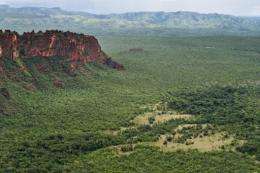
View of the Pantanal from the Cidade de Pedra viewpoint in the Chapada dos Guimaraes national park, Mato Grosso state, western Brazil on January 30. The Pantanal, a stunning biodiversity sanctuary in central-western Brazil, is threatened by intensive farming and deforestation, a leading environmental group warned as the world marked World Wetlands Day.
The Pantanal, a stunning biodiversity sanctuary in central-western Brazil, is threatened by intensive farming and deforestation, a leading environmental group warned as the world marked World Wetlands Day on Thursday.
Often referred to as the worlds largest freshwater wetland system, the Pantanal extends through millions of hectares of Brazil, eastern Bolivia and eastern Paraguay.
It includes sanctuaries for migratory birds, nursery grounds for aquatic life, and refuges for such creatures as the yacare caiman, deer, and jaguar. Some 4,500 different species live in the Pantanal.
A leading environmental group, the World Wildlife Fund for Nature (WWF), is sounding the alarm about the growing threat to the region posed by intensive farming, deforestation, urban growth and the proliferation of hydro-electric dams.
As evidence the group cites a three-year study by 30 experts from Brazil, Paraguay, Bolivia and Argentina, the counties that share the Paraguay river, which flows from its headwaters in Mato Grosso about 2,600 kilometers (1,620 miles) to its confluence with the Parana River in Argentina.
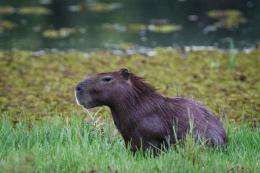
A wild capybara (Hydrochoerus hydrochaeris) is seen in Pantanal near Pocone, Mato Grosso state, western Brazil on January 31. The Pantanal, a stunning biodiversity sanctuary in central-western Brazil, is threatened by intensive farming and deforestation, a leading environmental group warned as the world marked World Wetlands Day.
"The Pantanal is under threat," said biologist Glauco Kimura, who coordinates the Water for Life program at WWF."This may seem surprising but it is the sad reality. Our study shows that 14 percent of the Paraguay River basin must be urgently protected," Kimura said.
Navigating the Cuiaba river, an important Pantanal tributary, escorted by raptors and colorful parrots overhead, Kimura and his team stop at the Chapada dos Guimaraes National Park, on a plateau at the edge of the Pantanal.
The threat, Kimura explains, comes from the highlands, known here as the Planalto.

A 'Pantaneiro' (herdsman) drives cattle along a road near Pocone, Mato Grosso state, western Brazil on January 31. The Pantanal, a stunning biodiversity sanctuary in central-western Brazil, is threatened by intensive farming and deforestation, a leading environmental group warned as the world marked World Wetlands Day.
"This region is like a plate," explains Kimura. "The Planalto on the edges and the Pantanal at the bottom of the plate." The Pantanal suffers from what goes on in the highlands, he says.There are thousands of acres of farmland across the highlands. Soybeans are the regions biggest crop, but corn, rice, cotton and sugarcane are also planted.
The Pantanal is also at risk from deforestation as cattle farmers cut down trees to make room for land for grazing.
Roughly 15 percent of the region's native vegetation has already been destroyed to make way for soybean cultivation and cattle ranching, according to the WWF, resulting in soil degradadation.
This worries Pierre Girard, a Canadian hydrologist at the Pantanal research center.
"Soybean is cultivated at the headwaters of the rivers that feed and then form the Pantanal. There are risks of erosion, but also of contamination of the Pantanal," he warns.
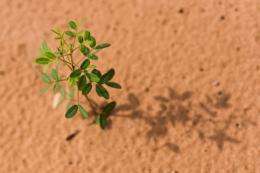
A native plant sprouts from the soil of the Cerrada plains in Chapada dos Guimaraes, Mato Grosso state, western Brazil on January 30. The Pantanal, a stunning biodiversity sanctuary in central-western Brazil, is threatened by intensive farming and deforestation, a leading environmental group warned as the world marked World Wetlands Day.
The WWF study -- conducted jointly with the US-based Nature Conservancy, another leading environmental group -- underscores the need for joint action by the countries and regions affected."There is no more space for intensive farming as if there was an infinite stock of native forest to destroy and fresh water to pollute," says Kimura. "We need to protect ground water, create more protected areas and improve agribusiness practices."
Kimura believes that protecting the Paraguay river basin is crucial to conserve the region's unparalleled wildlife diversity. Currently only 11 percent of the basin is protected.
(c) 2012 AFP
-
From lemons to lemonade: Reaction uses carbon dioxide to make carbon-based semiconductor,
32 comments
-
Thioridazine kills cancer stem cells in human while avoiding toxic side-effects of conventional cancer treatments,
3 comments
-
SpaceX private rocket blasts off for space station (Update),
42 comments
-
Climate scientists say they have solved riddle of rising sea,
31 comments
-
Landmark calculation clears the way to answering how matter is formed,
55 comments
-
Hypothetical desert earth
May 26, 2012
-
More human population = greater mass?
May 25, 2012
-
Conversion from aircraft bearing to normal degrees
May 23, 2012
-
Interpretation/Analysis of the Lab results(HEPA filter)
May 22, 2012
-
Has anyone here attended the The Urbino Summer School in Paleoclimatology?
May 22, 2012
-
Earthquakes: Mag 6 N. Italy and Mag 5.6 W. Bulgaria
May 21, 2012
- More from Physics Forums - Earth
More news stories
Yale study concludes public apathy over climate change unrelated to science literacy
Are members of the public divided about climate change because they don't understand the science behind it? If Americans knew more basic science and were more proficient in technical reasoning, would public consensus match ...
11 hours ago |
4.8 / 5 (6) |
27
|
Land and sea species differ in climate change response: study
(Phys.org) -- Marine and terrestrial species will likely differ in their responses to climate warming, new research by Simon Fraser University and Australia’s University of Tasmania has found.
9 hours ago |
4 / 5 (5) |
6
|
10 million years needed to recover from mass extinction
It took some 10 million years for Earth to recover from the greatest mass extinction of all time, latest research has revealed.
Space & Earth / Earth Sciences
11 hours ago |
4.2 / 5 (5) |
2
|
Sophisticated simulations predict future warming
The chances of our planet being hit by a global warming of 3 degrees Celsius by 2050 is as likely as it being hit by an increase of 1.4 degrees, new research shows. Presented in the journal Nature Geoscience, the British study ...
Space & Earth / Earth Sciences
May 22, 2012 |
3.8 / 5 (11) |
51
Kyoto Protocol architect 'frustrated' by climate dialogue
UN climate talks are going nowhere, as politicians dither or bicker while the pace of warming dangerously speeds up, one of the architects of the Kyoto Protocol told AFP.
May 23, 2012 |
3.4 / 5 (8) |
42
'Unzipped' carbon nanotubes could help energize fuel cells, batteries
Multi-walled carbon nanotubes riddled with defects and impurities on the outside could replace some of the expensive platinum catalysts used in fuel cells and metal-air batteries, according to scientists at ...
Change in developmental timing was crucial in the evolutionary shift from dinosaurs to birds: study
At first glance, it's hard to see how a common house sparrow and a Tyrannosaurus Rex might have anything in common. After all, one is a bird that weighs less than an ounce, and the other is a dinosaur that ...
Computer model used to pinpoint prime materials for efficient carbon capture
When power plants begin capturing their carbon emissions to reduce greenhouse gases and to most in the electric power industry, it's a question of when, not if it will be an expensive undertaking.
T cells 'hunt' parasites like animal predators seek prey, study shows
By pairing an intimate knowledge of immune-system function with a deep understanding of statistical physics, a cross-disciplinary team at the University of Pennsylvania has arrived at a surprising finding: T cells use a movement ...
Stunning image of smallest possible five-ringed structure
Scientists have created and imaged the smallest possible five-ringed structure about 100,000 times thinner than a human hair and you'll probably recognise its shape.
Browser wars flare in mobile space
The browser wars are heating up again, but this time the fight is for dominance of the mobile Internet.


