Coral growth in Western Australia found to be thriving in warmer water
February 3, 2012 by Bob Yirka
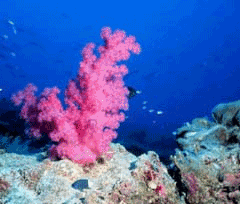
(PhysOrg.com) -- As most people are well aware, global warming isn’t just about the atmosphere, it’s about rising ocean temperatures as well. And like increases in the atmosphere, scientists aren’t really clear on what impact such temperature increases will have on the oceans. One such impact most researchers thought was well understood was the bleaching of coral reefs. As ocean temperatures rise and become more acidic, coral reefs tend to slough off the algae that grows on them, causing them to slowly die. Now however, new research by a team from the Australian Institute of Marine Science, has found that coral reefs off the western shores of the Australian continent are not only not suffering from the increased temperature, but are apparently thriving, as the study they’ve published in Science describes, they have actually been growing faster in the past hundred years than prior to that time.
Research has shown as air temperatures rise, so too do ocean temperatures and as more carbon dioxide is released into the air, more of it is soaked up by oceans the world over, where it reacts to make carbonic acid. That in turn causes the water to have lowered pH levels which causes lowered levels of dissolved carbonate, which is what corals use to create their skeletons. The result seen thus far has been slowed coral growth.
It was those skeletons that the team looked at in the waters off Australia’s west coast, specifically those of Porites. As corals grow over time, they create layers of skeleton material that can be read like tree rings to discern not just their age, but how much the coral grew each year. By drilling into some of the larger coral reefs, the team was able to trace the corals back hundreds of years. But it was the record of the last hundred that surprised them. Rather than finding slowed growth, such as has been seen with the Great Barrier Reef on the eastern part of the country, the growth in some areas of the southern sections had actually been growing at a faster rate than prior to the start of global warming.
After more thought, the team has come to the conclusion that what they’ve found makes sense. The increased growth rates were found only in the more southern corals where water temperatures are generally cooler than in the north, thus, an increase in temperature would be more conducive to coral growth. But only up to a point. They believe once temperatures reach those of the north, the same slowed growth patterns seen elsewhere will appear.
Interestingly, the team did not sample the ocean water at the sites where the coral samples were taken, and because of that, it’s not known if acidity levels in those areas that saw high growth rates had higher acidity levels or not.
More information: Growth of Western Australian Corals in the Anthropocene, Science 3 February 2012: Vol. 335 no. 6068 pp. 593-596. DOI: 10.1126/science.1214570
ABSTRACT
Anthropogenic increases of atmospheric carbon dioxide lead to warmer sea surface temperatures and altered ocean chemistry. Experimental evidence suggests that coral calcification decreases as aragonite saturation drops but increases as temperatures rise toward thresholds optimal for coral growth. In situ studies have documented alarming recent declines in calcification rates on several tropical coral reef ecosystems. We show there is no widespread pattern of consistent decline in calcification rates of massive Porites during the 20th century on reefs spanning an 11° latitudinal range in the southeast Indian Ocean off Western Australia. Increasing calcification rates on the high-latitude reefs contrast with the downward trajectory reported for corals on Australias Great Barrier Reef and provide additional evidence that recent changes in coral calcification are responses to temperature rather than ocean acidification.
Journal reference:
Science
© 2011 PhysOrg.com
-
From lemons to lemonade: Reaction uses carbon dioxide to make carbon-based semiconductor,
28 comments
-
Thioridazine kills cancer stem cells in human while avoiding toxic side-effects of conventional cancer treatments,
3 comments
-
SpaceX private rocket blasts off for space station (Update),
41 comments
-
Climate scientists say they have solved riddle of rising sea,
30 comments
-
Scotland passes turbine test to harness tidal power,
40 comments
-
More human population = greater mass?
21 hours ago
-
Conversion from aircraft bearing to normal degrees
May 23, 2012
-
Interpretation/Analysis of the Lab results(HEPA filter)
May 22, 2012
-
Has anyone here attended the The Urbino Summer School in Paleoclimatology?
May 22, 2012
-
Earthquakes: Mag 6 N. Italy and Mag 5.6 W. Bulgaria
May 21, 2012
-
determining time frame for most recent geological layers
May 17, 2012
- More from Physics Forums - Earth
More news stories
Astronauts enter world's 1st private supply ship
(AP) -- Space station astronauts floated into the Dragon on Saturday, a day after its heralded arrival as the world's first commercial supply ship.
Space & Earth / Space Exploration
50 minutes ago |
5 / 5 (1) |
0
Australia hails surprise super-telescope decision
Australia has hailed a surprise decision giving it a role in a radio telescope project aimed at revolutionising astronomy, vowing to draw on its decades of experience in space science.
48 minutes ago |
not rated yet |
0
SpaceX capsule has 'new car' smell, astronauts say
SpaceX's Dragon cargo vessel smells like a new car, said astronauts at the International Space Station after opening the hatches Saturday following the spacecraft's landmark mission to the orbiting lab.
Space & Earth / Space Exploration
48 minutes ago |
not rated yet |
0
Astronomers seize last chance in lifetime for Venus Transit
Astronomers are gearing for one the rarest events in the Solar System: an alignment of Earth, Venus and the Sun that will not be seen for another 105 years.
45 minutes ago |
5 / 5 (1) |
0
Dragon arrives at space station in historic 1st (Update 2)
The privately bankrolled Dragon capsule made a historic arrival at the International Space Station on Friday, triumphantly captured by astronauts wielding a giant robot arm.
Space & Earth / Space Exploration
22 hours ago |
5 / 5 (8) |
16
SpotterRF debuts Radar Backpack Kit (w/ Video)
(Phys.org) -- SpotterRF has announced a special radar backpack kit designed to enhance situational awareness for soldiers on the ground. The company says its special radar is designed for warfighters as part ...
Thousands of shellfish found dead in Peru
Thousands of crustaceans were found dead off the coast of Lima following the mystery mass death of dolphins and pelicans, the Peruvian Navy said Friday.
Travel to high altitudes tied to Crohn's, colitis flare-ups
(HealthDay) -- People with inflammatory bowel disease, which includes Crohn's disease and colitis, may be at increased risk for flare-ups when they fly or travel to high altitudes for skiing or mountain climbing, ...
Transvaginal mesh op restores pelvic organ prolapse at price
(HealthDay) -- Transvaginal mesh (TVM) procedures are effective for anatomical restoration of pelvic organ prolapse (POP), but patients report a worsening of sexual function following surgery, according to ...
Oldest Jewish archaeological evidence on the Iberian Peninsula
German archaeologists of the Friedrich Schiller University Jena found one of the oldest archaeological evidence so far of Jewish Culture on the Iberian Peninsula at an excavation site in the south of Portugal, ...
MIT researchers devise new means to synchronize a group of robots (w/ Video)
(Phys.org) -- For several years, roboticists have been working out ways to get a group of robots to perform synchronized activities as demonstrated most often in dance routines. Its not just about trying ...
Feb 03, 2012
Rank: 2.6 / 5 (10)
Don't look for this story on the state run media.
Feb 03, 2012
Rank: 2 / 5 (8)
The jokes is on you, the title contradicts the article:
Second of all:
Thus a very inconclusive article.
They forgot to include that because of ocean pollution (including thermal pollution) and drying up of rivers by irrigation; the oceans chemistry and environment changes and as a result we have learned that ocean absorbs less carbon which is one of the many factors the ocean becomes more acidic.
Feb 03, 2012
Rank: 1 / 5 (1)
Feb 03, 2012
Rank: 1 / 5 (4)
LOGICALLY - more dissolved CO2 may be a good thing. If the coral are directly using the CO2 to then form carbonate-complexes 'shell', then MORE dissolved CO2 may be a good thing. If the coral are indirectly utilizing CO2 in the form of bicarbonates, then MORE acid should be beneficial as more bicarbonate will be available for the structure.
Measurements of dissolved CO2 and bicarbonate (pH, Temp., etc.) are EASY to perform, but should be PROSPECTIVE in order to answer the fundamental questions in the survival of the coral reefs. Having more questions after research has been published is good - but having fundamental questions unanswered is just poor research.
Feb 03, 2012
Rank: 1.6 / 5 (7)
Feb 03, 2012
Rank: 5 / 5 (2)
Considering temperature only, that might be true. What we might see is a shift in coral reefs from tropics to higher latitudes. Unfortunately the death rate of the old reefs is much higher than the growth rate of the potentially new reefs, so ocean ecosystems will still collapse over timescales humans care about. Plus, this article didn't study acidification, which should increase all over the ocean and will probably ultimately become the dominant factor that affects coral growth. So the most probably scenario is a near complete loss of coral reefs within 100 years or so. Possibly within 30-50 years based on more recent acidification studies (it's worse than previously thought... climate change deniers won't like that).
Feb 03, 2012
Rank: 1 / 5 (6)
No. And those periods were warmer than today.
As for acidification ... the oceans are not acid, won't be acid, and will drop 130m during the next ice age. Which is overdue.
Feb 04, 2012
Rank: 1 / 5 (3)
I think this "science writer" had issues translating. First, with increased CO2 uptake by the ocean, the dissolved carbonates would increase, not decrease.
Aragonite is a calcium salt which is by definition "insoluable" in water but does exist in very low amounts. The abstract, appearently misinterpreted by the writer here, suggests that the calcium salt solution would increase as the CO2 absorption increses thus lowering the pH to make the ocean more acidic and thus disolving more aragonite or increasing the dissolved CO2 mineral.
The Absract suggest that as the aragonite (dissolved CALCIUM carbonate) "saturation drops" as with lower temperature and higher pH. The writer communicated the right message with the wrong interpretation.