Asteroids: The new 'It mission' for space exploration
Feb 01, 2012
source: asteroidapophis.com/

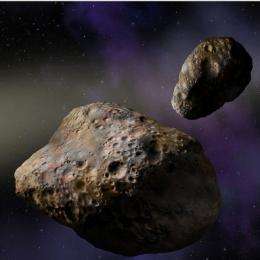
The Japanese are heading back into space on a second attempt to collect samples from a nearby asteroid.

The asteroid selected, 1999 JU3 is a perfect specimen, said Humberto Campins, a University of Central Florida professor and international expert on asteroids and comets.

“Based on our analysis, it should be rich in primitive materials, specifically organic molecules and hydrated minerals from the early days of our solar system,” Campins said. “If successful it could give us clues about the birth of water and life in our world.”

Campins has been studying the 1999 JU3 for years. He published an article in 1999 in Astronomy & Astrophysics on this asteroid and its potential to hold raw materials and perhaps even evidence of water. It is believed to have come from the asteroid belt located between Mars and Jupiter.

Finding water in asteroids and comets is a major focus of research. NASA and the European Space Agency are both planning trips to recover samples from two asteroids in the next five to seven years through the OSIRIS-REx (NASA) and Marco Polo-R (European Space Agency) missions. Campins is part of both teams.

Since the end of Space Shuttle flights in 2011, robotic missions to collect asteroid samples have become popular. NASA, the European Space Agency and the Japan Aerospace Exploration Agency (JAXA) have all announced missions that could launch as early as 2014.

The samples recovered by these missions could help explain how planets formed, provide information about the origin of organic molecules and life on Earth, and probe the physical structure of an asteroid. Knowing more about the structure of asteroids is important in developing strategies for preventing potentially threatening asteroids from striking earth.

JAXA got into the asteroid lassoing business early. In 2003 it sent off a probe to scoop up a sample from another near Earth. Although the collection mechanism did not work properly, when the probe returned to earth in 2010 and scientists cracked open the package, they were pleased to find a small amount of asteroidal dust.

Explore further: Building a better team—on Mars

add to favorites email to friend print save as pdf

Related Stories

Hayabusa 2 Mission approved by Japanese government

Feb 01, 2012

In 2010, the Japanese spacecraft Hayabusa completed an exciting although nail-biting mission to the asteroid Itokawa, successfully returning samples to Earth after first reaching the asteroid in 2005; the ...

Thousands flock to see asteroid pod in Japan

Aug 15, 2010

Thousands of people flocked to an exhibition in Japan on Sunday to see a capsule from the Hyabusa space probe which was hoped to have brought asteroid dust to Earth.

Recommended for you

Forecast for Titan: Wild weather could be ahead

3 hours ago

(Phys.org) —Saturn's moon Titan might be in for some wild weather as it heads into its spring and summer, if two new models are correct. Scientists think that as the seasons change in Titan's northern hemisphere, ...

SDO observes mid-level solar flare

3 hours ago

UPDATE 16:30 p.m. EDT: The M7-class flare was also associated with a coronal mass ejection or CME, another solar phenomenon that can send billions of tons of particles into space. While this CME was not Ea ...

NASA's IRIS mission readies for a new challenge

12 hours ago

(Phys.org) —The time draws near. NASA is getting ready to launch a new mission, a mission to observe a largely unexplored region of the solar atmosphere that powers its dynamic million-degree outer atmosphere and drives ...

User comments : 0

More news stories

Forecast for Titan: Wild weather could be ahead

(Phys.org) —Saturn's moon Titan might be in for some wild weather as it heads into its spring and summer, if two new models are correct. Scientists think that as the seasons change in Titan's northern hemisphere, ...

SDO observes mid-level solar flare

UPDATE 16:30 p.m. EDT: The M7-class flare was also associated with a coronal mass ejection or CME, another solar phenomenon that can send billions of tons of particles into space. While this CME was not Ea ...

NASA's Landsat satellite looks for a cloud-free view

For decades, Landsat satellites have documented the desiccation of the Aral Sea in Central Asia. Once one of the largest seas in the world, it shrunk to a tenth of its original volume after Russia diverted ...