Desert footprints reveal ancient origins of elephants' social lives
Feb 22, 2012 By Eric Gershon
Desert footprints reveal ancient origins of elephants? social lives
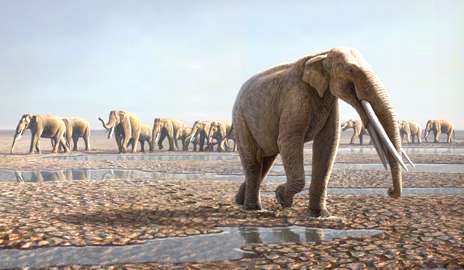
This painting depicts the site, in the Arabian desert in Abu Dhabi, as it might have appeared when the elephants passed through (Illustration by Mauricio Antňn).

(PhysOrg.com) -- A cluster of ancient footprints in the Arabian desert offers the clearest evidence yet for the early origins of modern elephants’ social structure, according to a Yale-led research team.

Roughly seven million years old, the prints represent the movements of at least 14 prehistoric elephants through the inland desert of the Arab Emirate of Abu Dhabi, anthropologists report in a paper published on Feb. 22 in Biology Letters. The research shows that early elephants exhibited social patterns typical of their modern descendants — herding by adult females and offspring, and solitary wandering by adult males.

“It is definitely clear that you have two social modes in elephants at this time,” said Yale anthropologist Andrew Hill, a senior researcher on the project.

Plainly visible in the crusty surface of the desert, the footprints were known to researchers for several years. But the inherent relationships among them only became clear after researchers produced and analyzed a detailed photo mosaic of the area using high-resolution aerial cameras.
Desert footprints reveal ancient origins of elephants' social lives
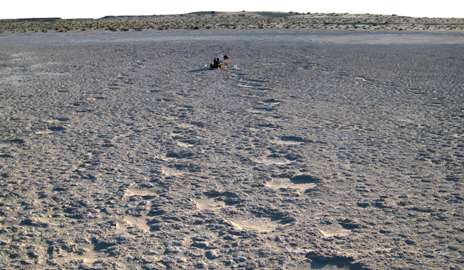
This photograph shows the trackways in the Arabian desert in Abu Dhabi (Photo by Faysal Bibi).

The analysis revealed two distinct trackways — one belonging to a herd of about 13 elephants of varying sizes, and an intersecting trail of a lone, larger elephant. At more than 260 meters long, the latter trackway is among the longest fossilized mammalian routes ever recorded.

“It’s like walking back in time,” said Hill, whose former Yale graduate student, Faysal Bibi, now a postdoctoral fellow in Europe, is the paper’s first author.

Elephants long ago vanished from the United Arab Emirates.

Other authors are Brian Kraatz of the College of Osteopathic Medicine of the Pacific; Nathan Craig of Pennsylvania State University; Mark Beech of the Abu Dhabi Tourism and Culture Authority; and Mathieu Schuster of the Université de Strasbourg.

Support for the research came from the Abu Dhabi Tourism and Culture Authority, the National Science Foundation, the Institute International de Paleoprimatologie et Paleontologie Humaine, the Agence Nationale de la Recherche, and Yale University.

Marilyn Fox of Yale’s Peabody Museum has produced replicas of some of the individual footprints, which are now part of the museum’s collection.

Explore further: Principles of locomotion in confined spaces could help fire ant-inspired robot teams work underground (w/ video)

More information: More details about the project are available online.

Related Stories

'Miracle' baby elephant cheats death in birth

Mar 10, 2010

A baby elephant believed to have died during a nine-day labour was born alive at an Australian zoo on Wednesday, amazing its keepers and defying expert opinion that such an outcome would take a "miracle".

Oldest evidence of dinosaurs found in Polish footprints

Oct 06, 2010

fossilized tracks -- is described this week in Proceedings of the Royal Society B. Just one or two million years after the massive Permian-Triassic extinction, an animal smaller than a house cat walked across ...

Fewer elephants with tusks born in China

Jul 18, 2005

More of China's male elephants reportedly are being born without tusks because hunting of the animals for their ivory is affecting the gene pool.

Social networking elephants never forget

Jul 26, 2011

Asian elephants typically live in small, flexible, social groups centered around females and calves while adult males roam independently. However, new research published in BioMed Central's open access journal BMC Ecology sh ...

Recommended for you

Lovelorn frogs bag closest crooner

14 hours ago

What lures a lady frog to her lover? Good looks, the sound of his voice, the size of his pad or none of the above? After weighing up their options, female strawberry poison frogs (Oophaga pumilio) bag th ...

Honeybees trained in Croatia to find land mines

May 19, 2013

(AP)—Mirjana Filipovic is still haunted by the land mine blast that killed her boyfriend and blew off her left leg while on a fishing trip nearly a decade ago. It happened in a field that was supposedly ...

User comments : 0

More news stories

Intestinal bacteria protect against E. coli O157:H7

A cocktail of non-pathogenic bacteria naturally occurring in the digestive tract of healthy humans can protect against a potentially lethal E. coli infection in animal models according to research presented today at the 11 ...

Study shows how bilinguals switch between languages

(Medical Xpress)—Individuals who learn two languages at an early age seem to switch back and forth between separate "sound systems" for each language, according to new research conducted at the University of Arizona.

Non-wetting fabric drains sweat

(Phys.org) —Waterproof fabrics that whisk away sweat could be the latest application of microfluidic technology developed by bioengineers at the University of California, Davis.

SARS-like virus claims new life in Saudi

A Saudi man who had contracted the coronavirus has died, raising the death toll in the kingdom from the SARS-like virus to 16, the health ministry announced on Monday on its Internet website.