Wildlife find path to safety under US roads
January 2, 2012 by Robert MacPherson
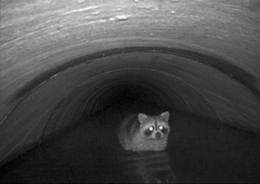
A racoon uses a highway culvert in Maryland to cross from one side of the street to the other. To find out, researchers in Maryland put motion-detection cameras in culverts throughout the mid-Atlantic US state to learn more about how wildlife of all kinds use culverts, or storm drains, to avoid motor traffic.
So how did the chicken cross the road? Or the raccoon, Virginia opossum, woodchuck, red fox, white-tailed deer or great blue heron?
To find out, researchers in Maryland put motion-detection cameras in culverts throughout the mid-Atlantic US state to learn more about how wildlife of all kinds use culverts, or storm drains, to avoid motor traffic.
Culverts are intended to channel water under a highway. But it turns out that animals of all kinds have figured out how to exploit such man-made structures to avoid becoming roadkill.
"I was really surprised by the number of species actually using these culverts," professor J. Edward Gates of the University of Maryland's Center for Environmental Science told AFP in a telephone interview.
"It was just about every mammal in Maryland, except for three species: bobcat, black bear and coyote."
Funding for the project came from the Maryland State Highway Administration, which like its counterparts across the United States is keen to find ways to lower the cost of roadkill for animals and humans alike.
Every year, vehicle-animal collisions kill more than 200 people as well as "millions" of animals, the federal Department of Transportation says.
Crashes involving deer alone add up to more than $4.6 billion in vehicle damage and health-care costs for injured persons, adds the Insurance Information Institute.
To assess how culverts can help, Gates' team put Moultrie Game Spy infrared cameras -- normally used by hunters to monitor game trails -- inside some 300 culverts in every county in the state.
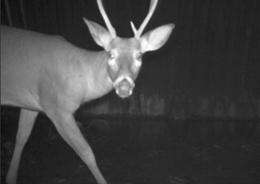
A deer uses a storm drain to cross a highway in Maryland. A study conducted by the University of Maryland Center for Environmental Science reveals that animals are using the safer storm drains as shortcuts through traffic. Culverts are intended to channel water under a highway. But it turns out that animals of all kinds have figured out how to exploit such man-made structures
Some of the culverts ran under Interstate 95, one of the most-traveled superhighways in North America. Others lay beneath sleepy country roads along the Chesapeake Bay and in the Appalachian mountains.Then, over two years and eight seasons, until January this year, the researchers watched the critters come through.
Raccoons turned out to be the most frequent culvert users by far, turning up in 246 of the drain pipes on 24,800 occasions. (One of them, looking forlorn in chest-deep water, is something of a poster child for the project.)
Virginia opossums, famous for their ability to fake death when threatened, appeared 2,169 times in 103 culverts, woodchucks 822 times in 97 culverts, and red foxes 928 times in 66 culverts.
But a real surprise was the white-tailed deer, whose numbers have proliferated so much in North America that they now are more likely to be fatally hit by a car than shot by a hunter.
"We had deer using a range of culvert sizes, which we found just amazing," Gates said, with 1,093 sightings in 63 culverts.
"Most studies previously have said deer need a fairly large culvert, that they needed to be able to feel unconfined and to see through the culvert to the other side," he said.
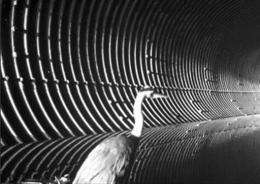
A heron usrd a highway culvert in Maryland to cross from one side of the street to the other. Every year, vehicle-animal collisions kill more than 200 people as well as "millions" of animals, the federal Department of Transportation says.
"But we found them using culverts where their heads were nearly touching the ceiling -- so if they're motivated... they'll use a very small culvert."Equally surprising was the great blue heron, photographed 545 times in 77 culverts, revealing that birds can be just as likely as earthbound wildlife to favor an underground route.
"All the culverts they used tended to be larger culverts, and they all contained deeper water," Gates said.
"Possibly they were on the outside catching fish or crayfish and foraging, and they just merely walked into the culvert (to go) after some additional food."
Other culvert-using species included the fox, grey squirrel, mallard duck, chipmunk, beaver, otter, Canada goose and skunk. Making one-off cameos were the starling, wren, canvasback duck, watersnake, snapping turtle and meadow mouse.
Domestic animals turned up, too, including cats, dogs, cattle (547 of them, albeit at the same one culvert) -- and that most domesticated animal of all, the human being (399 times in 66 culverts).
And chickens? "Everybody asks me that question," said Gates with a laugh. "No, we had no chickens."
(c) 2012 AFP
-
From lemons to lemonade: Reaction uses carbon dioxide to make carbon-based semiconductor,
32 comments
-
Thioridazine kills cancer stem cells in human while avoiding toxic side-effects of conventional cancer treatments,
3 comments
-
SpaceX private rocket blasts off for space station (Update),
42 comments
-
Climate scientists say they have solved riddle of rising sea,
31 comments
-
SpaceX capsule has 'new car' smell, astronauts say (Update),
4 comments
-
What would stain as translucent on light-coloured fabric?
May 26, 2012
-
How do I identify different bacteria on culture plates?
May 26, 2012
-
Why Do Dogs do Strange things...
May 25, 2012
-
What does exophillic and endophillic mean in terms of mosquito and their control?
May 24, 2012
-
Semen stains glows under black lights (uv light)?
May 23, 2012
-
Question on Human Chromosome 2
May 23, 2012
- More from Physics Forums - Biology
More news stories
Manufacturing genes to attack flu virus
An international research team has manufactured a new protein that can combat deadly flu epidemics.
6 hours ago |
not rated yet |
0
|
Scientist: Evolution debate will soon be history
(AP) -- Richard Leakey predicts skepticism over evolution will soon be history. Not that the avowed atheist has any doubts himself.
May 26, 2012 |
3.5 / 5 (20) |
89
More plant species responding to global warming than previously thought
(Phys.org) -- Far more wild plant species may be responding to global warming than previous large-scale estimates have suggested.
May 22, 2012 |
4.6 / 5 (14) |
18
|
For monogamous sparrows, it doesn't pay to stray (but they do it anyway)
It's quite common for a female song sparrow to stray from her breeding partner and mate with the male next door, but a new study shows that sleeping around can be costly.
May 22, 2012 |
5 / 5 (2) |
8
|
Thousands of shellfish found dead in Peru
Thousands of crustaceans were found dead off the coast of Lima following the mystery mass death of dolphins and pelicans, the Peruvian Navy said Friday.
May 26, 2012 |
4.7 / 5 (7) |
7
Stunning image of smallest possible five-ringed structure
Scientists have created and imaged the smallest possible five-ringed structure about 100,000 times thinner than a human hair and you'll probably recognise its shape.
'Unzipped' carbon nanotubes could help energize fuel cells, batteries
Multi-walled carbon nanotubes riddled with defects and impurities on the outside could replace some of the expensive platinum catalysts used in fuel cells and metal-air batteries, according to scientists at ...
Change in developmental timing was crucial in the evolutionary shift from dinosaurs to birds: study
At first glance, it's hard to see how a common house sparrow and a Tyrannosaurus Rex might have anything in common. After all, one is a bird that weighs less than an ounce, and the other is a dinosaur that ...
Computer model used to pinpoint prime materials for efficient carbon capture
When power plants begin capturing their carbon emissions to reduce greenhouse gases and to most in the electric power industry, it's a question of when, not if it will be an expensive undertaking.
T cells 'hunt' parasites like animal predators seek prey, study shows
By pairing an intimate knowledge of immune-system function with a deep understanding of statistical physics, a cross-disciplinary team at the University of Pennsylvania has arrived at a surprising finding: T cells use a movement ...
Land and sea species differ in climate change response: study
(Phys.org) -- Marine and terrestrial species will likely differ in their responses to climate warming, new research by Simon Fraser University and Australia’s University of Tasmania has found.


Jan 02, 2012
Rank: not rated yet
Jan 02, 2012
Rank: not rated yet