Voltaire's English alter-ego unmasked by new letters
14 newly-discovered letters by Francois Voltaire have allowed an Oxford University team to shed light on his brief but important time in England.
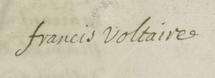
Two of the new letters shed new light on the extent of the author’s interactions with the English aristocracy and in one letter he even signs his name ‘Francis Voltaire’ – something he has never before been recorded as doing.
The letters have been edited by Professor Nicholas Cronk, director of Oxford University’s Voltaire Foundation and lecturer in the Medieval and Modern Languages Faculty, and are being made available online in the Bodleian Library’s Electronic Enlightenment project.
Professor Cronk said: ‘Voltaire spent two important but relatively undocumented years in England in his early thirties at a time when he was best known as a poet – he arrived with only a recommendation from the British Ambassador to Paris. While here, he was exposed to ideas of English writers and later took empiricism back to the Continent where it became the basis for the Enlightenment. These newly-discovered letters are therefore very interesting because they show how Voltaire’s close interaction with the English aristocracy exposed him to Enlightenment ideas and help us to piece together the nature of those interactions.’
One letter is from Voltaire to Lord Bathurst, a patron of the arts who often hosted great English thinkers at his manor, Richings, including Alexander Pope who wrote much of his translation of Homer there. In this letter Voltaire thanks Bathurst for ‘the freedom of your house and the many liberties I enjoyed in that fine library’. ‘This shows us one way in which Voltaire would have been exposed to so much of Shakespeare, Newton, Locke, Swift, Pope and others – both by reading their books in the library at Richings and perhaps even by meeting contemporary English thinkers,’ Professor Cronk explained.
In another letter, Voltaire writes to the Treasury to confirm receipt of a £200 grant from George II and signs his name ‘Francis Voltaire’. Professor Cronk said: ‘This is interesting in itself – the name ‘Voltaire’ was an invention (he was born ‘Francois Arouet’) so to call himself ‘Francis’ is an English invention of his original invention. But the letter’s significance lies in the fact that this grant probably came to Voltaire at the request of Queen Caroline, a protector of the arts, which reinforces just how closely Voltaire had integrated himself into the English aristocracy in such a short time.’
Professor Cronk came across the new letters during the course of his archival research - 11 were found in the New York Public Library, whose former president Paul LeClerc is himself a Voltaire scholar; two were found in the University of Morgan library and one in the library at the University of Columbia.
Professor Cronk added: ‘Voltaire came to England as a relatively unknown poet with only a recommendation from the British ambassador to Paris, so to make the aristocratic connections that he did shows him to be a brilliant social climber. Sarkozy referred to the stay when during his pre-election campaign he told French businessman in England that they were following in Voltaire’s footsteps so it is exciting to be able to add to the existing knowledge of this short but important visit.’
These letters have been put on the Bodleian Library’s Electronic Enlightenment website, which now houses the most complete collection of Voltaire’s works and correspondence, along with commentary by academics and other digital resources. This is expected to open up the study of Voltaire, allowing interested members to see his original text for themselves without having to travel to the relevant library, and the high-resolution imaging that is possible has already solved one riddle about Voltaire.
Professor Cronk explained: ‘There is one famous letter from Voltaire addressing Alexander Pope as ‘Master Pope’ which we had previously been unable to date. Using the digital archive, which shows every page rather than missing some while photocopying, a post office stamp on the reverse side of the letter reveals this letter to be from October 7 1727.
More than 20,000 letters of Voltaire are known about and Professor Cronk estimates that there must be as many still in existence.
The Voltaire Foundation is carrying out a fifty year project to produce the definitive scholarly edition of Voltaire's complete writings and the project is estimated for completion in 2018.
Provided by Oxford University


