Texas experts hope citrus greening disease is not widespread
Years of proactive efforts to protect the Texas citrus industry should fend off the ill effects of the recent finding of citrus greening disease, according to industry leaders and citrus experts.
“It had always been a matter of when citrus greening would be discovered here, not if,” said Dr. Juan Anciso, a Texas AgriLife Extension Service citrus specialist in Weslaco. “Thanks to grower efforts, the citrus industry is in very good shape to defend itself.”
What’s needed now is the cooperation of the public, Anciso said.
“We’re asking the public to not move any citrus plant material into or out of Texas, but especially the 5-mile radius quarantine area,” he said. “Please buy certified trees only, and homeowners should immediately spray any citrus trees they may have on their properties.”
Citrus greening was discovered on a tree in a commercial orange grove south of San Juan, but poses absolutely no threat to human health, according to a news release by the Texas Department of Agriculture.
Plants that host the disease cannot be moved from the temporary emergency quarantine area, and any citrus harvested there must be free of leaf material and debris before it can be taken out, the news release states.
“The detection of citrus greening is a major event for the Texas citrus industry, but there are reasons for optimism,” said Dr. John da Graca, director of the Texas A&M-Kingsville Citrus Center at Weslaco.
“For four years, alongside state and federal agencies, we’ve been conducting very thorough surveys of citrus psyllids, the insects that transmit this disease from tree to tree. We tested 35,000 insects and 20,000 leaf samples before the disease was found here. That gives me hope that the disease is not widespread, that it won’t be found beyond the quarantined area.”
Da Graca also cited the center’s longtime budwood program which provides industry, nurseries and wholesalers with certified, disease-free citrus trees.
Commercial groves, about 28,000 acres, in the Rio Grande Valley are currently being harvested, with 60 percent of the crop still on the trees, according to Ray Prewett, president of Texas Citrus Mutual, a commodity group.
“This year’s crop is down because of last year’s freeze and drought, but this finding of citrus greening won’t affect this season at all. Citrus prices won’t be affected, and consumers won’t be impacted in any way,” he said. “Citrus greening is not a short-term issue, it’s a long-term issue and it will be a long time before we find out what the impact might be.”
Citrus greening is a bacterial disease that affects the vascular system of trees, eventually killing them, according to Dr. Mamoudou Setamou, an entomologist at the citrus center.
“There is no cure for citrus greening at this time,” Setamou said. “Fortunately, coordinated, area-wide grower spray programs that started two years ago in South Texas have been very effective in keeping populations of psyllids very low,” he said. “That’s the good news. The challenge now is to educate the public so that homeowners can spray their trees and help protect our citrus industry.”
Spraying trees to eliminate psyllids is not difficult, and products are readily available, Setamou said.
“It’s easy to spray their citrus trees with several insecticides found at Wal-Mart, Home Depot, Lowe’s and other such stores,” he said. “For details, visit our website, call the citrus center at 956-447-3360, call an AgriLife Extension county agent, or contact the Texas Department of Agriculture.”
A list of products homeowners can use, and more information on citrus greening can be found at www.texascitrusgreening.org/ .
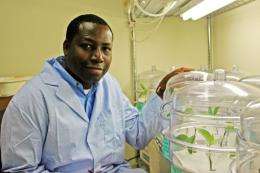
Dr. Erik Mirkov, a Texas AgriLife Research plant pathologist at the Texas AgriLife Research and Extension Center at Weslaco, said genetically enhanced citrus trees that he’s developing through biotechnology could offer resistance to greening in the future.
“We started this work about eight years ago to develop resistance to citrus canker, another bacterial disease of citrus, and discovered that what we had done also gives resistance to citrus greening,” he said. “They are showing good resistance and/or immunity at tests in Florida.”
While progress has been made in obtaining the regulatory approvals to ensure that the new trees are safe for the environment and that the fruit is safe to eat, it will be several more years before they can be grown commercially, Mirkov said.
Citrus greening has now been confirmed in Florida, Georgia, Louisiana, South Carolina, Texas and most citrus-producing regions of Mexico.
Texas Agriculture Commissioner Todd Staples said the citrus industry in Texas is a valuable industry worth protecting.
“With a statewide economic impact of more than $140 million, our citrus industry is a vital part of the Texas agricultural economy and the economy of the Lower Rio Grande Valley,” he stated in a news release. “The Texas Department of Agriculture will aggressively work with the U.S. Department of Agriculture and our industry partners to protect our vital citrus industry.”
Provided by Texas A&M AgriLife


