Stranded Mars probe could fall to Earth in 11 days: report
Jan 04, 2012
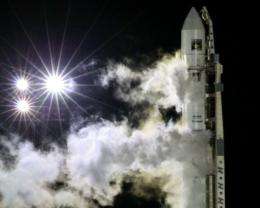
A Zenit-2SB rocket, carrying the Phobos-Grunt spacecraft stands at a launch pad in Kazakhstan's Baikonur cosmodrome in 2011, just before it's blast off toward Mars. Fragments of the stranded Mars probe could fall to Earth on January 15, the spokesman of Russia's military space forces told Russian news agencies.

Fragments of Russia's stranded Mars probe Phobos-Grunt could fall to Earth on January 15, the spokesman of Russia's military space forces told Russian news agencies on Wednesday.

"As of Wednesday morning, the fragments of Phobos-Grunt are expected to fall January 15, 2012. The final date could change due to external factors," said spokesman Alexei Zolotukhin, quoted by the Interfax news agency.

In an embarrassing setback, the $165-million probe designed to travel to the Mars moon of and bring back soil samples, blasted off on November 9 but failed to leave the Earth's orbit.

The military space forces' monitoring centre had earlier predicted in November that the probe, which is gradually descending and slowing down, would fall to Earth in January or February.

Space forces spokesman Zolotukhin said the probe is now circling at an altitude of between 184 kilometres (114 miles) and 224 kilometres (139 miles) above Earth.

The said in December that it expected the 13.5-tonne probe to fall to Earth between January 6 and 19, but that it would only be possible to predict the exact time and place a few days in advance.

It said that 20 to 30 fragments weighing a total of no more than 200 kilograms were expected to fall to Earth, with the spacecraft's highly toxic fuel burning up on entering the Earth's atmosphere.

The ambitious and high-stakes project aimed to revive Russia's interplanetary programme, which has not seen a successful mission since the fall of the Soviet Union, and prepare the way for a manned mission to Mars.

Russia has experienced a series of serious space failures in the past year.

An unmanned Progress supply ship bound for the crashed into Siberia in August last year after its launch by a , forcing the rockets' temporary grounding.

Russia also lost three , an advanced military satellite and a .

In the latest setback, a fragment of a Russian communications satellite crashed into a Siberian village in December after it failed to reach orbit due to the failure of its Soyuz rocket.

Explore further: Mice, gerbils perish in Russia space flight

add to favorites email to friend print save as pdf

Related Stories

Russia Mars probe considered lost: report

Nov 12, 2011

Efforts to resume contact with a Russian space mission to Mars stuck in Earth orbit after launch have failed and the probe must be considered lost, Interfax news agency reported Saturday.

Russia Mars probe may fall to Earth in January

Nov 14, 2011

A Russian probe that was to visit a moon of Mars but is stuck in orbit around the Earth could burn up in the Earth's atmosphere in January, the head of the Russian space agency said Monday.

Russian satellite crashes into Siberia after launch

Dec 23, 2011

A Russian satellite on Friday crashed into Siberia minutes after its launch due to rocket failure, the defence ministry said, in the latest humiliating setback for Russia's embattled space programme.

Russian satellite hits Siberia's 'Cosmonaut Street'

Dec 24, 2011

A fragment of a Russian satellite that crashed into Siberia in the latest setback for Russia's space programme hit a residential house on a street named after cosmonauts, officials said Saturday. ...

Recommended for you

Proba-V opens its eyes

4 hours ago

(Phys.org) —Earth watcher Proba-V is in good health following its launch last week. The Vegetation imager has been switched on and the first image has been captured over western France.

Mice, gerbils perish in Russia space flight

May 19, 2013

A number of mice and eight gerbils sent into space in a Russian capsule destined to find out how well organisms can withstand extended flights perished during their journey, scientists said Sunday as the ...

Mars rover Opportunity examines clay clues in rock

May 18, 2013

(Phys.org) —NASA's senior Mars rover, Opportunity, is driving to a new study area after a dramatic finish to 20 months on "Cape York" with examination of a rock intensely altered by water.

NASA's STEREO detects a CME from the sun

May 17, 2013

On 5:24 a.m. EDT on May 17, 2013, the sun erupted with an Earth-directed coronal mass ejection or CME, a solar phenomenon that can send billions of tons of solar particles into space that can reach Earth ...

User comments : 0

More news stories

Slow earthquakes: It's all in the rock mechanics

(Phys.org) —Earthquakes that last minutes rather than seconds are a relatively recent discovery, according to an international team of seismologists. Researchers have been aware of these slow earthquakes, ...

Cracking the ice code

(Phys.org) —What happened the last time a vegetated Earth shifted from an extremely cold climate to desert-like conditions? And what does it tell us about climate change today?

Tiny, implantable coil promises hope for emphysema patients

A small, easily implantable device called the Lung Volume Reduction Coil (LVRC) may play a key role in the treatment of two types of emphysema, according to a study conducted in Europe. Results of the study indicate the beneficial ...