New snake species announced
January 9, 2012

New snake in Tanzania: 'Fierce, probably venomous' (AP)

Enlarge

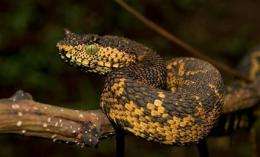
In this photo taken Wednesday, March 30, 2011 and released by The Wildlife Conservation Society on Wednesday, Jan. 11, 2012, a Matilda's Horned Viper is photographed in a forest habitat in southwestern Tanzania. The world's newest snake was discovered in a small patch of southwest Tanzania about two years ago and was introduced last month in an issue of Zootaxa as the world's newest known snake species - named after the 7-year-old daughter of Tim Davenport, director of the Wildlife Conservation Society in Tanzania, who was on the three-person team that discovered the viper. (AP Photo/Wildlife Conservation Society, Tim Davenport) EDITORIAL USE ONLY, NO SALES

The Wildlife Conservation Society (WCS) announced the discovery of a spectacularly colored snake from a remote area of Tanzania in East Africa.

The striking black-and-yellow snake is called Matilda's horned viper. It measures 2.1 feet (60 centimeters) and has horn-like scales above its eyes.

The discovery is described in the December issue of Zootaxa. Authors of the study include: Michele Menegon of Museo delle Scienze of Trento, Italy; Tim Davenport of the ; and Kim Howell of the University of Dar es Salaam.

The authors are keeping the exact location of the new species a secret, since the snake could be of interest to the illegal pet collectors. Its habitat, estimated at only a few square miles is already severely degraded from logging and manufacture. The authors expect the species will be classified as critically endangered and have already established a small captive breeding colony.

The snake is named after the daughter of co-author Tim Davenport, Director of WCS's Tanzania Program.

More information: For more information about the snake, go to: http://www.atherismatildae.org/

Provided by Wildlife Conservation Society search and more info website

Filter


Move the slider to adjust rank threshold, so that you can hide some of the comments.


Display comments: newest first

Callippo
Jan 12, 2012

Rank: not rated yet
Atheris matildae is actually a newly recognized subspecies of Atheris ceratophora - well known as a low-land form of eyelash bush viper between herpetologists and amateur terrarists.
Rank 4 /5 (1 vote)
Relevant PhysicsForums posts

More news stories

Manufacturing genes to attack flu virus

An international research team has manufactured a new protein that can combat deadly flu epidemics.

Biology / Biotechnology

created 5 hours ago | popularity not rated yet | comments 0 | with audio podcast

Scientist: Evolution debate will soon be history

(AP) -- Richard Leakey predicts skepticism over evolution will soon be history. Not that the avowed atheist has any doubts himself.

Biology / Evolution

created May 26, 2012 | popularity 3.5 / 5 (20) | comments 88

More plant species responding to global warming than previously thought

(Phys.org) -- Far more wild plant species may be responding to global warming than previous large-scale estimates have suggested.

Biology / Ecology

created May 22, 2012 | popularity 4.6 / 5 (14) | comments 18 | with audio podcast

For monogamous sparrows, it doesn't pay to stray (but they do it anyway)

It's quite common for a female song sparrow to stray from her breeding partner and mate with the male next door, but a new study shows that sleeping around can be costly.

Biology / Plants & Animals

created May 22, 2012 | popularity 5 / 5 (2) | comments 8 | with audio podcast

Thousands of shellfish found dead in Peru

Thousands of crustaceans were found dead off the coast of Lima following the mystery mass death of dolphins and pelicans, the Peruvian Navy said Friday.

Biology / Ecology

created May 26, 2012 | popularity 4.7 / 5 (7) | comments 7


'Unzipped' carbon nanotubes could help energize fuel cells, batteries

Multi-walled carbon nanotubes riddled with defects and impurities on the outside could replace some of the expensive platinum catalysts used in fuel cells and metal-air batteries, according to scientists at ...

Change in developmental timing was crucial in the evolutionary shift from dinosaurs to birds: study

At first glance, it's hard to see how a common house sparrow and a Tyrannosaurus Rex might have anything in common. After all, one is a bird that weighs less than an ounce, and the other is a dinosaur that ...

Computer model used to pinpoint prime materials for efficient carbon capture

When power plants begin capturing their carbon emissions to reduce greenhouse gases – and to most in the electric power industry, it's a question of when, not if – it will be an expensive undertaking.

T cells 'hunt' parasites like animal predators seek prey, study shows

By pairing an intimate knowledge of immune-system function with a deep understanding of statistical physics, a cross-disciplinary team at the University of Pennsylvania has arrived at a surprising finding: T cells use a movement ...

Land and sea species differ in climate change response: study

(Phys.org) -- Marine and terrestrial species will likely differ in their responses to climate warming, new research by Simon Fraser University and Australia’s University of Tasmania has found.

Yale study concludes public apathy over climate change unrelated to science literacy

Are members of the public divided about climate change because they don't understand the science behind it? If Americans knew more basic science and were more proficient in technical reasoning, would public consensus match ...