Rich Asians threaten high-value fish: experts
January 24, 2012

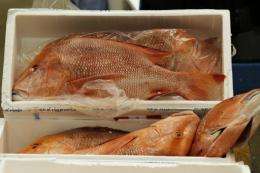
As Asians became more prosperous, they prefer to eat more "high-value" fish species, such as groupers

Enlarge

This file photo shows groupers displayed at a fresh food market. The growing ranks of wealthy Asians and their increasing appetite for more expensive fish are threatening stocks, potentially causing wider environmental damage, experts at a UN conference said on Tuesday.

The growing ranks of wealthy Asians and their increasing appetite for more expensive fish are threatening stocks, potentially causing wider environmental damage, experts at a UN conference said on Tuesday.

As became more prosperous, they prefer to eat more "high-value" species, forcing fishermen to catch more of them even if it means using environmentally harmful and illegal methods, they said.

"Increased wealth, especially in Asia," had raised demand for more expensive fish like certain groupers and tunas, said Jackie Alder, head of the marine coastal office of the UN Environment Programme.

"They are no longer satisfied with anchovies," she told reporters on the sidelines of a UN conference on oceans in the Philippine capital.

She warned that fish production had stabilised at 80 million tonnes in the 1980s and scientists believed that it would not go any higher.

"There is no doubt that changing lifestyles and are having an effect on resources," said Jerker Tamelander, head of the UN Environment Programme's coral reef unit.

He cited the case of live groupers which are in such demand in Asia that use cyanide to stun them and catch them alive, even if this kills other fish and harms .

Even then, many of these groupers die during transport across Asia, he warned.

"There is high mortality, high transport costs but also high returns."

Depleting the stocks of high-value fish could also upset the balance of nature in coral reefs, possibly leading to their degradation, he added.

(c) 2012 AFP


Rank not rated yet
Relevant PhysicsForums posts

More news stories

Manufacturing genes to attack flu virus

An international research team has manufactured a new protein that can combat deadly flu epidemics.

Biology / Biotechnology

created 8 hours ago | popularity not rated yet | comments 0 | with audio podcast

Scientist: Evolution debate will soon be history

(AP) -- Richard Leakey predicts skepticism over evolution will soon be history. Not that the avowed atheist has any doubts himself.

Biology / Evolution

created May 26, 2012 | popularity 3.4 / 5 (21) | comments 97

More plant species responding to global warming than previously thought

(Phys.org) -- Far more wild plant species may be responding to global warming than previous large-scale estimates have suggested.

Biology / Ecology

created May 22, 2012 | popularity 4.6 / 5 (14) | comments 18 | with audio podcast

For monogamous sparrows, it doesn't pay to stray (but they do it anyway)

It's quite common for a female song sparrow to stray from her breeding partner and mate with the male next door, but a new study shows that sleeping around can be costly.

Biology / Plants & Animals

created May 22, 2012 | popularity 5 / 5 (2) | comments 8 | with audio podcast

Thousands of shellfish found dead in Peru

Thousands of crustaceans were found dead off the coast of Lima following the mystery mass death of dolphins and pelicans, the Peruvian Navy said Friday.

Biology / Ecology

created May 26, 2012 | popularity 4.7 / 5 (7) | comments 7


Stunning image of smallest possible five-ringed structure

Scientists have created and imaged the smallest possible five-ringed structure – about 100,000 times thinner than a human hair – and you'll probably recognise its shape.

'Unzipped' carbon nanotubes could help energize fuel cells, batteries

Multi-walled carbon nanotubes riddled with defects and impurities on the outside could replace some of the expensive platinum catalysts used in fuel cells and metal-air batteries, according to scientists at ...

Change in developmental timing was crucial in the evolutionary shift from dinosaurs to birds: study

At first glance, it's hard to see how a common house sparrow and a Tyrannosaurus Rex might have anything in common. After all, one is a bird that weighs less than an ounce, and the other is a dinosaur that ...

Computer model used to pinpoint prime materials for efficient carbon capture

When power plants begin capturing their carbon emissions to reduce greenhouse gases – and to most in the electric power industry, it's a question of when, not if – it will be an expensive undertaking.

T cells 'hunt' parasites like animal predators seek prey, study shows

By pairing an intimate knowledge of immune-system function with a deep understanding of statistical physics, a cross-disciplinary team at the University of Pennsylvania has arrived at a surprising finding: T cells use a movement ...

Land and sea species differ in climate change response: study

(Phys.org) -- Marine and terrestrial species will likely differ in their responses to climate warming, new research by Simon Fraser University and Australia’s University of Tasmania has found.