New data finds regions of North America have remained extremely stable for more than one billion years
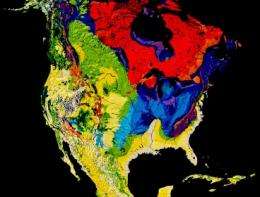
Like lines in a deeply weathered face, the cracks and fissures in the Earth’s crust reveal a long and tumultuous lifetime. Massive continent-bearing plates have come together and broken apart, setting off earthquakes and volcanic eruptions that have fragmented underlying rock, changing the face of the planet over billions of years.
Despite a geologically fractious history, Earth’s rigid outer layer, or lithosphere, retains ancient sections called cratons in which rocks have been left relatively undisturbed since they formed billions of years ago. These cratons typically occur at the center of continental landmasses, and contain some of Earth’s oldest rocks. How these cratons have survived on Earth’s surface, avoiding destruction by both plate-tectonic processes and erosion over billions of years, has been of interest to geologists for decades.
In a new paper published today in Science, researchers at MIT have reconstructed the ancient history of the Wyoming Province, one of the oldest fragments within the North American craton. The team found that at this site, the continental crust experienced a short, intense period of erosion between 1.8 and 1.5 billion years ago before settling into a more stable period that has persisted to the present day. They did this by developing a novel technique to pinpoint when continents transition from high to low rates of erosion, which they say could also be used in other parts of the world to reconstruct similar histories.
“In our continental masses, the most stable regions have been exactly this way for billions of years,” says lead author Terrence Blackburn, a graduate student in MIT’s Department of Earth, Atmospheric and Planetary Sciences (EAPS). “Today the North American craton is eroding very slowly, and our data tell us regions like that have been behaving like that for vast amounts of Earth’s history.”
At the crust of the matter
Blackburn worked with colleagues at MIT and the University of Colorado to investigate samples from the North American craton in a region of Montana where two continental fragments collided 1.8 million years ago, forming a mountain range. Scientists have found that over time the mountain range eroded — first quickly, then much more slowly, over a billion years or more.
To pinpoint exactly when this transition in erosion happened, the group worked to reconstruct the thermal history of lower crustal xenoliths — fragments of crust that resided deep within the lithosphere for billions of years before relatively recent volcanic activity brought them to the surface. Blackburn and his colleagues reasoned that the rate of erosion on the surface affects the amount of heat escaping from deeper in Earth’s crust: Like removing one’s hat, eroding a mountaintop lets more heat escape. The team then developed a new technique to determine the rate at which these xenoliths cooled over more than a billion years.
The researchers reconstructed the thermal history of these once-deeply buried samples, using a radiometric dating technique that estimates the time at which rocks form. The technique measures the radioactive decay of uranium into lead to establish an absolute age of events in Earth history.
In a slight twist on the technique, Blackburn and his colleagues focused on dating minerals that lose radioactive lead at high temperatures — the hotter a rock, the more lead diffuses out. Only when the rock cools will the mineral begin to retain lead, effectively starting a radiometric “clock.” This temperature-sensitive dating technique is called “thermochronology.” By establishing the timing and rate of cooling within the lithosphere, the team was able to reconstruct the thermal evolution of the lithosphere, and infer the amount of erosion the region experienced.
“This data set we have tells us for the first time what is the maximum duration at which fast erosion of topographically high mountains can last,” Blackburn says. “It’s just a fraction of the craton’s lifetime, three hundred million years at most, before the mountain belts are flattened, and after that, erosion is very slow.”
Blackburn says the new technique may be used to reconstruct the histories of other continental masses.
The paper’s other authors include EAPS professor Sam Bowring; EAPS assistant professor J. Taylor Perron; EAPS research associate Francis Dudas; and Kevin Mahan and Katherine Barnhart from the University of Colorado.
Provided by Massachusetts Institute of Technology
This story is republished courtesy of MIT News (web.mit.edu/newsoffice/), a popular site that covers news about MIT research, innovation and teaching.


