Patterns of antibiotic-resistant bacteria found in Galapagos reptiles
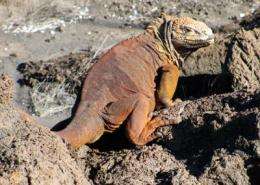
Proximity to human settlements or tourist sites was the best predictor of antibiotic-resistant bacteria in Galapagos reptiles. Land iguanas such as this lizard on Isla Fernandina live in remote locations with no human contact and are unlikely to carry resistance genes. Credit: Roderick Mackie
Land and marine iguanas and giant tortoises living close to human settlements or tourist sites in the Galápagos islands are more likely to harbor antibiotic-resistant bacteria than those living in more remote or protected sites on the islands, researchers report in a new study.
Feces collected at several different sites from free-living reptiles harbored Escherichia coli bacteria that were resistant to ampicillin, doxycycline, tetracycline, and trimethoprin/sulfamethoxazole. Another bacterial species collected from the feces, Salmonella enterica, was found to be only mildly resistant or not resistant at all to the same antibiotics, most likely because of the differing ecology of these two bacterial species in the gut, researchers said.
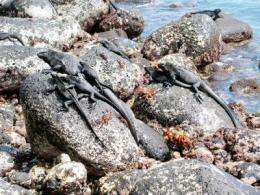
Marine iguanas, including these on Isla Fernandina, live in large aggregations on the rocky shores of the islands. Some harbor bacteria that are resistant to antibiotics commonly used in humans. Credit: Roderick Mackie
The study results are reported in the Journal of Wildlife Diseases.This is not the first study to find that wild animals living near humans or affected by tourism can obtain antibiotic-resistant bacteria from that exposure, said University of Illinois animal sciences professor Roderick Mackie, who led the study. But it does offer researchers and wildlife managers a way to determine which vulnerable animal species are most at risk of exposure to human pathogens.
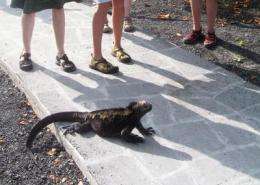
About 150,000 people visit the Galapagos islands every year and 25,000-30,000 live there. The reptiles with the most exposure to humans, like this iguana in Puerto Ayora, Isla Santa Cruz, were more likely to harbor multiple antibiotic-resistant bacteria than those in more remote or protected areas, researchers found. Credit: Roderick Mackie
"Oceanic island systems such as the Galápagos archipelago are ideal for studying patterns and processes of ecology and evolution, such as antibiotic resistance," Mackie said. "Although the data are interesting, we don't have enough data to identify the likely source of antibiotic exposure and origin of the resistance genes, or to draw conclusions about transmission direction."Also, it is not yet clear "to what extent this potential exposure translates to ongoing exchange of bacterial strains or bacterial traits," the researchers wrote. Further studies are needed "to understand better how human associations influence disease risk in endemic Galápagos wildlife."
The work was carried out by Emily Wheeler as part of her doctoral studies in Mackie's lab, and was supported by a U.S. Environmental Protection Agency STAR Fellowship and a student research grant from the Conservation Medicine Center of Chicago. Postdoctoral researcher Pei-Ying Hong and field biologist Lenin Cruz Bedon, of Isla Santa Cruz, Galápagos, are co-authors on the study.
More information: The paper is "Carriage of Antibiotic-Resistant Enteric Bacteria Varies Among Sites in Galápagos Reptiles"
Provided by
University of Illinois at Urbana-Champaign
-
From lemons to lemonade: Reaction uses carbon dioxide to make carbon-based semiconductor,
32 comments
-
Thioridazine kills cancer stem cells in human while avoiding toxic side-effects of conventional cancer treatments,
3 comments
-
SpaceX private rocket blasts off for space station (Update),
42 comments
-
Climate scientists say they have solved riddle of rising sea,
31 comments
-
SpaceX capsule has 'new car' smell, astronauts say (Update),
4 comments
-
osmotic pressure vs diffusion
48 minutes ago
-
What would stain as translucent on light-coloured fabric?
May 26, 2012
-
How do I identify different bacteria on culture plates?
May 26, 2012
-
Why Do Dogs do Strange things...
May 25, 2012
-
What does exophillic and endophillic mean in terms of mosquito and their control?
May 24, 2012
-
Semen stains glows under black lights (uv light)?
May 23, 2012
- More from Physics Forums - Biology
More news stories
Manufacturing genes to attack flu virus
An international research team has manufactured a new protein that can combat deadly flu epidemics.
8 hours ago |
not rated yet |
0
|
Scientist: Evolution debate will soon be history
(AP) -- Richard Leakey predicts skepticism over evolution will soon be history. Not that the avowed atheist has any doubts himself.
May 26, 2012 |
3.4 / 5 (21) |
97
More plant species responding to global warming than previously thought
(Phys.org) -- Far more wild plant species may be responding to global warming than previous large-scale estimates have suggested.
May 22, 2012 |
4.6 / 5 (14) |
18
|
For monogamous sparrows, it doesn't pay to stray (but they do it anyway)
It's quite common for a female song sparrow to stray from her breeding partner and mate with the male next door, but a new study shows that sleeping around can be costly.
May 22, 2012 |
5 / 5 (2) |
8
|
Thousands of shellfish found dead in Peru
Thousands of crustaceans were found dead off the coast of Lima following the mystery mass death of dolphins and pelicans, the Peruvian Navy said Friday.
May 26, 2012 |
4.7 / 5 (7) |
7
Stunning image of smallest possible five-ringed structure
Scientists have created and imaged the smallest possible five-ringed structure about 100,000 times thinner than a human hair and you'll probably recognise its shape.
'Unzipped' carbon nanotubes could help energize fuel cells, batteries
Multi-walled carbon nanotubes riddled with defects and impurities on the outside could replace some of the expensive platinum catalysts used in fuel cells and metal-air batteries, according to scientists at ...
Change in developmental timing was crucial in the evolutionary shift from dinosaurs to birds: study
At first glance, it's hard to see how a common house sparrow and a Tyrannosaurus Rex might have anything in common. After all, one is a bird that weighs less than an ounce, and the other is a dinosaur that ...
Computer model used to pinpoint prime materials for efficient carbon capture
When power plants begin capturing their carbon emissions to reduce greenhouse gases and to most in the electric power industry, it's a question of when, not if it will be an expensive undertaking.
T cells 'hunt' parasites like animal predators seek prey, study shows
By pairing an intimate knowledge of immune-system function with a deep understanding of statistical physics, a cross-disciplinary team at the University of Pennsylvania has arrived at a surprising finding: T cells use a movement ...
Land and sea species differ in climate change response: study
(Phys.org) -- Marine and terrestrial species will likely differ in their responses to climate warming, new research by Simon Fraser University and Australia’s University of Tasmania has found.

