Plant pathologists put the squeeze on citrus disease
January 17, 2012 By Amanda Garris
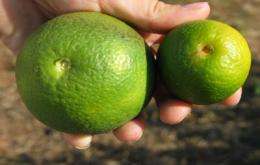
Huonglongbing impedes the distribution of nutrients within the tree, resulting in fruit that are abnormally small and frequently unmarketable due to off-flavors. Image: Rick Kress
(PhysOrg.com) -- With Florida's $9 billion citrus industry threatened by a deadly bacterial disease, Rick Kress '73 asked scientists at Cornell's New York State Agricultural Experiment Station in Geneva for help. Three years later, the researchers have delivered several genetically engineered orange trees that could provide a long-term solution.
The trees were engineered to provide a natural resistance to the Asian citrus phyllid, the insect responsible for spreading the deadly bacterial disease huanglongbing -- also known as citrus greening because it causes perpetually immature green fruit that tastes bitter, medicinal and sour. First confirmed in Florida in 2005, the disease has spread to all citrus growing counties, and growers face a costly regime of cutting out dying trees and spraying insecticides to reduce the psyllid populations.
Far from the citrus growing climate and the federally quarantined psyllid pest, Cornell scientists turned to a model system instead: tomatoes.
Plant pathology and plant-microbe biology faculty members Kerik Cox and Herb Aldwinckle first identified a handful of naturally occurring insecticides produced by bacteria, fungi and plants known to fend off other types of insects.
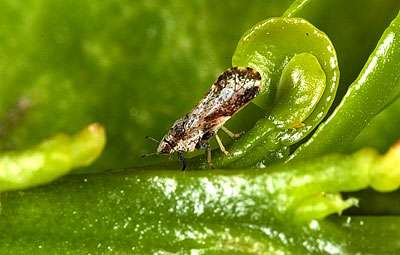
The Asian citrus psyllid spreads the bacteria that cause huonglongbing, also known as citrus greening. Provided by the USDA
Research support specialist Ewa Borejsza-Wysocka and technicians Peggy Abbott and Shirley Kuehne then used genetic engineering to insert candidate genes individually and in groups into tomato plants. They found some transgenic lines were very effective in making the tomato leaves unappealing to tomato psyllid insects and inserted the most promising genes into the Hamlin orange variety.The diminutive transgenic orange plants await the opportunity to prove themselves against the Asian citrus psyllid on its home turf in Florida while the required permits and approvals are being secured. Aldwinkle said that he hopes to have some results of the trials within a year.
Kress, president of Southern Gardens Citrus Inc., one of the largest citrus growers and processors of not-from-concentrate orange juice in Florida, is in the process of continuing the overall research in Florida through evaluation of disease resistance on a commercial basis. He is optimistic that the work will have tremendous economic benefits. "It would also have a positive environmental impact by reducing insecticide sprays, because in Florida, trying to eliminate the Asian citrus psyllid is as daunting as trying to get rid of mosquitoes," Kress said.
Provided by
Cornell University
-
From lemons to lemonade: Reaction uses carbon dioxide to make carbon-based semiconductor,
32 comments
-
Thioridazine kills cancer stem cells in human while avoiding toxic side-effects of conventional cancer treatments,
3 comments
-
SpaceX private rocket blasts off for space station (Update),
42 comments
-
Climate scientists say they have solved riddle of rising sea,
31 comments
-
SpaceX capsule has 'new car' smell, astronauts say (Update),
4 comments
-
osmotic pressure vs diffusion
48 minutes ago
-
What would stain as translucent on light-coloured fabric?
May 26, 2012
-
How do I identify different bacteria on culture plates?
May 26, 2012
-
Why Do Dogs do Strange things...
May 25, 2012
-
What does exophillic and endophillic mean in terms of mosquito and their control?
May 24, 2012
-
Semen stains glows under black lights (uv light)?
May 23, 2012
- More from Physics Forums - Biology
More news stories
Manufacturing genes to attack flu virus
An international research team has manufactured a new protein that can combat deadly flu epidemics.
8 hours ago |
not rated yet |
0
|
Scientist: Evolution debate will soon be history
(AP) -- Richard Leakey predicts skepticism over evolution will soon be history. Not that the avowed atheist has any doubts himself.
May 26, 2012 |
3.4 / 5 (21) |
97
More plant species responding to global warming than previously thought
(Phys.org) -- Far more wild plant species may be responding to global warming than previous large-scale estimates have suggested.
May 22, 2012 |
4.6 / 5 (14) |
18
|
For monogamous sparrows, it doesn't pay to stray (but they do it anyway)
It's quite common for a female song sparrow to stray from her breeding partner and mate with the male next door, but a new study shows that sleeping around can be costly.
May 22, 2012 |
5 / 5 (2) |
8
|
Thousands of shellfish found dead in Peru
Thousands of crustaceans were found dead off the coast of Lima following the mystery mass death of dolphins and pelicans, the Peruvian Navy said Friday.
May 26, 2012 |
4.7 / 5 (7) |
7
Stunning image of smallest possible five-ringed structure
Scientists have created and imaged the smallest possible five-ringed structure about 100,000 times thinner than a human hair and you'll probably recognise its shape.
'Unzipped' carbon nanotubes could help energize fuel cells, batteries
Multi-walled carbon nanotubes riddled with defects and impurities on the outside could replace some of the expensive platinum catalysts used in fuel cells and metal-air batteries, according to scientists at ...
Change in developmental timing was crucial in the evolutionary shift from dinosaurs to birds: study
At first glance, it's hard to see how a common house sparrow and a Tyrannosaurus Rex might have anything in common. After all, one is a bird that weighs less than an ounce, and the other is a dinosaur that ...
Computer model used to pinpoint prime materials for efficient carbon capture
When power plants begin capturing their carbon emissions to reduce greenhouse gases and to most in the electric power industry, it's a question of when, not if it will be an expensive undertaking.
T cells 'hunt' parasites like animal predators seek prey, study shows
By pairing an intimate knowledge of immune-system function with a deep understanding of statistical physics, a cross-disciplinary team at the University of Pennsylvania has arrived at a surprising finding: T cells use a movement ...
Land and sea species differ in climate change response: study
(Phys.org) -- Marine and terrestrial species will likely differ in their responses to climate warming, new research by Simon Fraser University and Australia’s University of Tasmania has found.
Jan 17, 2012
Rank: not rated yet
If I wanted GM food I would have already eaten it every day since it was first introduced.
It is not beyond the realms of possibility that the bug and its bacteria can be naturally out competed but it will require a change of growing habits too. But no they go for the quick fix with no idea as to what it will do to humans and the environment.......again!